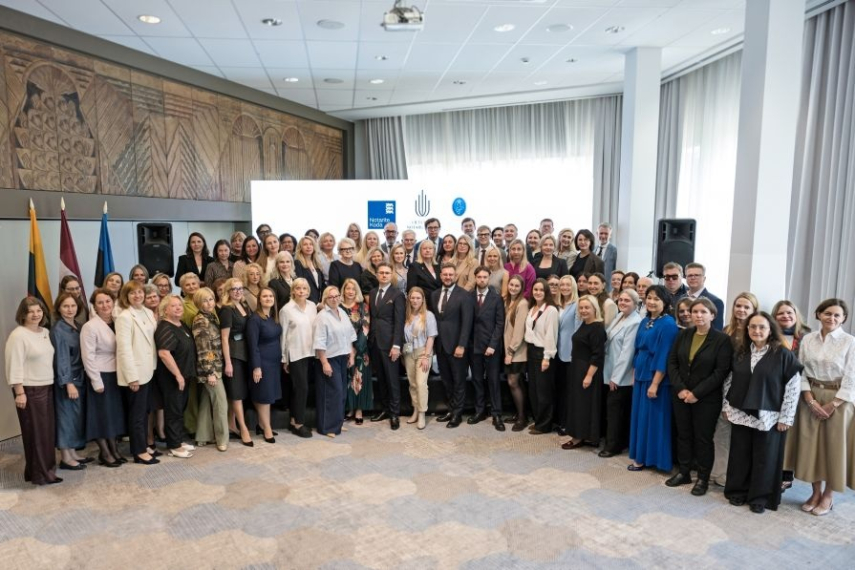

Photo: Dovilė Šakalienė is former Minister of Defence of Lithuania, Member of the Seimas, Lithuania’s Parliament
On 10 September 2025, at least 19 russian drones of an Iranian design crossed deep into Poland. It was no accident. It was an assessment of how fast NATO’s eastern flank identifies a threat, how united its decision, and how lethal its response. The drone that sends Vilnius to the shelters and the one that tears through an apartment building in Kyiv share a blueprint drawn in Tehran and a production line built in Tatarstan.
One fact frames it all: the war on Europe’s border is not russia’s alone. It is a joint enterprise. North Korea has sent over ten thousand soldiers against Ukraine, and the shells that keep russia’s guns firing; in return, Pyongyang receives missile and satellite technology. Iran gave russia not only Shaheds but their blueprints and training, so russia now builds thousands a month at home. And China – still calling itself neutral – was found by three European intelligence services, and confirmed by the EU, to have secretly trained russian drone crews in 2025, some later sent to the front. Nine in ten components in russia’s drones are Chinese.
Four regimes. One front. They are not waiting for 2027. The Dark Alliance is tearing through the fabric of our world right now.
When we are told there is no hybrid warfare, the answer is russia’s sabotage campaign across NATO states – assaults and (attempted) murders, train derailments, attacks on critical infrastructure, the IKEA arson in Vilnius, the foiled plot to murder Rheinmetall’s CEO. When we are told that de-risking harms Europe, the answer is the Chinese parts in our weapons. When we are told Taiwan is an internal matter, the answer is russian soldiers trained in Beijing and murdering civilians in Kyiv.
Washington’s own bipartisan Congressional Commission on the U.S. Strategic Posture concluded in 2023 that America, its allies and partners must be ready to deter and defeat russia and China simultaneously, in Europe and Asia, in the 2027–2035 window – and that the two powers are working to fracture the bonds between allies.
That is the strategy. Fracture. Make Europe watch only russia, make America turn only to the Indo-Pacific, and sell the illusion that russia can be split from China - as if that could sate their thirst for blood.
Their method is ancient. Befriend the distant, attack the near - the third-century-BC Qin stratagem that blocks defensive alliances (which allowed the Qin State systematically swallow neighbouring states); and defeat them one by one – Sun Tzu’s tactic of forcing the enemy to split his forces so you can strike where he is weakest.
We should know better, yet the trap still works millennia later: the Belt and Road, the 17+1 format, decades of russian energy games. We unplugged from russian energy and dismantled China’s divisive format years ago - but it is only the start.
It’s time to regroup – not by retreating into national or regional fortresses, and not by imagining Europe or the US can stand alone. Isolation is exactly what the Dark Alliance wants. The answer is the one thing it fears: to weave russia’s and China’s theatres into one picture, and bind America, Europe and the Indo-Pacific into one team.
It means seeing more together – shared intelligence and a common picture across both oceans. It means acting together – combined exercises, including in cyber and countering disinformation. It means building together – sharing defence technology and pooling munitions production, so allied output reinforces rather than duplicates, and "too little, too slow" finally ends. It means de-risking together – coordinating supply chains and export controls so democracies stop building their deterrent on the adversary's inputs, above all the rare earths our defence industries need. And it means institutionalising it – a standing NATO–Indo-Pacific link, with the front-line nations, the Baltics, Poland, Finland, Taiwan, Japan and Korea, as its early-warning nodes.
This is no fantasy. Japan now says that the security of the Euro-Atlantic and the Indo-Pacific is “indivisible.” When a Japanese defence minister and a Lithuanian former defence minister reach the same conclusion from opposite ends of the earth, that convergence is the argument.
Such a network does not replace the transatlantic alliance; it strengthens it.
They built one war machine across three theatres. We must build one shield across two oceans. The Dark Alliance is betting it can divide us. Our task is to prove it wrong.

Please enter your username and password.

2026 © The Baltic Times /Cookies Policy Privacy Policy