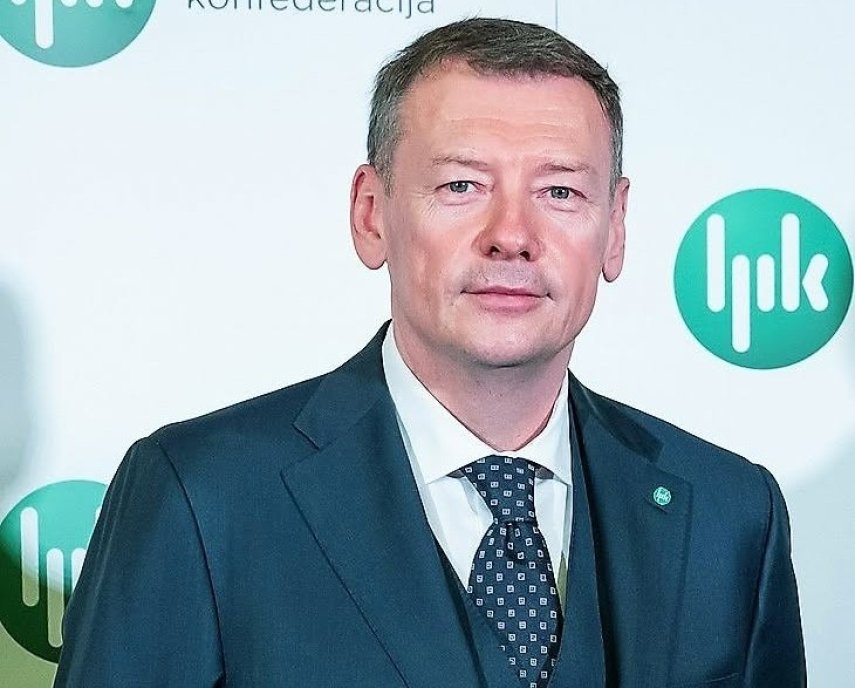
Photo: Vidmantas Janulevicius is the President of the Lithuanian Confederation of Industrialists (LPK), Chairman of the Board, BOD GROUP
Europe does not suffer from a lack of ambition. If anything, it may be suffering from the opposite.
The continent wants to strengthen its defence capabilities after decades of underinvestment. It wants to accelerate the green transition while reducing dependence on imported energy. It wants to compete with the United States and China in artificial intelligence and advanced technologies. It wants to preserve its social model despite ageing populations and growing fiscal pressures. And it wants to remain globally competitive in a world that is becoming less open, less predictable and more geopolitical.
Each of these goals is rational.
The question is whether Europe can realistically pursue all of them at the same speed.
Since Russia's invasion of Ukraine, this question has become more urgent. NATO's commitment to move towards defence spending equivalent to 5% of GDP reflects a strategic reality that Europe can no longer ignore. Security has returned to the centre of political and economic decision-making.
Yet the debate about defence increasingly risks focusing on the wrong problem.
Across Europe, discussions revolve around where additional money should come from, how much governments can borrow, which taxes should be raised or which expenditures should be reduced. These are legitimate questions, but they overlook a more fundamental one.
What if Europe's biggest constraint is not fiscal capacity, but competitive capacity?
And what if the scarcest strategic resource of the next decade is not money, energy or even critical minerals, but Europe's ability to innovate?
The real challenge facing Europe is not simply how to finance its ambitions. It is how to sustain them.
A continent with weak productivity growth, high energy costs, ageing demographics and declining industrial competitiveness will eventually struggle to finance any long-term strategy, regardless of how ambitious its targets may be.
For years, Europe benefited from conditions that allowed it to postpone difficult choices. Globalisation expanded markets. Cheap energy lowered costs. Stable geopolitical conditions reduced security concerns. Growth was often sufficient to accommodate competing priorities.
That environment no longer exists.
Europe is trying to rearm, decarbonise, digitalise and preserve its welfare model at the same time, while growing more slowly than its principal competitors.
At precisely the moment when Europe is being asked to spend more on defence, it is also facing stronger competition from both the United States and China. Washington has embraced industrial policy on a scale that would have seemed unlikely only a decade ago. Beijing continues to strengthen its manufacturing position through long-term planning, state-backed financing and strategic control of critical supply chains.
Europe, meanwhile, has been reluctant to acknowledge that pursuing every objective comes with trade-offs.
This is not primarily a defence problem.
It is a prioritisation problem.
For smaller, export-oriented economies such as those of the Baltic States, the consequences of getting this balance wrong may become visible sooner than elsewhere.
The answer will depend not only on how much Europe spends, but on how much value it creates.
This is why innovation deserves a far more central place in Europe's strategic thinking.
Europe frequently discusses access to critical raw materials, rare earth elements, energy resources and strategic supply chains. These concerns are justified. Yet one strategic resource receives far less attention despite becoming increasingly important for both competitiveness and security.
Innovation.
Europe cannot quickly reverse demographic trends. It cannot easily replicate the scale of American capital markets. Nor is it likely to enjoy the same energy-cost advantages as some of its competitors.
Innovation is one of the few resources that can expand despite those constraints.
In the coming decade, the ability to generate, commercialise and scale new ideas may become as strategically important as access to energy, capital or critical minerals.
For countries such as Lithuania, competing through scale alone will always be difficult. We can, however, compete through knowledge, technology and innovation. The challenge is no longer producing good ideas. It is creating an environment in which those ideas can become globally competitive businesses.
Europe's defence debate is therefore becoming something much larger than a discussion about military spending.
It is becoming a debate about competitiveness.
And Europe's competitiveness debate is increasingly becoming a debate about innovation.
Ultimately, Europe's future will not be determined by how many strategies it adopts or how many targets it announces.
It will be determined by whether it can make difficult choices, establish clear priorities and create the economic capacity needed to support its ambitions.
Because security, like prosperity, cannot be financed indefinitely through borrowing, redistribution or taxation alone.
In the coming decade, Europe will need many things: more security, more resilience and more investment.
But above all, it will need a resource that receives far less attention than defence budgets, energy imports or critical minerals.
It will need more innovation.
Because in an increasingly competitive world, innovation is becoming not only an economic asset, but a strategic one.

Please enter your username and password.

2026 © The Baltic Times /Cookies Policy Privacy Policy