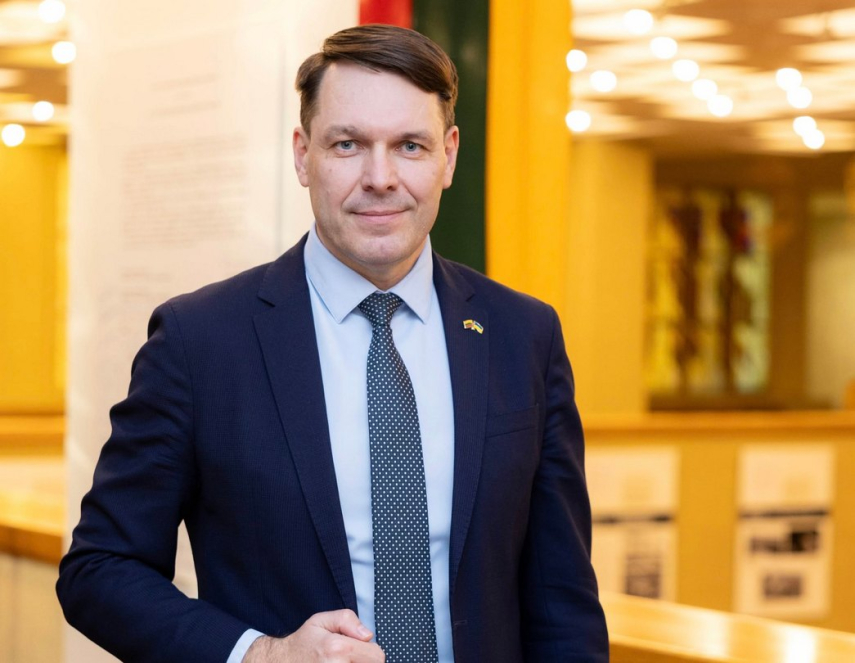
Photo: Andrius Bagdonas is Member of Lithuanian Parliament Seimas
In recent years, after elections across Europe, the United States, and Lithuania, one question has been asked with increasing frequency: is liberalism dead?
The question itself says much about the political moment we are living through. Across much of the democratic world, rational debate about the economy, the role of the state, human rights, and long-term policy is increasingly being replaced by emotion, anger, and simplistic political promises.
Liberal ideas such as lower taxes, responsible governance, free markets, democracy, and personal responsibility are under pressure from both sides. On one side, populist movements continue to gain strength. On the other, left-wing political forces argue for an ever-expanding role of the state in both the economy and everyday life.
The United States offers perhaps the clearest example of this shift. American politics today revolves around extremes. On one side stands Donald Trump's populism; on the other, a Democratic agenda built around greater regulation and expanding public spending. The United States was once seen as a symbol of liberal capitalism: economic freedom, entrepreneurial ambition, lower taxes, and personal responsibility. Today, however, political life is increasingly shaped by emotional battles between "us" and "them" rather than serious discussions about how to build a strong economy or an effective state.
Europe is facing a similar trend. In France, Marine Le Pen's far-right movement continues to gain ground. In Germany, support for Alternative for Germany is rising. Giorgia Meloni came to power in Italy, while anti-immigration political forces achieved major victories in the Netherlands. After the pandemic, the energy crisis, and the war in Ukraine, many Europeans have grown tired of instability and uncertainty. In such a climate, politicians offering emotionally satisfying and easily understood answers inevitably become more attractive.
At the same time, many left-leaning political forces across Europe continue to advocate greater redistribution, stronger state intervention, higher taxes, and broader welfare programmes. Liberal arguments about competitiveness, responsible public finances, entrepreneurship, and reducing bureaucracy often struggle to break through in a political environment increasingly driven by emotion rather than reason.
Lithuania is no exception. Liberal parties in our country have repeatedly found themselves pushed into a defensive position. The moment politicians begin speaking about tax reductions, a smaller bureaucracy, or a more efficient state, they are quickly accused of lacking empathy or ignoring social justice.
Meanwhile, populists offer voters simple promises: higher benefits, lower prices, quick solutions. Left-wing politicians speak about broader state protection and greater redistribution. Liberals are left with the more difficult task of explaining that long-term prosperity does not come from distributing promises, but from creating conditions in which people can work, invest, innovate, and build.
This became especially visible after the pandemic and the inflation crisis. Many people naturally began expecting the state to solve an ever-growing number of problems, from energy prices to wage growth. Politicians found it easier to promise compensation packages and new benefits than to speak honestly about structural reform, fiscal discipline, or personal responsibility.
Yet to say that liberalism is dead would be a mistake. Liberalism has never been an ideology built on fear, outrage, or political theatre. Its strength lies in common sense, respect for the individual, and the ability to balance freedom with responsibility. Liberal democracies remain among the world's strongest economies, most innovative societies, and most reliable defenders of human rights.
It was not authoritarian systems that created the world's leading universities, strongest technologies, or highest standards of living. Those achievements were built by free societies that trusted human initiative and creativity.
When the state becomes too powerful, initiative weakens, economic growth slows, and the sense of personal responsibility begins to fade. When politics becomes dominated by populism, societies grow more divided and political decisions become driven by emotion rather than facts. We can already see this happening across many democracies today.
That is why the role of liberalism is not to compete in radicalism or louder slogans. Its role is to remind society that politics can still be rational, serious, respectful, and focused on long-term results rather than short-term emotional reactions.
Today, liberalism remains necessary as a counterweight both to populist anger and to excessive state intervention in people's lives. Democracy is not only about majority rule. It also depends on respect for opposing views, independent courts, free media, institutional balance, and fundamental rights.
So, is liberalism dead?
No. Liberalism is undoubtedly going through a difficult period. Yet moments of crisis often reveal most clearly why freedom, democracy, responsibility, and institutional balance matter. For people who reject both extreme populism and an all-controlling state, liberalism remains the politics of reason, restraint, and common sense.

Please enter your username and password.


2026 © The Baltic Times /Cookies Policy Privacy Policy