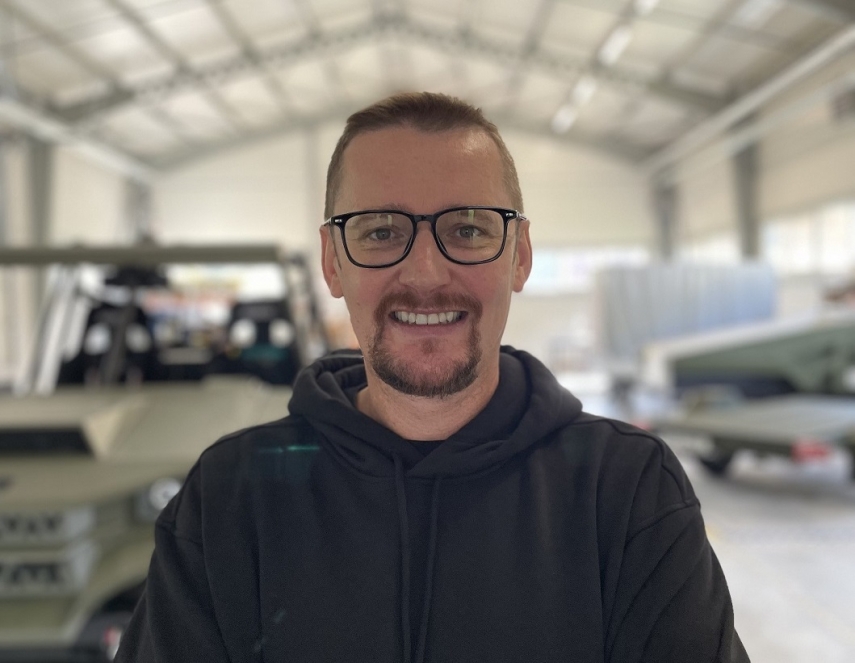
Darius Antanaitis, a well-known Lithuanian military analyst, defence expert, and retired major of the Lithuanian Armed Forces who served for around 16 years in the Lithuanian military, including missions in Iraq and Afghanistan, says Russia will remain a local problem in the short and medium term.
“Before the full-scale war in Ukraine, Russia was considered a regional problem, but now it has fallen to an even lower level – a local problem. Even Iran has become a bigger player than Russia, while China remains a global security challenge,” he emphasized to The Baltic Times Magazine.
How do you assess the current security situation? Do you see any major shifts in the balance of power or in NATO’s role?
If we look at the situation through this prism, no fundamentally new security challenges have emerged, so there is no need for drastic changes either. Although we often say that everything changed when Donald Trump became president, in reality very little has changed in the field of security.
The United States has its own global challenges and is restructuring its military capabilities accordingly, but this does not mean it is abandoning NATO. We react far too often to rhetoric and pay too little attention to the numbers.
It is worth mentioning the increasing frequency of Ukrainian strikes against Russian infrastructure targets using long-range weapon systems. I believe this is precisely the factor that, over time, could lead to changes in Russia at the political, economic, and infrastructure levels. Nevertheless, Russia is also striking Ukrainian targets, and it appears to be doing so more effectively than Ukraine’s strikes on Russia. However, there is one fundamental difference: Ukraine is supported by the majority of NATO and EU member states and receives assistance on diplomatic, economic, military, and other levels.
In what direction is the defence industry moving globally and in Lithuania?
By following military media, especially procurement trends, it becomes very clear that artificial intelligence solutions are being implemented at various levels – from administration to the development of new weapons systems. This contributes to the digitalization of the battlefield and the surrounding infrastructure.
The so-called NCW (Network Centric Warfare) concept, which NATO has been implementing, is becoming increasingly dominant. In this concept, it is not individual units or soldiers that participate in battle, but systems: entire armed forces or different actors connected into one network and sharing information.
Information itself is the key element. Whoever possesses more accurate information, processes it faster, and makes decisions more quickly gains the advantage on the battlefield.
How can one effectively defend against drones?
The best examples of how to defend against drones are Israel and the United States. This was especially evident during the joint US-Israeli operation against Iran. The United States intercepted about 98 percent of all Iranian drones. This means the drones’ effectiveness was only around 2 percent, which is a very low figure. In warfare, anything with less than 90 percent effectiveness is considered an ineffective solution.
It is also worth paying attention to Israel’s operations against the terrorist organizations Hamas and Hezbollah. These organizations also attempted to widely use drones, trying to replicate the experience of the Russia-Ukraine war, but unsuccessfully. Even Israeli army tanks were relatively rarely seen equipped with protective cages designed to shield combat vehicles from anti-tank charges carried by drones.
Again, we return to the importance of information. The United States and Israel receive intelligence in advance about drone production sites, launch positions, and flight paths. This allows them to act proactively and eliminate threats before they become difficult to control.
Therefore, the best protection against drones is intelligence, rapid decision-making, effectors capable of neutralizing threats at an early stage, and speed. Your ‘kill chain’ must function quickly and effectively – from obtaining information about the target to confirming that it has been destroyed.
Will drones in the future be the size of crows, fly very low, and be difficult to detect and neutralize?
Drones may even become the size of flies, but the essence is not the drone itself – it is what the drone does. Can a crow-sized drone carry an explosive charge capable of destroying a combat vehicle? Certainly not. Combat equipment is destroyed by explosive charges, not by the drone itself.
Smaller drones are also highly vulnerable to atmospheric conditions such as wind, precipitation, and similar factors. Another important component is the capability of the battery or other energy source. The smaller the energy source, the fewer capabilities the drone itself will have.

Please enter your username and password.

2026 © The Baltic Times /Cookies Policy Privacy Policy