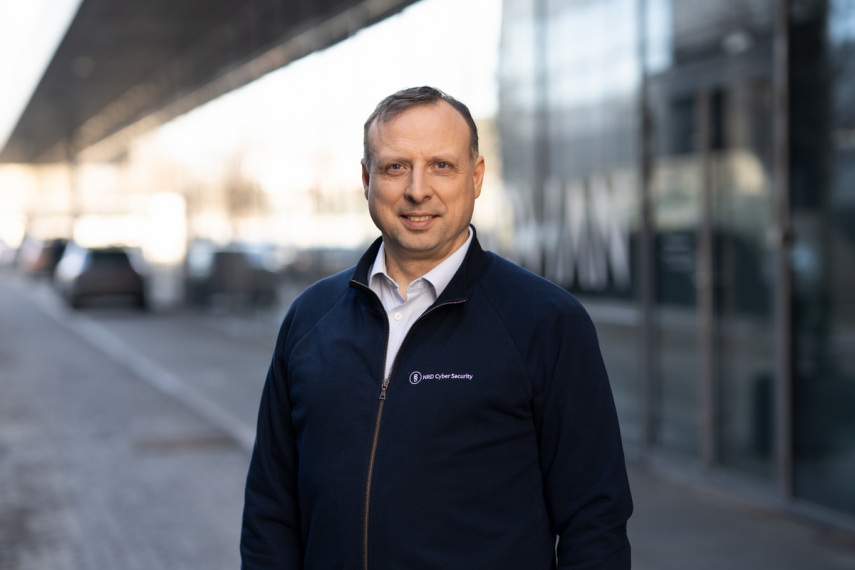
Russia’s war against Ukraine and the rapid adoption of artificial intelligence are reshaping the cybersecurity environment, forcing governments and businesses to think about resilience well beyond traditional IT defences, according to Vilius Benetis, Director of Lithuania-based NRD Cyber Security.
The company reported €14.2mn in revenue in 2025, up 24 percent on year, and carried out projects in 34 countries.
“For the Baltic states, sitting on NATO and the EU’s eastern flank, the experience of Ukraine has provided particularly important lessons about protecting critical infrastructure and preparing organisations to continue operating during sustained attacks. Ukraine’s critical infrastructure, particularly its energy and public sectors, have been subject to numerous attacks. Representatives from Ukraine’s critical infrastructure often attend cybersecurity conferences, where they share insights on these attacks. In a sense, we are in a fortunate position to be able to consider events and possibilities such as cyber provocations, and to discuss how we are going to react, behave, mobilise and organise ourselves. In such a way we are building our additional resilience – mental, cooperative, and technical,” Benetis told The Baltic Times.
He says all three Baltic countries have invested heavily in strengthening national and sectoral cyber resilience, although their regulatory structures and approaches differ. Each has also developed an ecosystem combining domestic and international cybersecurity companies, regulators and academia.
Critical infrastructure remains an obvious target. Rather than describing particular industries as the most vulnerable, however, Benetis prefers to focus on those facing the greatest pressure.
“Perhaps a more accurate formulation could be ‘most targeted’. According to ENISA (European Cybersecurity Agency) cyber threat landscape report, financial, logistics and healthcare are the sectors where most cyber-attacks have been reported. We observe public and energy/utility sectors among the most targeted ones,” he says.
According to him, AI is now adding another dimension. Automation allows attackers to probe systems faster and at much greater scale.
“The attacks are changing both in scale and size – it becomes easier to organize an automated attack which is not only exploiting the known vulnerability, but explores other vulnerabilities at the same time, relentlessly.”
Defenders are adopting the same technology to strengthen security, meaning the contest is increasingly about speed.
“In the meantime, defenders are using more and more AI-powered tools to ensure preemptive security posture, identify, understand and fix weaknesses, and even handle impactful incidents.”
NRD Cyber Security has evolved alongside these threats. Founded in 2013 as a cybersecurity consultancy, it began developing proprietary products in 2017 and has expanded its managed security service provider business since 2019. The company says its client-centred approach has helped it expand internationally.
“We consider ourselves part of our clients – we like to take responsibility for their success in cybersecurity, and we evaluate how much we have contributed to actual improvements in cybersecurity. Such an attitude of sincerely caring about a client’s success does not seem to be too common yet,” Benetis said.
Its proprietary technologies include Natrix, an IT security threat, incident and network monitoring platform used by security teams and organisations including SOCs and CSIRTs. NRD Cyber Security is increasingly offering the technology to organisations seeking to establish monitoring capabilities in Europe and elsewhere.
Looking five years ahead, Benetis expects the company to combine international consultancy, managed services and proprietary technology.
“We are helping even more countries, sectors, and organisations to secure their digital environments. Our aim is to strengthen our consultancy business, while continuing to provide quality managed security services and offer key cybersecurity technologies. We focus on areas where main enterprise cybersecurity solution vendors are not creating value effectively or not at the right price point for the local market,” Benetis shared the vision.

Please enter your username and password.


2026 © The Baltic Times /Cookies Policy Privacy Policy