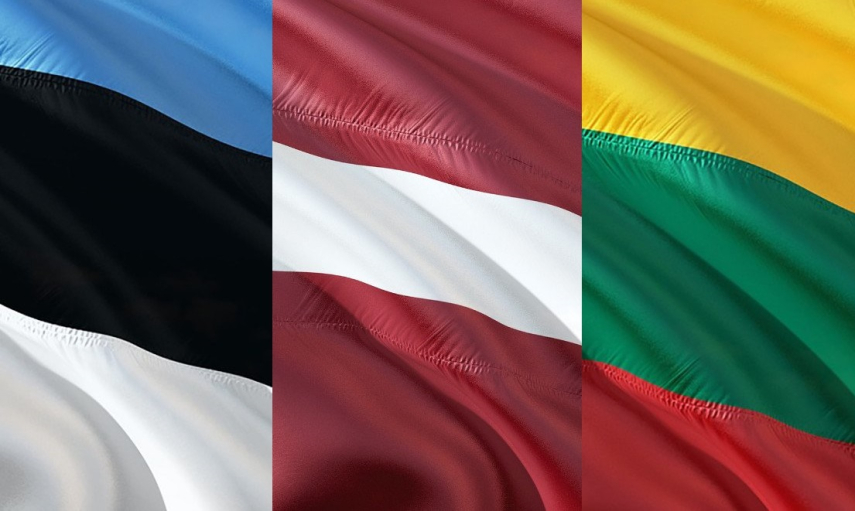
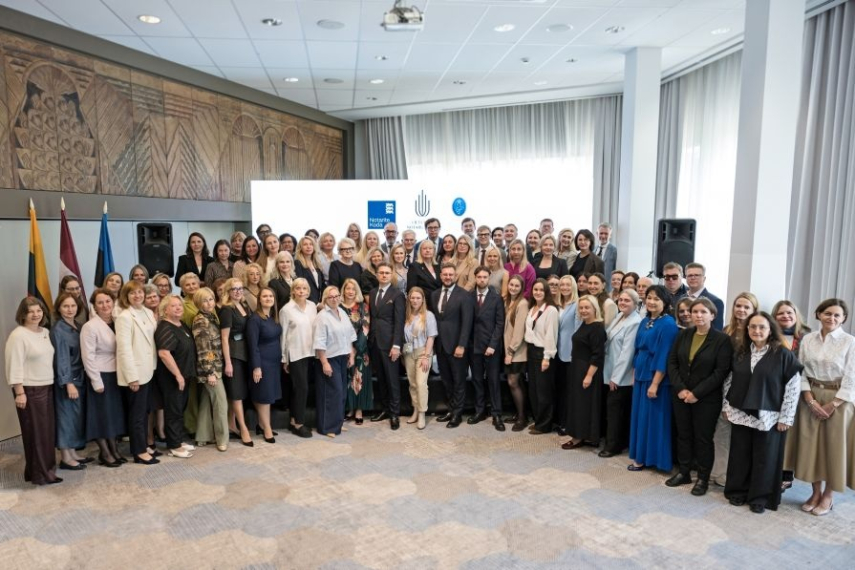
The 30th Meeting of the Baltic Councils of Notaries was held on 04 September this year in Palanga – it is a traditional forum of Lithuanian, Latvian and Estonian notary self-governing bodies, where delegations of notaries from the three Baltic States shared the most relevant profession-specific news, discussed changes and challenges in notary activities, and debated about the future of notariat in a rapidly developing legal and technological environment.
The assembled delegations of notaries from the three countries were congratulated on their anniversary meeting in Palanga by the Minister of Justice of the Republic of Lithuania, Rita Tamašunienė, and the Chairman of the Committee on Legal Affairs of the Seimas of the Republic of Lithuania, Julius Sabatauskas. Insights into the image of the notary profession on social networks were shared by the founder of UAB Repsense, a Communication Strategist, Mykolas Katkus. The President of the Lithuanian Academy of Sciences, Academician Prof. Dr Vytautas Nekrošius, spoke about the path taken by the Latin notariat and its prospects, and the Dean of the Faculty of Law of Vilnius University Prof. Dr Vigita Vėbraitė presented the ways how to encourage the younger generation of lawyers to choose the notary profession.
Although each country’s legal system and the competencies of notaries differ, digitalisation, cyber security, customer service quality, availability of notary services, attractiveness of the profession and discussions on the development of the functions assigned to notaries occupy an increasingly prominent place in the agenda of notaries in all three Baltic States.
Lithuanian Notariat – More Attention Drawn to New Functions
President of the Lithuanian Chamber of Notaries, Marius Stračkaitis, underlined during the conference:
“Notaries in the Baltic States face indistinguishable challenges. We must ensure that technological progress not only speeds up the work of notaries, but also reinforces legal security, customer trust, and service accessibility. At the same time, we see that certain non-contentious functions can be effectively carried out not in courts, but in notary offices. In Lithuania, after successfully implementing the reform of notarial divorce in cases where spouses do not have minor children, another step could be taken in the future, namely, the possibility of allowing notarial divorce for spouses with minor children is being considered.”
According to him, this is what legal scholars from the JuWiLi II project “Justice Without Litigation” recommend for Lithuania. They also paid attention to a unique European-wide condition enshrined in Lithuanian law – that spouses can divorce at a notary only if they have not lived in conjugality for more than a year and do not run a joint household.
“I believe it is worth commencing a discussion in Lithuania on the waiver of the currently valid condition that spouses can only terminate their marriage with a notary when they have not been living in conjugality for more than a year and are not running a joint household. In 2025, notaries approved 1,179 contracts for divorce by mutual consent of both spouses, and 6,180 cases were resolved in the courts of first instance on this issue. Thus, it is obvious that the waiver of the aforesaid conditions would help to further reduce the workload of the courts,” stated M. Stračkaitis.
Estonian Notariat Strengthens Customer Protection and Digitalisation
President of the Estonian Chamber of Notaries, Merle Saar-Johanson, welcomed the participants of the meeting and highlighted the significance of the long-standing partnership between the notaries of the Baltic States and the opportunity to learn from each other.
President of the Estonian Chamber of Notaries, M. Saar-Johanson, underlined:
“As we celebrate the 30th anniversary of the Baltic notary’s cooperation, I am particularly pleased that the Lithuanian Chamber of Notaries has decided to mark this milestone anniversary with such care and solemnity. I greatly appreciate our cooperation and am proud to have been a part of it. Although we gather annually, and sometimes it may appear that twelve months is a too short time for major changes to occur, I still take away from each meeting of the Baltic notaries the same feeling that the notaries of all our countries have done something exceptional that others can learn from. We always have something to celebrate – the notaries of the Baltic States are constantly improving, and our meetings maintain a truly warm and open atmosphere. It is this combination of professional progress, mutual trust and friendship that unites and strengthens us. I sincerely hope that this tradition will be preserved for many years.”
The Estonian notariat is dedicating 2026 to four main directions: updating notary fees, improving customer experience, preventing fraud and money laundering, and bolstering cyber security.
To better protect customers from fraud risks, the Estonian Chamber of Notaries is cooperating with the police and the banking sector and improving the capabilities of notaries to recognise potential fraud cases. At the same time, the future of digital archiving of notarial documents in Estonia is being considered and solutions are being sought that would allow for more efficient use of the already accumulated electronic data of notarial documentation.
“As since 2009, electronic copies of certified documents have been stored in the Estonian e-Notary system, the possibility of creating a digital archive of notarial documents in the future and therefore, gradually abandoning paper archiving is being analysed,” the President of the Estonian Chamber of Notaries presented one of the considered directions for digitising the Estonian notariat.
Latvian Notariat Expands Functions and Improves Sustainability of Services
This year, the Latvian notariat is paying close attention to the development of notary functions, the financial sustainability of services, and the continuity of notarial operations.
In April, notary fees in Latvia were increased in response to rising consumer prices and the increased costs of rendering notarial services, including ICT (Information and Communication Technology) system maintenance costs. Several of the revised fees had not been reviewed for the previous ten years. New rates were also introduced for additional functions assigned to notaries in succession proceedings.
One of the most relevant innovations in Latvia is that, as of 1 March this year, the divorce procedure has been altered for spouses with minor children. Agreements on child custody, contact rights and child maintenance in such cases must be concluded in the form of a notarial deed (previously – mandatory). If one of the parents fails to comply with such an agreement, enforcement may be initiated on its basis through an out-of-court procedure.
According to the President of the Latvian Council of Sworn Notaries, Aigars Kaupe, this innovation is one of the practical examples of transferring non-contentious functions to notaries, which is also being discussed in the context of the JuWiLi II Justice Without Litigation project.
A. Kaupe stated:
“Over the years, the notariat has successfully assumed new functions for the benefit of both the state and society while maintaining high professional standards and legal certainty. For example, at the request of the Ministry of Justice, the Latvian notariat is currently exploring also the possibility of taking on Land Registry functions, as well as certain functions currently performed by guardianship and curatorship institutions. While the assessment is still underway, I am confident that the notariat would also be capable of performing such functions effectively.”
During the Assembly meeting, A. Kaupe also emphasised the significance of cooperation among the notaries of the Baltic States and their long-standing shared traditions, which reflect a strong partnership and unity.
“We have always supported one another, and these meetings give us the opportunity to learn from each other, grow together and inspire one another.”
A. Kaupe also expressed his sincere appreciation for the well-organised anniversary conference, which placed valuable focus on issues and challenges of particular importance to notaries in the digital age, including effective communication and the need to attract new professionals to the profession.
“The Baltic notariats must continue to strengthen their role in society, uphold the rule of law, and work together to meet future challenges.”
About the Meeting of the Baltic Chambers of Notaries
The annual meeting of the Baltic Chambers of Notaries is a long-established tradition that brings together notaries from Lithuania, Latvia and Estonia to review the past year’s achievements and to exchange opinions on the most relevant changes at the national, European and international levels. Last year, the meeting was hosted in Latvia, and next year it will be held in Estonia.

Please enter your username and password.


2026 © The Baltic Times /Cookies Policy Privacy Policy