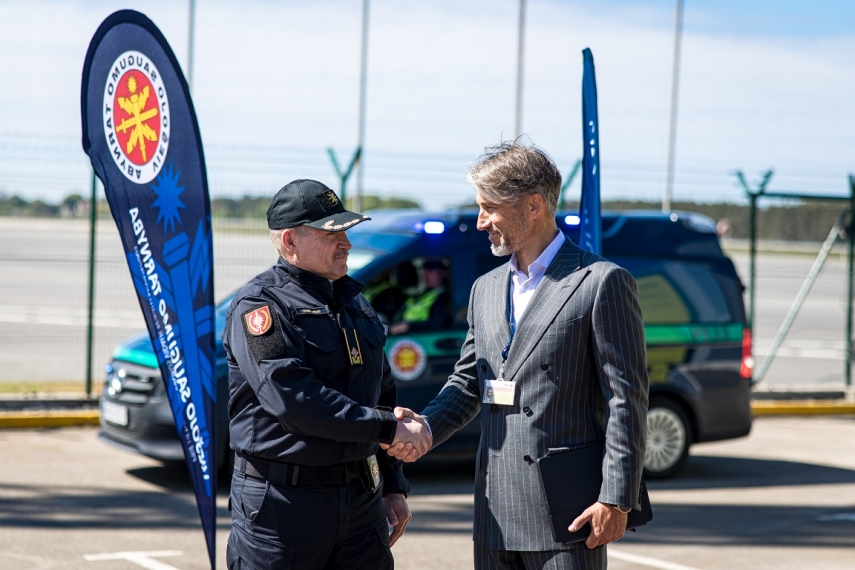
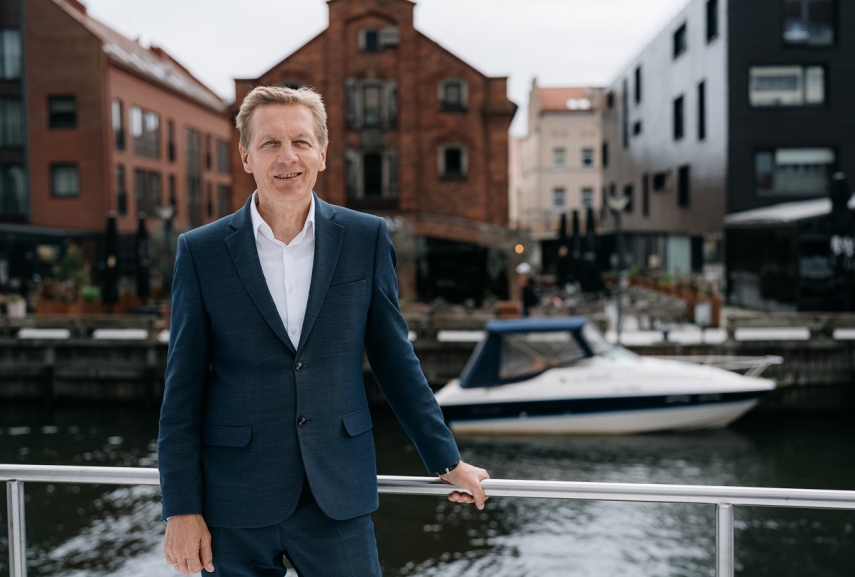
Photo: Klaipeda Mayor Arvydas Vaitkus (by Domas Rimeika)
After I mentioned, half-jokingly, that five out of six cab drivers I had spoken to a week before our long-awaited interview praised the recent changes in the city, Arvydas Vaitkus – Mayor of Klaipeda, Lithuania’s third-largest city on the Baltic coast and home to the largest seaport on the Baltic Sea, already known as a tough captain at the city’s helm – allowed himself a faint grin. “That’s important to me. Taxi drivers are blunt and they don’t lie. And objectively, they shouldn’t have much to complain about, as we have significantly improved the transportation infrastructure – repairing streets, opening new parking spaces, and overhauling the city’s transport system,” Vaitkus told The Baltic Times Magazine. However, the city’s recent changes have been much more tangible than that.
Which economic and socio-economic indicators demonstrating the city’s vibrancy and vigor stand out to you?
First, I do not think Klaipeda should be competing with the country’s other major cities. I would rather speak of it as a port – a Baltic port – and, to tell the truth, I have seen many ports in my life. I prefer to see Klaipeda, with its large port and unique industry generator, the free economic zone, measured against other Baltic Sea ports. Klaipeda is the country’s main transportation hub and one of its key passenger transit hubs.
What makes Klaipeda unique nationwide is the concentration of essential national energy infrastructure here: the LNG terminal with its floating storage and regasification unit (FSRU) Independence, the high-voltage direct-current submarine cable linking Lithuania to Sweden, a major pipeline, and extensive renewable-energy infrastructure – all in one place. Amid today’s geopolitical tensions, the port plays a strategic role in Lithuania’s defense.
No other major Lithuanian city can boast such a large expansion of residential space in its old town – we have around 200,000 square meters of new housing currently being built in Klaipeda’s Old City – an entirely new ‘Memelis City’’ (Memel was the German name for the city now known as Klaipeda. The region was part of Germany until shortly after World War I, became separated from Germany under international administration in the 1920s, and was later annexed by Nazi Germany in March 1939 -TBT) will rise. Very soon, approximately 9,000 residents will move in, benefiting from the ready-to-use infrastructure nearby – shops, cafés, and more.
In addition, around 100 thousand square meters of residential space will be built in the territory where once was the Trinyciai factory (operated from 1903 to 2003 – TBT) on the outskirts of the old city.
Beyond that, I am very proud of what the local authority – and I, as mayor – have accomplished in improving social services and the well-being of many Klaipeda residents.
Previously, around 700 people in need would wait up to four years to receive help from a social service provider at home. Now, that waiting time has significantly decreased due the changes we made. Recognizing the importance of social services, the city has designated 2026 as the Year of Social Responsibility, meaning increased attention to the needs of the most vulnerable Klaipeda residents.
Starting in 2026, all Klaipeda pensioners will have heavily discounted public transport, paying as little as 10 euros per year for unlimited rides – a clear illustration of our social commitment.
In the field of culture, the restoration of the Klaipeda Castle and its entire complex – with work still ongoing – gives me great satisfaction. Additionally, the popular area around Jonas Mountain is being revitalized, and a new residential district is taking shape.
In my system of values, education stands out in particular. Therefore, as mayor, together with my team, we significantly increased the funding allocated to teachers’ assistants in Klaipeda – from 2 million euros to 8 million euros annually. As a result, the number of teacher assistants has grown from 110 to 570.
What new investments can you highlight?
My administration has been focusing heavily on the so-called “Golden Triangle”, which begins at the Jakai roundabout on Tilzes Street and the Klaipeda–Vilnius highway. For the past 15 years, I have been hearing requests from local businesses to install proper drainage so that the land would become suitable for construction. Only now are we finally doing it, investing around 6 million euros. Importantly, businesses have committed to investing roughly half a billion euros in this area over the next 10 years. The changes are already clearly visible to the naked eye.
To boost investments, city keeps in close touch both with the Free Economic Zone (fez.lt) and the Klaipeda seaport authority.
You’ve served nearly six years as CEO of the Klaipeda Port Authority and, previously, you worked as Secretary at the Transport Ministry. That gives you a particularly clear perspective on the city, does it not?
Indeed so. Therefore, I fully understand the importance of synergy between the city and the port. I am proud that in 2018, under my leadership, the Port of Klaipeda became the leading port in the Baltic Sea region, excluding Russian ports, which, for obvious reasons, are difficult to surpass in terms of volume.
If, back in 2002, when I assumed my role at the Transport ministry, someone had told me that the Port of Klaipeda would overtake major German, Polish, Swedish, and Finnish ports, let alone the Latvian and Estonian ones, I would have dismissed it as highly unlikely.
The relations between the city, the port, and other key stakeholders, such as the Ministry of Transport and the Government, could be better now. What has genuinely harmed the interests of the Port of Klaipeda was the Government’s decision, taken a couple of years ago, to change the port’s legal status from a state-owned enterprise to a joint-stock company. I believe this was a serious mistake, a regress backward.
You are described as a tough manager, and I heard that the city’s financial health has improved significantly under your leadership.
Like some other mayors who, like me, came into office from the business sector, I feel a strong responsibility for the use of budgetary resources – from the very start.
I remember that at the beginning of my term in 2023, some people wondered whether I would continue scrutinizing every financial figure so closely.
When I took office, I spearheaded an overhaul of how our city’s budget is used, and numerous shortcomings, poor decisions and negligence emerged. In that respect – everyone’s accountability – I may not be the easiest mayor to work with. But I believe we succeeded in making city management far more effective, with greater accountability among all city officials.
When I was sworn in as mayor in 2023, the city’s budget stood at nearly 360 million euros; today, it is projected to exceed half a billion. Most of the additional revenue has come from personal income tax, an outcome of our successful efforts to improve the business and investment environment for entrepreneurs in Klaipeda.
Last October, you were among 59 of the 60 mayors who co-signed a letter to the Government, urging it to withdraw its plan to appropriate municipalities’ budget surpluses from recent years. Did the government heed this request? What, in your view, most urgently needs to be improved in the relationship between municipalities and the state?
I am disappointed by the recent changes and instability in our governments.
To answer your question, the main bone of contention is last year’s municipal budget surplus. The government cited the Maastricht criterion and the European Commission to justify its intention to take this money from the municipalities.
When all the other mayors and I met with President Gitanas Nauseda at his office to discuss the measure, I became quite emotional, explaining that, if the government proceeds, all municipalities – including ours – will have to scrap their strategic development plans, cancel and derail investments, and abandon the vision of a better, more prosperous municipality and even the principle of self-governance itself.
You were elected Mayor in 2023, following the new edition of the Law on Elections to Municipal Councils of the Republic of Lithuania, which strengthened the mayor’s mandate and made the mayor the principal person responsible for the municipality. Which of these newly assigned mayoral responsibilities, in your view, are excessive, unfounded, or difficult to implement in practice? Please share your experience.
In fact, well before the election – already in 2019 – I used to say that mayors chosen in direct mayoral elections should be the leaders of local economies. Although the amendments have strengthened mayoral powers, much still needs improvement, particularly in the areas of support for needy families, children, and those affected by illness. This is something every mayor would draw your attention to, which is why Lithuania’s Association of Municipalities is seeking further amendments to the law in the Seimas. I hope these changes will take effect before the new mayoral and Council elections in 2027.
I personally find it unjust that mayors, who since 2023 are no longer members of local Councils, are effectively barred from engaging in politics – except for submitting draft proposals to the Council – despite enjoying the highest level of trust from local voters.
I believe it should be the opposite – a mayor whose programme helped win the election must be able to participate fully in local politics and advocate for what they believe in.
Depending on the day, I may sign anywhere from a dozen to more than a hundred different documents.
You must work with a rather mixed coalition that includes, among others, your own election committee Faithful for Klaipeda (Ištikimi Klaipėdai). Is it easy for you to get along with all the factions?
No, it is not. And for them, it is not always easy to get along with me. That is natural – I have my own convictions and quite a unique managerial background. I can be honest with you: some decisions were made “under the gun” – meaning under my pressure – or because I insisted that we give an idea a chance to see whether it works or not. For example, one of the most contentious issues that sparked many heated debates in the Council, was the adoption of the new parking amendments in our Old Town which was done to invigorate it. Despite the different agenda of all the factions of the ruling coalition, we were able to agree on a model acceptable to all of them, which I commend.
You mentioned you’ve visited and learnt of many other foreign seaports’ experiences. Which of the ports emerges in your mind as exemplary in terms of its relationship with the city and the state?
I am inspired by the examples of Barcelona and Hamburg. Barcelona transformed its central port terminals into a vibrant urban space – with a yacht club, shops, promenades and cafés. The change gave a significant boost to the city itself. Similarly, Hamburg, where I have lived, underwent a comparable transformation. Closer to home, Tallinn has also done an excellent job reshaping its port area, turning it into a lively residential and tourist district.
Can you assume the role of futurologist for a minute, please? What do you see Klaipeda looking like 50 years from now – in 2075?
I want to hope that the people living in the city then will feel happy – that is the ultimate feeling of a human being. Our great city with a great history should follow the best development patterns of the mentioned Hamburg or Barcelona, and I do not see a reason why our city could not succeed. I see our city – especially its heart, the old town – thriving with many beautiful residential and leisure buildings. What God and nature gave Klaipeda is unique and unfindable elsewhere in Lithuania. So, it is my honor and privilege to stay at the helm of the city, bridging it into the more foreseeable future.

Please enter your username and password.
2026 © The Baltic Times /Cookies Policy Privacy Policy