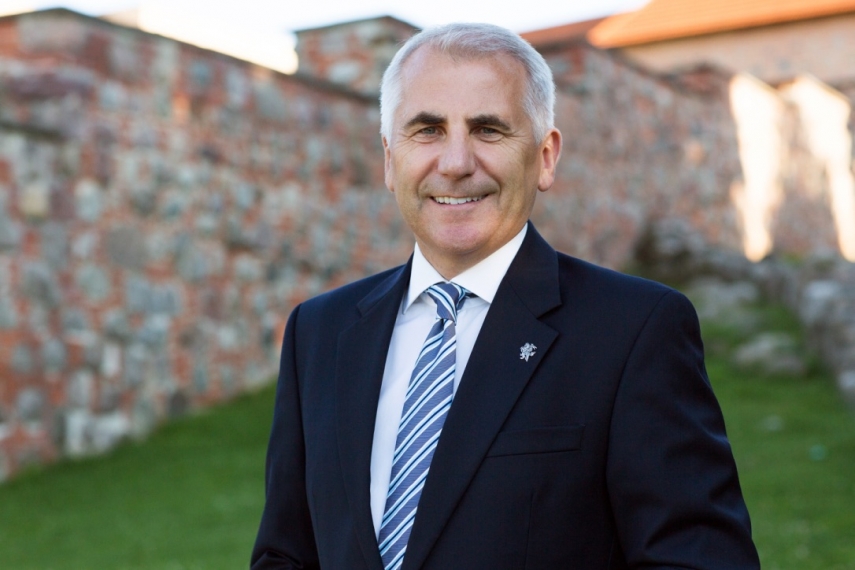
Photo: Vygaudas Usackas
In Lithuania–and, I would argue, across most of NATO’s Eastern flank–the United States’ strategic documents, defense budget, and the actions of U.S. leadership are assessed through a highly realistic and pragmatic lens. We have taken President Donald Trump’s words at face value. Even before his election as the 47th President of the United States–and especially after his return to the White House–Donald Trump has been explicit about his strategic priorities. He has clearly articulated a shift in U.S. political and military focus toward defending the U.S. homeland by securing America’s borders, airspace, and maritime approaches; “actively and fearlessly defending America’s interests throughout the Western Hemisphere”; deterring China and negotiating from a position of strength to sustain peace in the Indo-Pacific; and pressing Europe to assume primary responsibility for its own conventional defense as the most effective response to the security threats it faces.
This strategic reorientation of U.S. attention toward the Western Hemisphere and the Pacific is inevitable and long-term. At the same time, we in Europe recognize a difficult reality: Europe is not yet prepared to independently defend itself–let alone to guarantee the security and territorial integrity of countries such as Ukraine. Even with €800 billion in European Commission-announced financial instruments and historically high commitments to defense spending (thanks, in no small part, to Donald Trump’s pressure), Europe needs time. It must build a robust defense industrial base; develop integrated and autonomous military forces; strengthen air defense, intelligence, logistics, and infrastructure; and cultivate a shared strategic and security culture.
Against this backdrop, Lithuania’s–and other Eastern flank countries’–responses to President Trump’s foreign policy decisions have been driven by pragmatic calculations aimed at safeguarding our vital national interests. In the face of a growing Russian threat, the United States, with its unmatched military capabilities, remains an indispensable ally in protecting our sovereignty and territorial integrity–at least until Europeans acquire sufficient capabilities to act independently of American support. Realistically, this may take another 7-10, if not 15, years.
That said, support for Trump’s foreign policy agenda has recently been tested by assertions regarding Greenland. This issue required particularly careful and nuanced communication from the Baltic states: on the one hand, standing firmly with our close ally Denmark and upholding the internationally enshrined principle of territorial integrity; on the other, maintaining goodwill toward–and avoiding alienation from–the U.S. administration.
Already in the summer of 2024, some of us from the Baltic states (see my op-ed in 15min.lt, 23 July 2024: Vygaudas Ušackas. Europos sandoris su Trumpo Amerika: metas atsisakyti ideologizuotų šablonų) urged European NATO leaders to prepare a new “contract with Trump’s America,” grounded in shared interests and explicit trade-offs. The core objective was to secure continued U.S. military presence in Europe–and ideally expand it on the Eastern flank. We proposed that European leaders acknowledge, in response to Trump’s transactional diplomacy, NATO’s evolution from a community of shared values into a community of shared interests; increase defense spending to 4% of GDP, with at least 50% allocated to the procurement of U.S.-made defense equipment and intelligence services; assume the primary financial burden for Ukraine’s rearmament, including financing U.S. military support and leading Ukraine’s reconstruction; increase purchases of U.S. LNG to fully replace Russian gas supplies; and harmonize and align European economic policies with President Trump’s approach to containing China.
Some of these early calls have now begun to materialize–not because of appeals from Vilnius, but because of pressure, threats, and decisive actions by the new U.S. administration. As a consequence, almost all European NATO members have committed to spending 5% of GDP on defense. The European Commission has announced unprecedented financing instruments for defense. The European Commission’s ReArm Europe Plan/Readiness 2030, presented in March 2025, proposes to leverage over €800 billion in defense spending through national fiscal flexibility, a new €150 billion loan instrument (SAFE) for joint procurement, potential redirection of cohesion funds, and expanded European Investment Bank support. Europeans are financing U.S. military supplies to Ukraine. Together with the military support provided by EU Member States, overall EU support for the Ukrainian army is estimated at €63.2 billion. A European-led “coalition of the willing” is being formed to prepare for the potential deployment of a reassurance force in Ukraine following a ceasefire. Discussions are ongoing regarding the shape and scope of Europe’s future autonomous military capabilities. Last but not least, countries such as Germany have broken long-standing taboos, assuming a leading role in rearmament and accelerating the development and deployment of a deterrence brigade in Lithuania. This commitment is wholeheartedly welcomed and deeply appreciated by my fellow citizens and by other NATO member states in the region.
As transatlantic relations evolve, and irrespective of the eventual outcome of the war in Ukraine, Lithuania–and most Eastern European states–will continue to advocate for a strong U.S. defense and economic presence in Europe. In parallel, these countries are investing in European defense capabilities that remain interoperable with the United States. They will also engage in coalitions of the willing–from a Ukraine reassurance force to membership in the Forum on Resource Geostrategic Engagement (FORGE), and, upon request of the United States and Israel, I assume, will be open to sending troops to observe a Gaza ceasefire–to reinforce their security.
The recently updated Lithuanian Defense Strategy is part of a broader shift toward robust national preparedness and interoperability with NATO in response to a tense regional environment following Russia’s actions in Ukraine and along NATO’s eastern flank. The strategy highlights Russia’s potential, alongside Belarus, to undertake large-scale action against NATO by 2030. Lithuania is committed to spending at least 5-6% of GDP on defense by 2030, with the first major increase starting in 2026. This significantly exceeds NATO’s standard 2% benchmark and aims to accelerate capability development. The Seimas has approved a €4.79 billion defense budget (around 5.38% of GDP) for 2026, boosting force modernization, infrastructure, and readiness. The strategy also emphasizes strengthening the stationing of the German brigade and deepening defense partnerships with the United States and Nordic-Baltic partners. It includes a binding commitment of 0.25% of GDP for ongoing military training and support for Kyiv, as well as an increased focus on civil-military mobilization, infrastructure protection, and societal preparedness. Enhanced intelligence and counter-intelligence capabilities are prioritized to counter Russian and Belarusian hybrid threats, including espionage, sabotage, and disinformation, and to strengthen early warning capabilities and situational awareness, particularly in border regions and cyberspace.
Overall, the strategy underscores that national security relies on a comprehensive approach combining robust military power, strengthened intelligence, and societal resilience to prevent and deter potential aggression.
Vygaudas Usackas is a former Minister of Foreign Affairs of Lithuania. He has served as the EU Ambassador to Afghanistan and Russia, and previously as Lithuania’s ambassador to the United States and the United Kingdom

Please enter your username and password.

2026 © The Baltic Times /Cookies Policy Privacy Policy