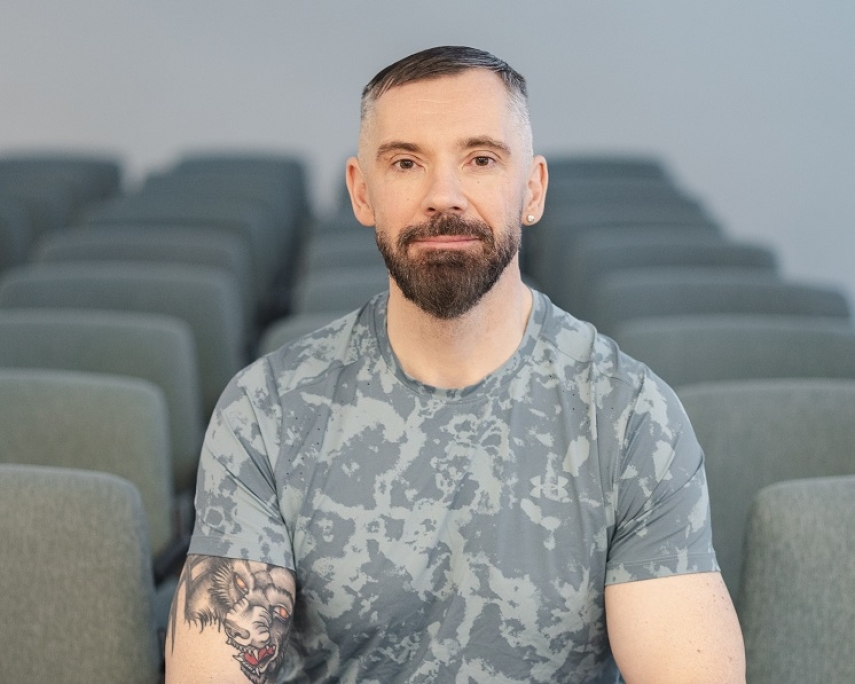
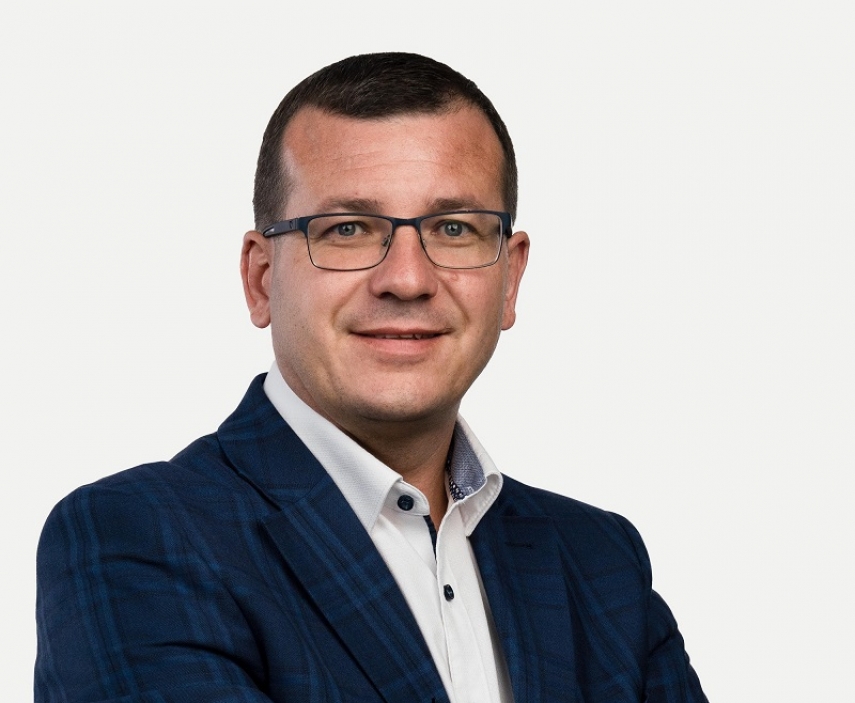
Photo: Edvinas Kerza is the founder and managing partner of ScaleWolf
The interview with Edvinas Kerza, the founder and managing partner of ScaleWolf, a Vilnius-based venture capital fund focused on dual-use defence technologies, started off with his reflection on the geopolitical gloom we find ourselves in and this impromptu, personal, heartfelt admission: “In the 1940s, with the Soviets in, most of my family was exiled, some escaping sat in an ordinary wooden boat and oared across the Baltic Sea – they reached Sweden after a dire seafaring. One of the travellers died; my great-grandmother, a very proud woman, decided to meet her fate – a Siberia-bound train wagon – so did my great-grandmother,” E. Kerza reminisced to The Baltic Times Magazine. “To be honest, that has been inspiring me all my life – it also serves as the best motivation, so my own children and grandchildren are spared the suffering and torture our ancestors were subjected to,” the ScaleWolf founder added.
At the end of 2025, Lithuania experienced a massive flyover of Vilnius-bound Belarusian balloons, which significantly disrupted air traffic and caused immeasurable economic and reputational damage. What do you make of the intrusion?
I am tracking various hybrid attacks, and this one is one of many. To remind you, before, we had the unidentified ‘little green men’ swarming (refers to Russia’s covert military operation, most famously during the 2014 takeover of Crimea, using unmarked soldiers to seize control while denying official involvement – TBT), massive disinformation attacks, including very sophisticated cyber-attacks in 2016–2018 (Edvinas Kerza served as Vice-Minister of National Defence of the Republic of Lithuania from February 2017 to April 2020 – TBT), and, to tell the truth, we found out about their scope and specifics only afterwards. And then we saw the so-called quality-information warfare against us, a form of information warfare that focuses not on volume or noise, but on credibility, precision, and long-term influence. Specifically, instead of flooding the space with obvious propaganda, quality-information warfare uses accurate or partly accurate information, respected messengers (experts, journalists, institutions), and so on.
The balloons you mentioned are kind of a new thing in hybrid warfare, yet unfortunately, we were not prepared for it and were not sufficiently active, allowing the hostile opponent to be one step ahead of us. In a word, we are missing an effective system to respond to all kinds of attacks – be they physical, like the balloons or, previously, undocumented migrants deliberately sent to our borders, cyber, or informational.
What do you believe is the best technological solution to the intrusion? How does ScaleWolf propose to address it?
I am glad to share that a couple of ScaleWolf teams are working together to address the problem. What I want everyone to understand is that it does not exclusively relate to balloons, which may appear different someday – perhaps as more high-tech intelligence drones high in the skies, spying on our critical (defence) infrastructure, or some loitering ammunition with specific goals.
So, in general, it is about proper and efficient air defence – we need to have an efficient plan for a set of challenges of this kind. Specifically, I believe we need to establish a system of monitoring, detecting, tracking, and other countermeasures – depending on the threat. I am sure that Lithuanian companies – and those funded by ScaleWolf – will propose solutions.
What do you believe can come next in terms of security threats on the nearly 700-kilometre Lithuanian-Belarusian border? Will we see explosives-laden raccoons or hogs, or remotely controlled AI-based robots sneaking through the border to harm us?
I expect underground automatic drones. Although we now speak about flying, crawling, and rolling robots – a new generation of weaponry – I think that here, in Lithuania, we will soon see next-generation drones able to dig tunnels and emerge in unexpected places. Therefore, in my opinion, we should do everything we can now to convert our current border protection into smart border protection – fully equipped with different sensors that would not only monitor what is happening in the air or on land but also detect vibrations and other motion-sensitive data underground. Importantly, our response to this kind of threat should be fully automatic, adequate, and, in some cases, AI-driven – without requiring a human to press a button.
In 2025, ScaleWolf bagged two major deals – with Pulsetto and PowerUP. Please talk about that.
Despite all the innovative technologies now available on the ground, the human being remains the most important factor. Ultimately, it is soldiers who make the difference on the battlefield. We need to respect them and understand that every day they operate in very dangerous and diverse circumstances, where they may be injured, lose their lives, or witness such events happen to their fellow soldiers.
On one hand, they must perform at their best when healthy in combat zones and be able to restore their top performance level when they sustain an injury. Alas, in some cases, soldiers die not because of a lack of preparedness or ammunition, but because they enter the battlefield too overhyped.
And that is where Pulsetto comes in (a Lithuanian health-tech startup that makes a wearable device for non-invasive vagus nerve stimulation (VNS) used to help with acute stress, mental resilience, and sleep disorders – TBT), helping soldiers regain emotional control after contact, lower the risk of stress-induced decision errors, get them prepared for the next day, and allow them to return to the battlefield faster.
In February, ScaleWolf provided Pulsetto with 2 million euros.
At the core of PowerUP’s mission is also a strong dual-use strategy: delivering dependable, hydrogen-based power solutions for defence operations as well as for critical civilian infrastructure.
To explain, electricity is key on a battlefield – your enemy or opponent always looks for heat tracks. If you use regular sources of electricity generation, like diesel generators, they emit heat, signalling the presence of troops. And that is where PowerUP’s technology steps in – the hydrogen technology it uses is both environmentally friendly and untraceable. Besides, the technology is flexible and easy to operate. Importantly, this is the next step not only on the battlefield but also for critical civilian infrastructure.
ScaleWolf, together with Mercaton Investment Group and Estonia’s SmartCap Green Fund, provided 10 million euros for the Estonian startup.
Lithuania has been allocated approximately 6.3 billion euros in defence-related loans under the new EU SAFE programme, which is aimed at boosting member states’ defence capabilities by subsidising arms and equipment purchases. Will ScaleWolf benefit from it? And what do you believe have to be the safeguards to make sure the money is used transparently and efficiently?
When it comes to money allocation and use, I have mixed feelings. On one hand, it is very important to have adequate financing for defence, but on the other hand, it is even more important to spend it wisely and, of course, transparently. According to Lithuania’s central bank, Lithuanians’ savings amount to a little over 23 billion euros – unused and affected by inflation.
At ScaleWolf, my team and I are exploring how private capital can be used for defence purposes more efficiently. Unlike EU or Lithuanian state money, private capital funds are slimmer, less bureaucratic, and very target-oriented. At ScaleWolf, I believe we need to be quicker and more business-oriented – especially in defence – rather than rely on EU or state subsidies. My experience shows that young startups grown on private capital usually produce more results, grow faster, and become competitive quickly – even internationally.
You state on ScaleWolf website that more than 60 defence-sector startups have completed ScaleWolf’s pre-accelerator and accelerator programmes. How many of these companies are involved in the war in Ukraine? And how many have contracts with NATO?
We have different stories. Some of them are digital, focusing on AI, cybersecurity, and intelligence. Usually, they are dual-use startups, working with critical infrastructure, governments, private entities, and so on. As regards hardware startups, all of them work with NATO and in Ukraine. The biggest acknowledgement and advantage they have is the possibility of testing their products and services on the battlefield. Without battle-proven technology, it is nearly impossible to secure customers and contracts.
I am proud that ScaleWolf-supported drone production or component production companies are returning to Lithuania from the hottest frontlines in Ukraine with strong performance records and feedback, which paves their way to the US, Germany, Scandinavia, and elsewhere.
When we spoke last summer, you emphasised the uptick of defence commercialisation. Yet some analysts claim that defence investments, apart from the sole defence purpose, are not viable long term. What would be your response to that?
We live in a time when defence and defending ourselves is existential – no exaggeration.
ScaleWolf has proved that the claim about the economic unviability of investment in the defence sector is not true – all our best startups are profitable, and the majority generate revenue in their first years, even before they become profitable. Not all companies in other sectors can say this.
Importantly, all our companies have a plan B – in case the geopolitical situation changes, i.e., improves, which is certainly not the case for now. Since the nature of most startups in ScaleWolf programmes is dual-use – defence and civil – their applicability is vast, including in civilian life.
What do you expect from 2026?
I really wish we finally get peace in Ukraine. That would be the best gift that 2026 could provide – for the whole world. Unfortunately, the price may be so high that it could push the timeline of this gift beyond 2026.
Before the war, many companies – even within the European Union and the Baltics – were competing, but the war united them, bringing an understanding that unity – like that in the Baltic Way in 1989 (The Baltic Way united Estonians, Latvians, and Lithuanians in an approximately 675-kilometre human chain, demanding freedom, independence, and historical justice, symbolizing peaceful resistance against Soviet rule through solidarity and courage – TBT), not competition, can help them grow in times like these. Many things were taken for granted, but now we are at a time when democracies – including ours – need to fight evil and prove that democracy works. Otherwise, we may not have a second chance.

Please enter your username and password.

2026 © The Baltic Times /Cookies Policy Privacy Policy