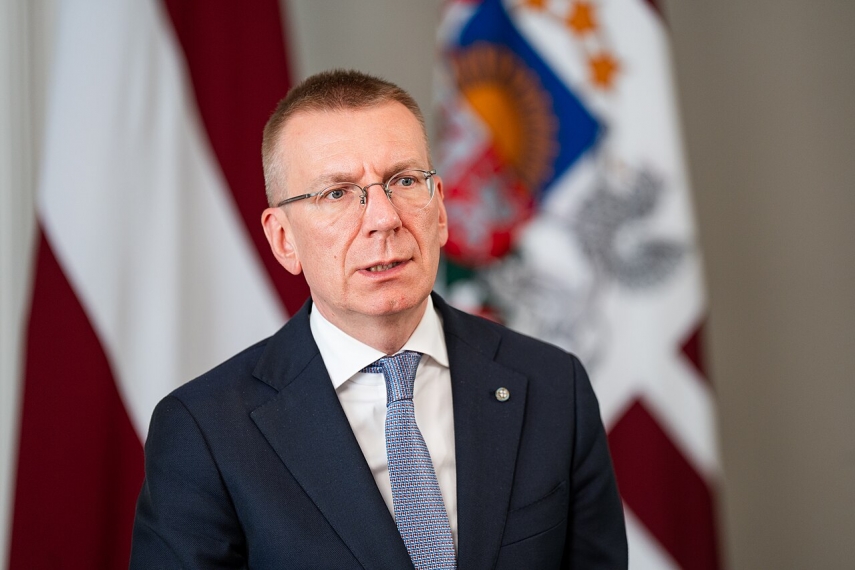
RIGA - As the official transition to education only in Latvian concludes, it is crucial to ensure that all children actually learn and use the language, President Edgars Rinkevics said during a meeting with Education and Science Minister Dace Melbarde (New Unity) on Thursday.
As the president's spokesman Martins Dregeris informed LETA, the officials discussed topical issues in education and sports, namely the transition to education in Latvian, the introduction of a new school financing model, changes in the regulation concerning distance learning, as well as reforms planned in the sports sector.
The conversation focused on the transition to learning in Latvian, which formally concludes this school year.
The president said that the transition to education in Latvian is an important step, but the decisive factor is what happens in the classroom, whether teachers have sufficient practical support, and whether children have the opportunity to really learn and use Latvian in everyday life.
"Schools and students are different, therefore schools need flexible solutions and sufficient resources to ensure an appropriate learning environment and the necessary support for each child," said Rinkevics.
In turn, regarding the restrictions on distance learning in grades 1 to 6, the president underlined that the new regulation should be introduced carefully, by developing a clear procedure for municipalities in a timely manner and ensuring that the best interests of the child are at the center in every case.
The development of the sports sector was also discussed during the meeting. Rinkevics noted that strong and accessible children's and youth sports across Latvia are the basis for both public health and high achievements by elite athletes.
A survey commissioned by the Education and Science Ministry in 2025 showed that more and more ethnic minority students use Latvian outside school, but a fifth still use it only at school.
The survey also found that 88 percent of students whose mother tongue is not Latvian believe that the Latvian language skills acquired at school help or rather help in life outside school. Young people use Latvian in everyday life on the internet, in communication with friends and family members, in clubs and sports school classes, in public places, and elsewhere. Meanwhile, 70 percent of respondents believe that participation in extracurricular activities helps to improve Latvian language skills.
According to the survey, 21 percent of respondents still admitted that they use the Latvian language only at school. This is a lower rate than the answers given by parents, and it indicates a wider use of the language in the daily life of students, the ministry notes.

Please enter your username and password.

2026 © The Baltic Times /Cookies Policy Privacy Policy