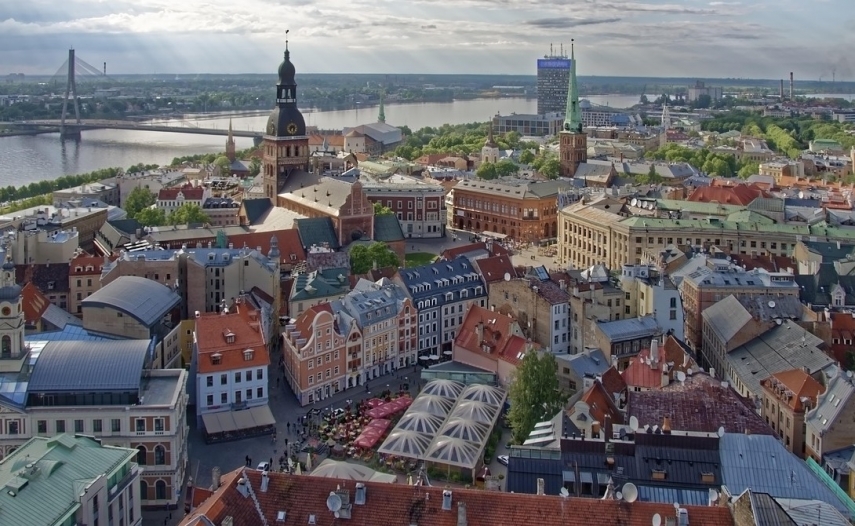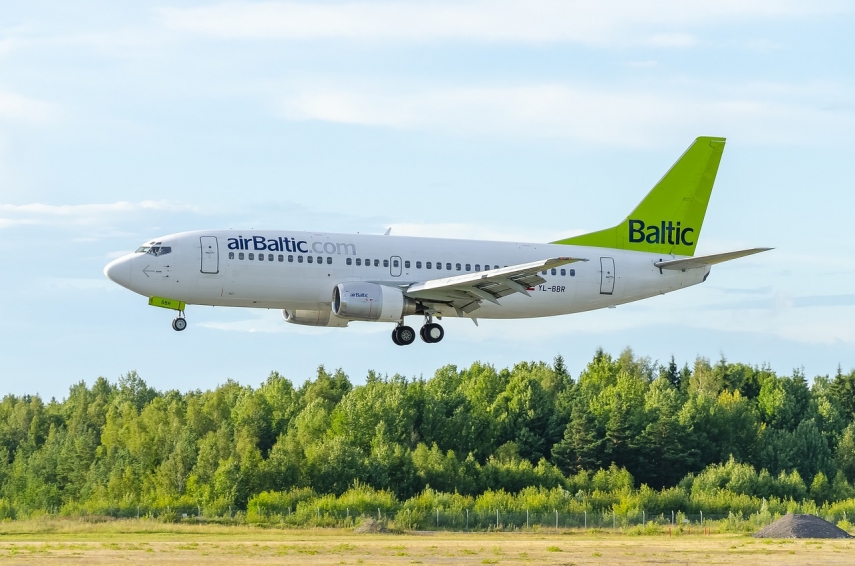
Photo: Johan Widén from Pixabay
RIGA - The decision taken by the government on Tuesday to grant another EUR 30 million loan to Latvia's national carrier airBaltic did not win the support of the Saeima Budget and Finance (Taxation) Committee on Wednesday, as MPs of the Union of Greens and Farmers objected to supporting the financially ailing airline, Transport Minister Atis Svinka (Progressives) told reporters.
The Saeima committee will revisit the issue on April 14, when it assembles for its first meeting after the Easter holidays, said Svinka. The committee was expected to approve the loan on Wednesday so that the Saeima could vote on it at Wednesday's sitting.
Svinka said that he was puzzled by the questions raised by Greens/Farmers on this issue and called it political rhetoric. The transport minister underlined that he had explained the matter to the coalition before, and that the government unanimously supported the loan on Tuesday, March 31, after hearing the minister's arguments.
According to Svinka, Greens/Farmers had been given all the necessary information in a very timely manner, and that the party received even more information than others. The Greens/Farmers-led Economics Ministry had also participated in the preparation of the government decision. "The lack of information in the Greens/Farmers faction makes me wonder about the quality of communication between the Greens/Farmers faction and its ministers," said Svinka.
"I have a lot of questions about how things are going within the party," the minister said.
Commenting on whether the delay of the decision will affect airBaltic's operations, Andrejs Martinovs, Chairman of the airBaltic supervisory board, told LETA that airBaltic continues to operate in a "regular and sufficiently sustainable mode".
He said that the airline feels quite stable. Martinovs added that there is no urgency about the loan decision. "In fact, we were prepared and expected it to take a bit more time," Martinovs said.
At the same time, he said that this is a routine process, with lawmakers and committee members raising valid questions that go beyond the prepared material, so extra time is needed to prepare.
As reported, the government decided on Tuesday to grant airBaltic a short-term loan of EUR 30 million due to the sharp rise in fuel prices. The government decision has yet to be approved by the Saeima.
Prime Minister Evika Silina (New Unity) told reporters on Tuesday that the government heard the Transport Ministry's report, according to which the situation in the Middle East and the resulting fluctuations in fuel prices had increased pressure on airBaltic.
airBaltic is critically important for strengthening Latvia's national security and improving connectivity. This is why the short-term loan will be granted to the airline as aviation fuel prices are rising the fastest, said Silina.
airBaltic CFO Vitolds Jakovlevs said in an investor call earlier this month that airBaltic's total fuel consumption for the remaining year was projected at around 165,000 tons.
airBaltic formally turned to the Transport Ministry at the end of March, informing the shareholder about the impact of external factors on the company's financial and operational performance. The military conflict in the Middle East has led to a significant increase in aviation fuel prices, which in turn has raised the company's costs and affected its profitability.
Having received and assessed airBaltic's letter on the need for a short-term loan as a possible preventive stabilization instrument, Svinka proposed to discuss the matter at the Cabinet meeting on Tuesday.
He also noted that it was essential to ensure the company's continued operations at a time when external factors were having a particularly strong impact on the aviation industry.
According to the Transport Ministry, the airline continues to operate flights according to the schedule and that a potential loan, if granted, could help the airline maintain a stable flight network, avoiding abrupt changes and absorbing the pressure from rising fuel prices.
airBaltic previously had to suspend flights to Tel Aviv and Dubai for security reasons, which has reduced revenues and affected efficiency of its route network, said the Transport Ministry. At the same time, aviation fuel prices rose significantly as a result of the conflict, at times nearly doubling.
In the meantime, work is underway on a new business plan for airBaltic, which is expected to be finalized in the summer. A short-term loan, if provided, could help the company stabilize its operations until implementation of the new plan begins, the Transport Ministry explained.
As reported, airBaltic's losses last year amounted to EUR 44.337 million, which is 2.7 times less than in 2024. Last year, airBaltic's turnover increased by 4.2 percent compared to 2024 and amounted to EUR 779.344 million.
In 2025, the airline carried a total of 5.2 million passengers on its route network, an increase of 1 percent compared to 2024.
At the end of August last year, German national airline Lufthansa became a shareholder in airBaltic. Currently, the Latvian state owns 88.37 percent of airBaltic shares, Lufthansa - 10 percent, financial investor Aircraft Leasing 1, owned by Danish businessman Lars Thuesen - 1.62 percent, and 0.01 percent - other shareholders. The company's share capital is EUR 41.819 million.
After the initial public offering (IPO) of airBaltic shares, the size of Lufthansa's stake will be determined by the potential IPO market price. The transaction also provides that Lufthansa will own at least 5 percent of airBaltic's capital after the potential IPO.
On August 30, 2024, the Latvian government agreed that the state should retain at least 25 percent plus one share in airBaltic's capital after the IPO. On August 19, 2025, the government decided that Latvia, like Germany's Lufthansa, would make a co-investment of EUR 14 million in airBaltic ahead of a potential IPO.
However, given the 2025 financial results and market conditions, airBaltic has suspended its planned IPO and does not currently view it as a potential source of capital for 2026, according to airBaltic’s annual report.
The report indicates that, despite the expected improvement in operational and commercial performance, the airline will operate with a negative free cash flow in 2026, and, based on current forecasts, management expects that an additional capital injection of EUR 100 to 150 million will be required to finance operations for the 2026/2027 winter season.
Svinka has noted that an IPO is not the only way to raise capital, and the airline’s management has been given the broadest possible mandate to seek opportunities to raise capital using various financial instruments. Thus, the airline’s goal for 2026 is not only to reduce costs but also to raise capital.

Please enter your username and password.


2026 © The Baltic Times /Cookies Policy Privacy Policy