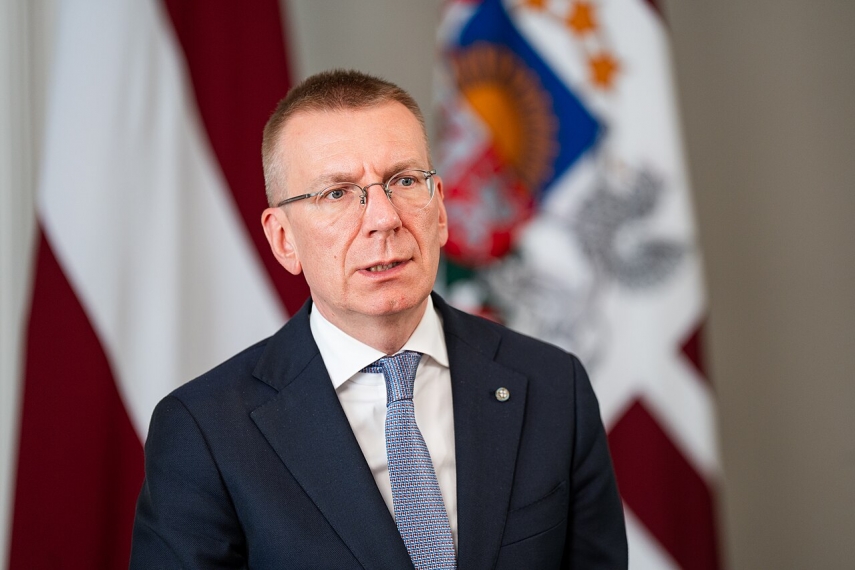
RIGA - There is some hesitation in Europe to respond to the US call for help to unblock the Strait of Hormuz, as there is a risk that a response would reinforce the US view of Europe as a doormat, the director of the Latvian National Defense Academy's Security and Strategic Research Center, Toms Rostoks, told LETA.
The expert said that this is not a European or NATO war, and the US and Israel did not consult European countries before launching their attack on Iran. Rostoks believes that the US-Israeli attack was "rather reckless" and did not go as both countries had intended, which is why US President Donald Trump is looking for ways to resolve the economic turmoil caused by the closure of the Strait of Hormuz.
"In Europe, the thinking has changed a lot," Rostoks said, admitting that there might be some countries that will respond to the US President's call, but that it might be difficult to do.
The closure of the Strait of Hormuz and the threat to shipping were predictable, the expert noted - the US and other militaries have played out such scenarios for decades. In Rostoks' view, the assumption in Washington was that if Iran did not decide to take more decisive steps during last year's 12-day war, it was weak and would not dare to close the Strait of Hormuz.
"What is different this year is that when the US President started the war, he declared that the goal was regime change in Iran, and accordingly, the Iranian regime reacted much more sharply than last year," the expert said.
Rostoks noted that the US call for assistance comes with threats regarding NATO's future. He attributed this to the US perception of Europe's weakness and the belief that Europe will do whatever the US tells it to do. The expert described this as "unfair treatment of allies".
The expert also warned that Europe and the US should think about whether the current situation could start a longer chain of events that will further destabilize the situation in the Middle East. Rostoks explained that the parents and wife of Iran's new supreme leader, Mojtaba Khamenei, were killed in an Israeli missile strike. He noted that under the previous supreme leader, Iran did not decide to take a decisive step toward nuclear weapons, but it is not known how the current leader will view this.
According to Rostoks, given that Iran has highly enriched uranium, Iran could develop its nuclear program, if it is still operational, and eventually arm itself with nuclear weapons. The expert also predicted that over time, Iran will be able to rebuild its missile capabilities, so the military effect of current strikes and attacks may not be lasting.
"The outcome of this war could probably be a much more intolerant and hostile regime in Tehran," Rostoks said.
Commenting on possible scenarios, the expert said that the war can become protracted. The gradual redeployment of US Marines from bases in Japan to the Middle East is evidence of preparations for a limited ground invasion. The US could also escalate the conflict by destroying oil infrastructure in Iran or by completely stopping ships transporting oil from Iran to East and Southeast Asia. In the expert's assessment, Iran also has "some trump cards" - the Strait of Hormuz and the ability to continue drone strikes against targets in other Gulf states for extended periods.
In Rostoks' view, attention should also be paid to the internal political processes in Iran, namely, whether the regime will be able to function and suppress unrest and protests. Rostoks stressed that if a civil war or a more serious military conflict were to break out in Iran, the consequences could be "very unpleasant". However, he did not rule out other scenarios if the warring parties decided that a quick end to the conflict was in their interests.
Europe is interested in the conflict ending as soon as possible, because economic growth in European countries has been rather weak for a long time and high oil prices would make the situation even worse.
Rostoks added that the war in Europe is ongoing - high oil prices are benefiting Russia and prolonging Russia's aggression against Ukraine. He pointed out that Europe insists on diplomatic solutions also because it has far fewer military tools at its disposal than the US.
As reported, the US President warned last Sunday that NATO faces a "very bad" future if allies do not help unblock the Strait of Hormuz.

Please enter your username and password.

2026 © The Baltic Times /Cookies Policy Privacy Policy