A new permanent archaeological exhibition, “Findings” ("Atradumi"), will open at 5 p.m. on Friday, 11 September, at the Draugu House Gallery in Konrāds Quarter, Cēsis. The exhibition brings centuries-old objects together with items that were lost or discarded only recently. The exhibits have been selected by well-known public figures, while children offer their interpretations of how unique antiquities may once have been used.
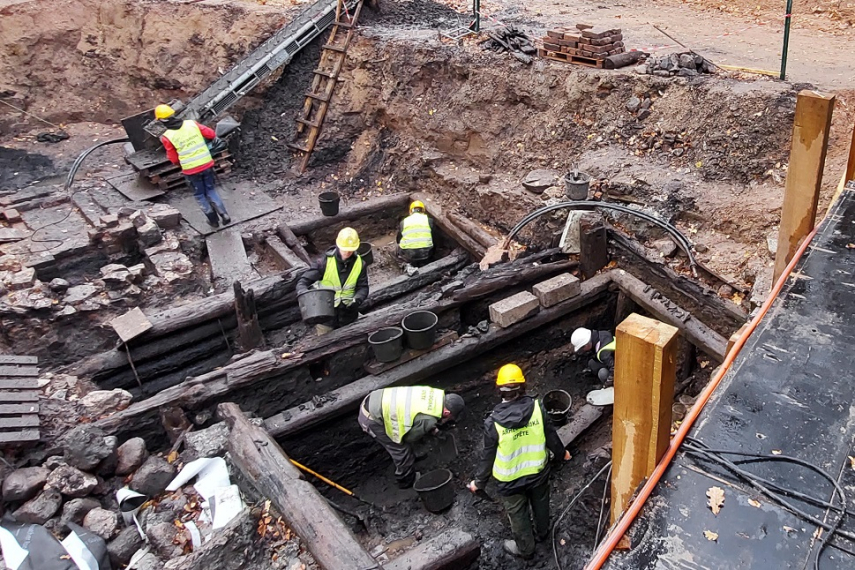
The exhibition is based on archaeological finds uncovered during the restoration of Konrāds Quarter. Archaeological investigations in the area between Cēsis Medieval Castle and St John’s Church began in the spring of 2024 and continued until last autumn.
Archaeologists discovered the remains of medieval timber buildings, the castle’s defensive wall, burials and numerous objects associated with the everyday lives and crafts of the town’s inhabitants. The finds include a 13th-century casting mould, medieval writing styli, amber rosary beads, fragments of wooden vessels, footwear and other leather goods.
However, the researchers preserved more than just ancient and rare objects during the excavations. In their view, even very recent finds bear witness to their time and can tell us how a place was used, how people lived and what habits they had. This idea has become one of the central themes of “Findings”. What determines whether we regard an object as valuable historical evidence or merely as an ordinary everyday item? And do archaeologists and people with no professional connection to archaeology notice the same things?
To explore these questions from a different perspective, people whose professional work is unrelated to archaeology were invited to help select the exhibits. The contents of the exhibition’s first display cases were chosen by technology entrepreneur Anna Andersone, actor and entrepreneur Juris Žagars, journalist Inga Spriņģe, poet Jānis Rokpelnis and digital marketing specialist Artūrs Mednis.
Each participant selected objects that surprised or intrigued them or made them reflect from centuries-old antiquities to very recent and seemingly insignificant items. In conversations with archaeologist Laura Lēģere, they learned what researchers had already discovered about their chosen objects and which questions remained unanswered. The conversations were filmed, and the recordings have become part of the exhibition.
Another section of “Findings” focuses on several remarkable antiquities, but this time it is the children who offer the explanations. In front of the camera, they try to work out how the objects discovered by archaeologists may once have been used and how they were made. Their guesses and conclusions provide a captivating and touching insight into how a centuries-old past is interpreted through the experiences and imagination of a child today.
“When creating history exhibitions, I have always tried to find unconventional ways of making the distant past understandable and engaging for contemporary audiences. This time, the circumstances offered an especially good opportunity to experiment with an unusual format to let people from entirely different fields select the finds and to entrust the interpretation of some antiquities to children. It was a wonderful experience. I am particularly delighted that we were able to involve so many different people in creating the exhibition from Cēsis and Riga, seasoned professionals and children with their own perspectives and ideas. To me, this meeting of different viewpoints is the very essence of ‘Findings’,” says Gundars Kalniņš, the exhibition’s curator and the author of its concept.
Although “Findings” has been created as a permanent exhibition, its contents will evolve over time. From time to time, some of the display cases will be completely renewed to feature finds selected by other well-known public figures. The exhibition’s next transformation will reveal which objects from the rich collection of archaeological finds uncovered in the courtyard of Konrāds Quarter have been chosen by educator Edgars Plētiens, editor Nellija Ločmele, event host Valdis Melderis, entrepreneur Egija Gailuma and artist Kristians Brekte.
“Findings” will therefore have no single definitive version. As the display cases and the people whose choices they present change, the story told by the exhibition will change as well giving visitors a reason to return again and again.

Please enter your username and password.

2026 © The Baltic Times /Cookies Policy Privacy Policy