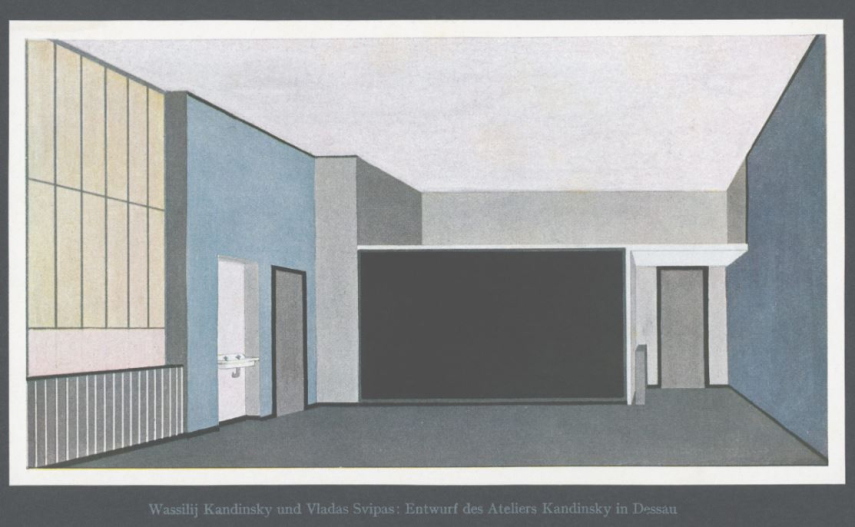
Photo: Vladas Švipas's colour scheme for the studio interior of Wassily Kandinsky's house, published in Gustav Adolf Platz's book Die Baukunst der neuesten Zeit (Berlin Propyläen Verlag, 1927, Plate XX)
On 9 October, at 5:00 PM, the National Gallery of Art of the Lithuanian National Museum of Art (LNMA) opens an exhibition celebrating the life and professional legacy of the architect Vladas Švipas (1900–1965). Titled Vladas Švipas: Pušalotas > Bauhaus > Kaunas > New York, the display tracks the path of Lithuanian Bauhaus alumnus from interwar Kaunas to a German Displaced Persons camp, and into New York, where he had to adapt to an émigré fate.
On the same day, from 3:00 to 4:30 PM, the opening of the exhibition is preceded by an international symposium on the interwar relationship of the Bauhaus and the Baltics. Dr Marija Drėmaitė (Vilnius University), Dr Anke Blümm (Erfurt University), and Dr Julia Secklehner (Masaryk University, Brno) will present at the symposium. Dr Birgitte Franzen, Director of the Bauhaus-Archiv/Museum, is expected to take part in a roundtable discussion moderated by Gabrielė Radzevičiūtė (NDG).
“Exhibitions based on recent research and introducing as-yet-unseen layers of Lithuanian culture and art are among the priorities in the exhibition programme of the National Gallery of Art. We are delighted to present, together with the architecture historian Marija Drėmaitė, a new page in the history of Lithuanian architecture and its international contexts,” says Dr Lolita Jablonskienė, director of the National Gallery of Art of the LNMA.
Lithuanian Bauhaus adherent: a civil servant who promoted ideas of modernism
According to the exhibition curator Dr Marija Drėmaitė, Švipas remains a relatively unfamiliar figure even within the Lithuanian art and architecture community – most likely because he designed only five residential buildings in Kaunas. However, his professional legacy highlights an entirely different side of a modernist architect’s career – his public service, his involvement in regional and territorial planning, and his work developing rules and regulations.
“In the 1930s, serving as head of Construction Department at the Chamber of Agriculture, Vladas Švipas acted as public promoter of Bauhaus ideas. He integrated these principles into modernization programmes of Lithuanian countryside, new settlers’ homestead designs, the plan of the campaign for “Brick Lithuania”, and the search for an ideal residential house. The exhibition illustrates how architectural practice reaches beyond an individual artistic creation, including also regular work of a modern-minded civil servant and technical expert,” says Drėmaitė.
The exhibition places Švipas’s architecture within a broader historical and cultural context of a modern state construction. The newly independent Lithuanian state (1918-1940), emerging from wars and the collapse of empires, was in great need of modern professionals. State scholarships encouraged young people to study in Western Europe, yet only one Lithuanian student-scholarship recipient chose the Bauhaus, the most avant-garde school of design of its time. The life and work of Vladas Švipas reveal the making of a new type of modernist architect and his role in shaping a modern state.
Studies and connections with celebrated 20th-century artists and architects
Švipas’s professional links with the leading figures of global modernism highlight the bold ambitions of interwar Lithuanian artists. Between 1924 and 1926, Švipas studied in Wassily Kandinsky's Wall-Painting Workshop (Wandmalerei), in 1928, he completed an internship at the Bauhaus Architecture Office under Hannes Meyer and Hans Wittwer. Returning to interwar Kaunas, he developed ideas of rational planning both through his public service and theoretical work.
During the Second World War, Švipas navigated between the Soviet and Nazi occupation regimes. At the end of the war, he withdrew to the West and lived from 1945 to 1949, in Dillingen DP camp in Germany. With the help of former Bauhaus director Walter Gropius and his fellow student Xanti Schawinsky, he later emigrated to the United States to begin a fresh chapter of his professional life in New York. Another Bauhaus colleague, Marcel Breuer, helped him with the search for work, while surviving Švipas’s correspondence with Gropius reveals warm ties between the former Bauhaus student and his mentor.
Švipas’s biography sparks questions about an architect’s desire to extend rational order into the landscape and navigate the realm of politics. More broadly, the exhibition tells a story of professional migration – showing how as historical ruptures and political regimes break and make ideas, knowledge, and connections. The exhibition is accompanied by a bilingual, Lithuanian and English, book by Maria Drėmaitė Vladas Švipas: Pušalotas > Bauhaus > Kaunas > New York by Lapas.
Curator-guided tour: Saturday, 10 October at 4:00 PM
Lecture by Dr Maria Drėmaitė: 19 November.
Produced by: Kultūros projektų asociacija Documentum
Project Manager: Lina Pranaitytė
Sponsor: Lithuanian Council for Culture
Curator: Dr Marija Drėmaitė (Vilnius University)
Architect and Designer: Vika Pranaitytė (O-D-A Architecture studio)
Photographer and Curator: Lukas Mykolaitis
Image editor: Ieva Austinskaitė (aust.studio)
Models: Urtė Šimkutė
Exhibition organized in partnership with the Lithuanian National Museum of Art (coordinator Giedrius Gulbinas).
Exhibits Loaned By: National M. K. Čiurlionis Museum of Art, Vilnius University Library, The Wroblewski Library of the Lithuanian Academy of Sciences, Martynas Mažvydas National Library of Lithuania, Lithuanian Central State Archives, Lithuanian National Museum, Ąžuolynas Kaunas County Public Library, Vaga Publishers, Alfonsas Švipas, Bernd Freese, and Galerie Berinson (Berlin).
Exhibition is on in Room 5 of the National Gallery of Art until 17 January 2027.

Please enter your username and password.


2026 © The Baltic Times /Cookies Policy Privacy Policy