Photo: commons.wikimedia.org / Estonian Foreign Ministry
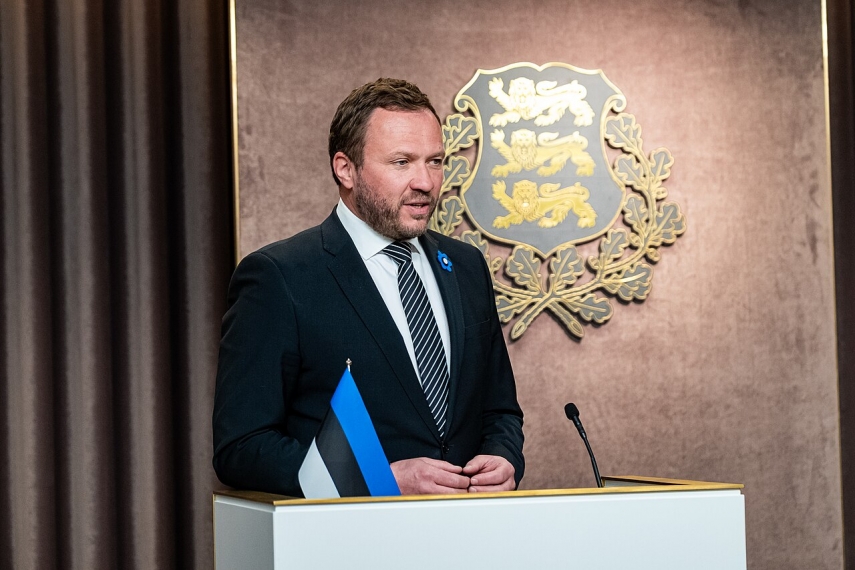
TALLINN - Foreign Minister Margus Tsahkna visited Israel on Tuesday, where he met with Israeli President Isaac Herzog and Foreign Minister Gideon Sa'ar to discuss the latest developments in the Middle East, their connection to European security, and the cooperation between Iran and Russia.
"Long-term stability in the Middle East is important for Estonia, and today's visit during an ongoing and active military conflict is proof of this," Tsahkna said. "The Iranian regime's nuclear and missile program, its support for terrorist groups, its aid to Russia's war of aggression in Ukraine, and its violent behavior towards its own people pose a threat to the security of the region and the world. Therefore, we support the steps taken by the US and Israel aimed at eliminating these threats," the foreign minister said.
According to Tsahkna, the ongoing military conflict in the Middle East has clearly shown how interconnected security is in Europe and the Middle East. "It is also very clear whose side Russia is on and whose side Ukraine is on in this conflict," Tsahkna said.
"Russia's exchange of information on targets or its tactics in drone warfare is something with which Russia supports the Tehran regime in achieving its goals. Ukraine, at the same time, has offered its assistance to both the US and the Gulf countries, including in combating drones," he noted.
"From the above, it is evident that it is in the security interests of both Europe and the Middle East to pressure Russia and support Ukraine," Tsahkna said. He added that he commends Israel for its support to Ukraine and called for that support to be further increased.
The meetings also addressed the impact of the military conflict on the rise in energy prices, which means revenue for Russia's war machine. "We support all steps to ensure maritime security and freedom of navigation. At the same time, it is important to ensure that Russia does not profit from the events in the Middle East and that its state budget revenues do not increase," Tsahkna said.
The situation in Gaza and the West Bank was also discussed. According to Tsahkna, Estonia awaits the launch of the second phase of the Gaza peace plan and the disarmament of Hamas. The foreign minister noted that the security situation in the region continues to be strained by the development of illegal settlements in the West Bank, the destruction of Palestinian property, and settler violence.
"These steps jeopardize the two-state solution, which from Estonia's point of view is the only solution to ensure long-term peace and security in the region for both Israelis and Palestinians," Tsahkna said.
Lebanon was also discussed, where, according to Foreign Minister Tsahkna, Hezbollah's intervention in the military conflict and Israel's counter-attacks are making the situation in the region even more complicated.
"The biggest sufferer here is the Lebanese people. The basis for de-escalating tensions is UN Security Council Resolution 1701, and the European Union has an important role in stabilizing Lebanon," Tsahkna said.
"Today's visit also paves the way for us to continue promoting the bilateral partnership between Estonia and Israel once the international situation stabilizes, primarily in the fields of innovation and cybersecurity, as well as strengthening economic cooperation and collaboration in defense," Tsahkna said.
The foreign minister noted that this year marks the centenary of the Estonian government's decision to grant Jews a cultural autonomy unique in the world, which characterizes the long-standing special relationship between our countries. Estonia has also, over the decades, largely taken inspiration from and learned from the resilience of Israeli society.

Please enter your username and password.

2026 © The Baltic Times /Cookies Policy Privacy Policy