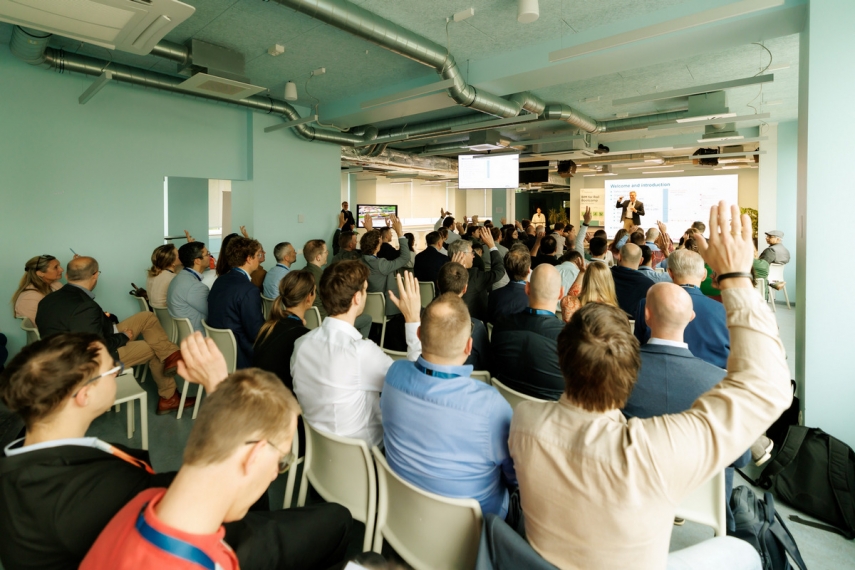
RIGA - Thanks to a strong ecosystem, Latvian IT innovations can stand out at the international level, Foreign Ministry Parliamentary Secretary Artjoms Ursulskis said at the inauguration of a new Delska Latvia data center on Wednesday.
The parliamentary secretary indicated that promoting the development of the Latvian IT sector one of the Foreign Ministry's top priorities.
In cooperation with embassies and the Investment and Development Agency of Latvia (LIAA), work takes place on a daily basis to develop new partnerships and support Latvian companies in strengthening their position in global markets.
Ursulskis stressed that these efforts are bearing fruit. Last year, exports of IT services to Germany grew by 20 percent, which demonstrates Latvia's ability to offer competitive, high-quality, and reliable solutions.
At the same time, Ursulskis said that work on expanding to new markets is continuing, including in North America, Southeast Asia, and other regions where Latvia has been less active in this sector. Although doing business in these markets is tough, Latvian innovations can excel there thanks to the established ecosystem in the country.
Delska Latvia CEO Andris Gailitis noted that the development of data centers has undergone significant changes in recent years. Whereas a decade ago 2-4 kilowatts (kW) per server rack was the norm, the trend is now toward around 200 kW per rack.
He explained that a single rack can now accommodate computing power that previously required an entire server room. This means significantly higher power consumption and increased cooling requirements, which creates new challenges and at the same time increases demand for modern data centers.
Gailitis said that the development of data centers is affected by several factors, including the geopolitical situation. In the current circumstances in Europe, the availability of local computing capacity is becoming increasingly important.
Prime Minister Evika Silina (New Unity) underlined that in today's environment, resilience and digital continuity are critical. The ability to store and protect data is directly linked to both economic stability and national security, and such infrastructure ensures the continued operation of critical systems.
Smart Administration and Regional Development Minister Raimonds Cudars (New Unity) noted that such investments show that digital infrastructure is not just a technological solution but an essential part of the modern economy and the functioning of the state.
Cudars said that digital sovereignty - the ability to make one's own decisions - is increasingly being discussed in Europe and among international partners. This applies to data management, the provision of digital services, and the ability to adapt to a rapidly changing world.
He pointed out that digital sovereignty is not just about declarations. It is built with reliable infrastructure, secure operators, and a clear legal framework.
Latvia is moving toward a model in which public authorities will increasingly rely on certified, secure, and reliable data centers and cloud services, including private sector solutions, Cudars said.
As reported, Delska Latvia has invested EUR 30 million in its new data center.
Delska Latvia pointed out that the new data center is considered one of the most technologically advanced in the Baltics. The 7,100 square meter modular building provides up to 250 kilowatts (kW) per rack and is designed for long-term development, with the possibility to expand the data center complex by up to 30 MW on already acquired land with reserved capacity.
The new data center, like Delska's existing data centers in Latvia and Lithuania, is powered entirely by renewable energy from wind and solar farms in Northern Europe, as well as hydroelectric power. The backup generators run on Neste MY renewable diesel, while the electricity generated during testing and maintenance is redirected to other consumers, thus reducing the environmental impact.
At the same time, Delska Latvia is negotiating with Rigas Siltums on a project to use the data center's heating to heat up to 25 apartment blocks. Such cooperation with the municipality promotes more efficient use of energy resources and is in line with the company's sustainable development goals, the company informs.
The data center is designed and built to achieve a power usage effectiveness (PUE) below 1.3. The data center supports both air and liquid cooling solutions for high-density workloads, as well as for the dedicated GPUs.
The data center project has already achieved Uptime Institute Tier III Design certification last year and is scheduled to be certified as a Tier III Facility in March, certifying that the building meets the same high accessibility standards as its design. In practice, this means that the data center is able to provide at least 99.982 percent of uninterrupted working hours.
In 2024, Delska Latvia had a turnover of EUR 9.776 million, an increase of 7.6 percent compared to 2023, while the company sustained a loss of EUR 613,830. The company's financial results for 2025 have not yet been published.
The company was registered in 1999. Delska Latvia is wholly owned by Baltic Rezo of Lithuania.

Please enter your username and password.

2026 © The Baltic Times /Cookies Policy Privacy Policy