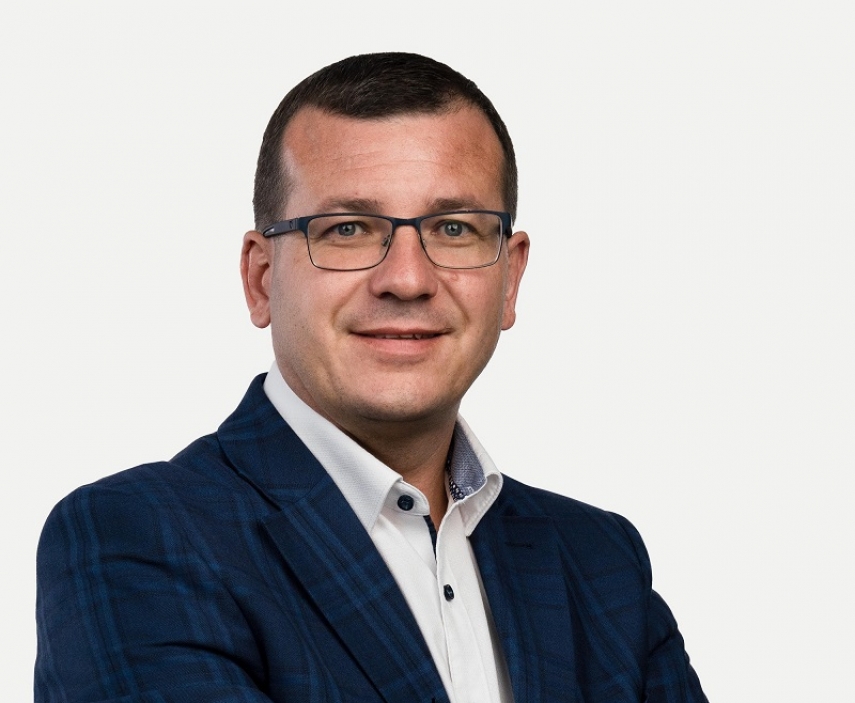
VILNIUS - Lithuanian Defense Minister Robertas Kaunas met with his visiting Danish counterpart Troels Lund Poulsen in Vilnius on Thursday and the two ministers discussed the regional security situation and the agenda for Lithuania's upcoming presidency of the Council of the European Union in 2027, the Defense Ministry reports.
Issues related to strengthening NATO security, air defense, cyber security, and support for Ukraine were also discussed.
When talking about the security situation in the region, the ministers paid a lot of attention to the fight against hybrid attacks.
"Airspace violations targeting airports and military bases show that Europe is facing the same hybrid challenge. In order to ensure Europe's security, it is necessary to implement the EU's Eastern Flank Watch and European Drone Defense Initiative as soon as possible, with adequate funding," Kaunas was quoted as saying in the statement.
The minister thanked Denmark for its significant contribution to the security of NATO's eastern flank as Denmark has already participated eight times in NATO's Baltic Air Policing mission and is also actively contributing to NATO's Multinational Battle Group in Latvia and Operation Eastern Sentry in Poland.
In addition, Danish military officers have led the NATO Force Integration Unit (NFIU) in Lithuania for a decade.
During their meeting, the two ministers also paid a lot of attention to issues related to support for Ukraine. Kaunas thanked Denmark for its participation in the Demining Coalition, co-led by Lithuania and Iceland. According to the ministry, the coalition made significant progress in 2024-2025, successfully training and equipping eight Ukrainian demining battalions and raising 119 million euros in funding for the purchase of necessary demining equipment at the end of last year.
"Lithuania remains committed to contributing to the Coalition of the Willing and deploying forces once a peace agreement or ceasefire is reached. Peacekeeping must be supported by forces with a real deterrent effect and strong air and anti-drone defenses, and the contribution of the United States is important for the success of these efforts," Kaunas pointed out.
The ministers also exchanged experiences in developing joint defense technology production with Ukraine in order to strengthen the defense industries and capabilities of both countries.
During the discussion on Lithuania's upcoming presidency of the Council of the EU, the Lithuanian defense minister learned about Denmark's experience in presiding over the Council in the second half of last year and emphasized that Lithuania would seek to maintain a consistent course of action.
Kaunas noted that Lithuania's agenda would prioritize strengthening the security and defense of the EU and the Euro-Atlantic region by ensuring comprehensive and timely support for Ukraine, sustainable development of the EU defense industry, and adequate defense funding.
In the discussion on strengthening NATO security, according to the ministry, Kaunas stressed the need for Europe to take financial responsibility for strengthening the Alliance, to move from air policing to air defense, and to ensure a significant allied presence in the region.
The minister also said that Lithuania would support greater NATO attention to strengthening security in the High North.
Kaunas also briefed his Danish counterpart on the progress made in hosting the incoming German brigade in Lithuania and the host nation support provided by Lithuania to US soldiers.
Lithuania and Denmark have a long-standing strategic partnership in the field of defense, according to the Defense Ministry. Denmark was Lithuania's first partner in international operations - in 1994-1996, Lithuanian soldiers participated in the first international operation in Croatia as part of the Danish battalion.
"Denmark has contributed significantly to the strengthening of the Lithuanian Armed Forces and the development of the Lithuanian National Defense Volunteer Forces (KASP) by providing early support for the development of the Lithuanian Armed Forces and targeted assistance during the period of preparation and negotiations for EU and NATO membership," the statement said.
Since 1993, the Danish volunteer forces have also been conducting various training courses for KASP volunteers. Danish and Lithuanian soldiers participate in joint exercises.

Please enter your username and password.
2026 © The Baltic Times /Cookies Policy Privacy Policy