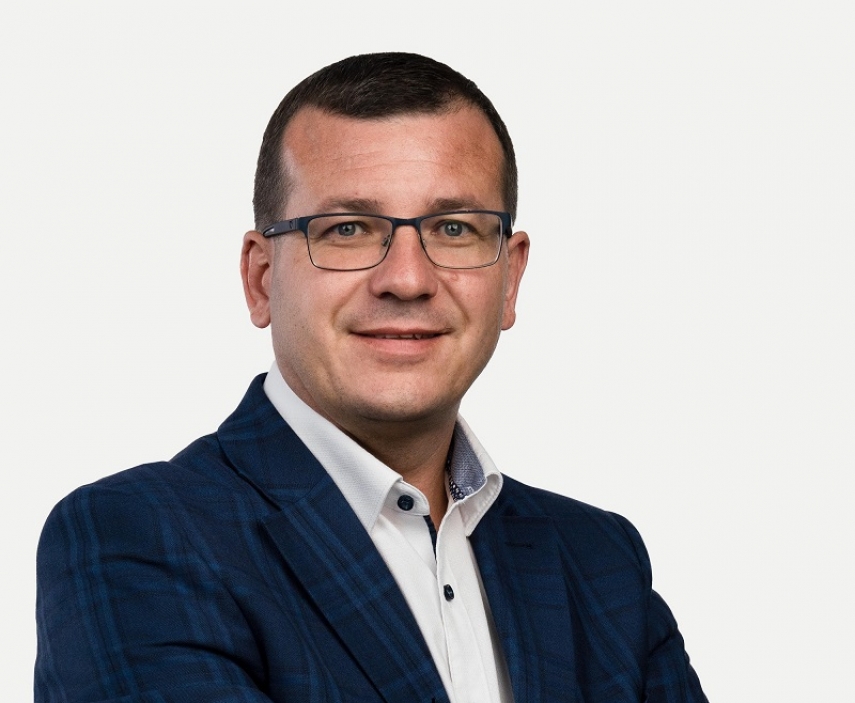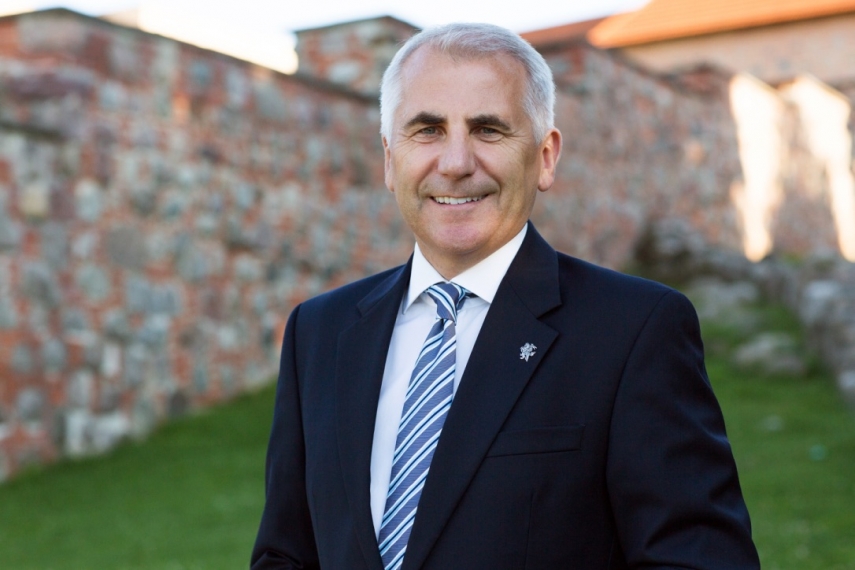
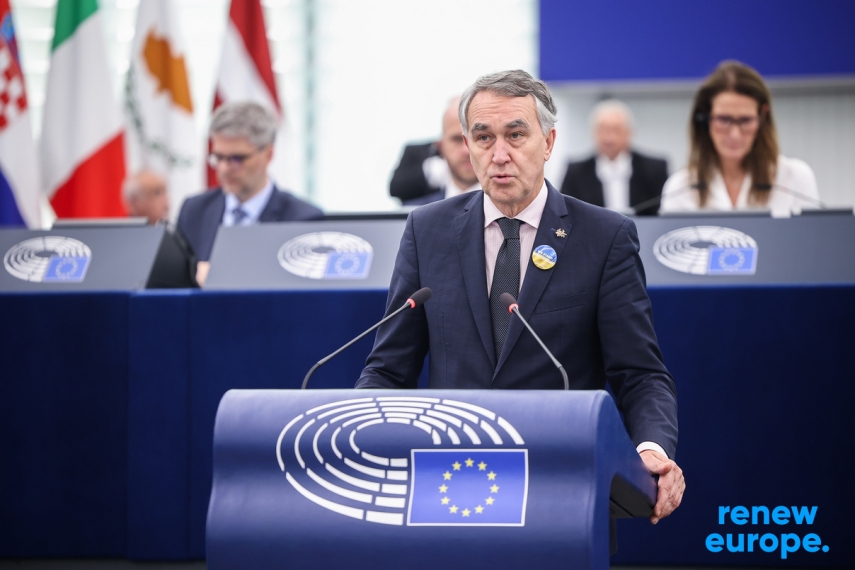
Photo: Lithuanian Liberal MEP Petras Austrevicius represents the Renew Europe group in the European Parliament
During the November session of the European Parliament in Strasbourg, Lithuanian Liberal MEP Petras Austrevicius, who represents the Renew Europe group in the European Parliament for the 2024-2029 term, where he serves as a member of the Committee on Foreign Affairs, the Committee on Security and Defence, and the Subcommittee on Human Rights, held an interview with The Baltic Times Magazine to discuss current issues in European lawmaking and other areas.
The European Union is once again revisiting some of its flagship policy agendas that, only a few years ago, appeared irreversible. The Green Deal, in particular, was long framed as a point of no return. Yet today, several of these assumed “irreversibilities” are being reconsidered. This raises a fundamental question: did policy move faster than reality? Were certain objectives more declarative than substantiated? Or are external political pressures, including shifts in the United States, playing a decisive role?
I keep maintaining that Europe’s Green Course remains an inevitability if we all want to live in peace with Mother Nature. If we fail to live more sustainably and keep living at its expense – it is still very generous to all of us – we may end up in a very precarious situation, marked by environmental catastrophes, a shortage of natural resources, and so on.
You were perhaps the only Baltic euro-parliamentarian who criticized the European People’s Party (EPP) (the largest, center-right political group in the European Parliament – TBT) for its votes together with the EP radicals in favour of the so-called “Omnibus” changes, which refer to several EU laws simplifying and adjusting the Green Deal, ESG, and reporting requirements. Why did you bring this up?
Because we have a precedent when an established, largest EP faction unites with anti-systemic EP factions. However, I understand that by doing that the EPP fulfilled its electoral pledge (the EP elections took place in 2024 – TBT) to be “pro-business”. I agree, though, that the European Union decided to rid itself of internal combustion engines too prematurely – especially given that modern ones are quite state-of-the-art and sustainable (at the end of 2025, reports emerged that the EU would repeal the plan to completely phase out internal combustion engines by 2035 and would look for a more realistic and less harmful way to reduce emissions – TBT).
Digital governance represents another evolving policy frontier. Towards the end of 2025, proposals emerged within the European Parliament to monitor private online communications using artificial intelligence, prompting both support and strong criticism. During the plenary session, the Parliament adopted a non-binding resolution calling for stricter rules on teenagers’ use of social media. Although the resolution does not alter EU law, it sends a clear political signal to consider digital safeguards. What is your take on this?
Indeed, debates of this kind are viewed differently on the EP floor. However, as a liberal, I also stand for stricter monitoring of the digital space. Lately, we see entire new AI-based (media) systems and platforms popping up in the digital space that have nothing to do with free speech – they operate in a manipulative, misleading way and care only about money-making and exerting political influence.
We need to admit that the biggest social media platforms have become states within states – with little regulation and oversight. Access to information is the EU’s core value, but if we do not apply the brakes now, preventing disinformation, we may doom our electorates, democracies, and ourselves. Yet I believe we are still at an early stage in the quest to protect our societies and our data in the digital age from multiple manipulators.
How important is the first European Defence Industry Programme (EDIP) that was deliberated and adopted at the EP Strasbourg session in November?
The European Defence Industry Programme (EDIP) represents the EU’s first coordinated attempt to strengthen defence industrial cooperation. Although its 1.5-billion-euro budget is modest, EDIP aims to improve interoperability, encourage joint procurement, and prioritise Europe-made defence systems. The war in Ukraine has exposed Europe’s long-standing reliance on arms exports rather than comprehensive defence readiness.
While EDIP is a belated step, it signals a shift toward a shared understanding of threats and collective defence needs. Nevertheless, Europe’s security architecture continues to rely heavily on transatlantic cooperation, a dependency complicated by growing uncertainty in US foreign policy.
I hope we can do our homework – fully understanding the threats and the importance.
It seems that the European Union did not have much – especially at the beginning – to say when, in the autumn, Belarus started sending Vilnius-bound contraband-laden balloons, disrupting air traffic in Lithuania, causing damage and denting our international reputation.
Hybrid threats further underscore Europe’s vulnerabilities. The Belarusian regime’s use of contraband-laden balloons targeting Lithuania represents yet another tactic in an evolving hybrid conflict. With Belarus willing to exploit unconventional methods, our preparedness must extend beyond traditional military frameworks. Ukraine’s battlefield experience offers valuable lessons in countering such threats, particularly in drone warfare and AI-enabled defence systems. As adversaries rapidly expand their technological capabilities, Europe must accelerate its own innovation efforts to avoid strategic lag.
What would be your response to those who say that Ukraine’s surrender of around 20 percent of its territory occupied now by Russia is inevitable, and that by prolonging the war Europe risks being engaged in a direct war with Russia?
The war in Ukraine remains central to Europe’s security calculus. Any scenario involving territorial concessions would not only undermine Ukraine’s sovereignty but also destabilise Europe by creating a persistent grey zone of insecurity at its borders. Such an outcome would ultimately demand even greater defence spending across the continent. While authoritarian regimes can rapidly regenerate military capacity with little regard for human cost – we see that in Russia, the conflict’s trajectory is not predetermined. Ukraine’s experience highlights both the adaptability of its adversary and the urgency of sustained European support.
When will the EU move from the often-crippling unanimous voting system in passing important decisions to a mathematical majority system, which you said over a year ago is in the making?
I still believe that it is inevitable, especially considering the further expansion of the European Union (as of the end of 2025, there are nine recognised candidate countries for EU membership, and six of them are actively negotiating accession – i.e. they have open membership talks with the EU – TBT).
We see that institutional reform within the EU is becoming increasingly difficult to postpone. The vote unanimity requirement in key decision-making processes is widely viewed as an obstacle to timely and effective action – be it the expansion or the war (in December 2025, the European Union agreed to indefinitely freeze about 210 billion euros of Russian central bank assets held in EU territory. This decision was based on an emergency clause in the EU treaties (Article 122) that only required a qualified majority, not unanimity, to adopt the measure – TBT)
With further EU enlargement on the horizon, pressure to shift toward qualified majority voting will intensify. While such reforms may not be imposed as accession conditions, proposals for limited or phased membership, granting market access without voting rights, are already under discussion. In an era of heightened geopolitical tension, the EU’s ability to act decisively may prove as critical as the policies it adopts.


Please enter your username and password.

2026 © The Baltic Times /Cookies Policy Privacy Policy