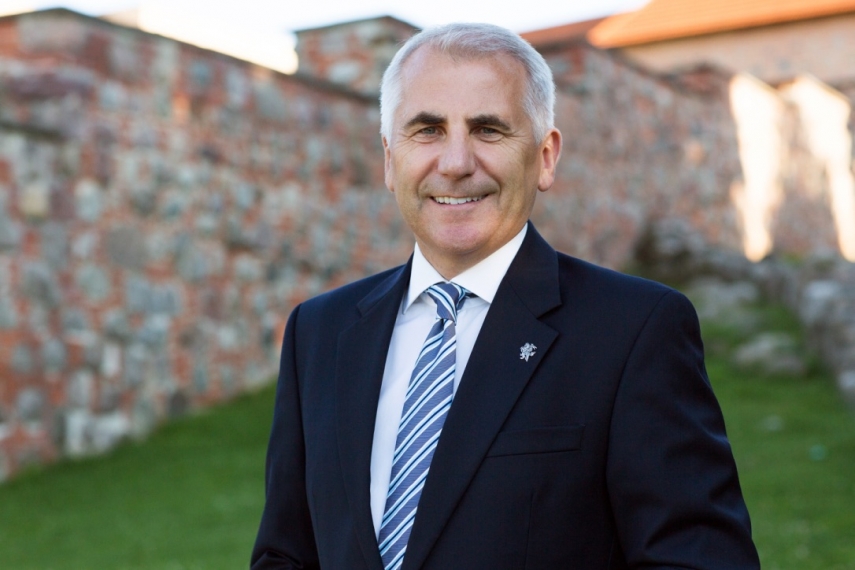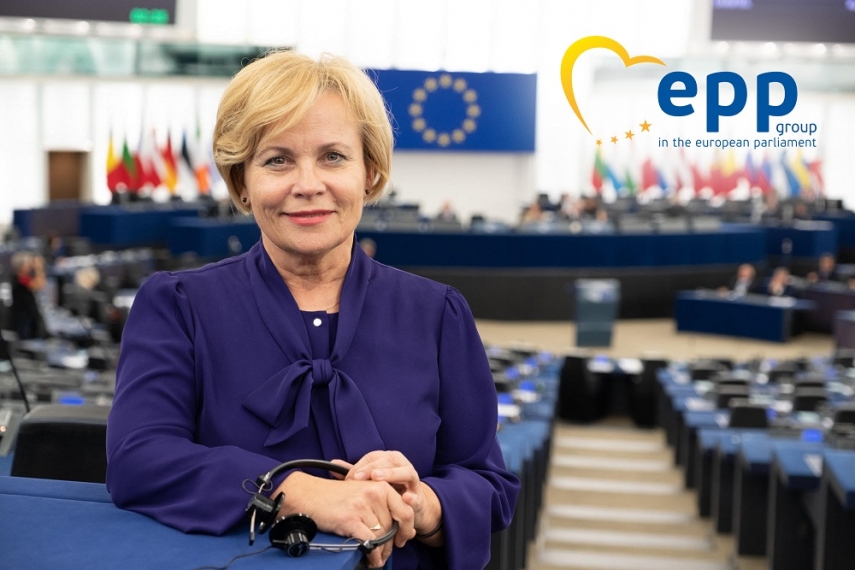
Rasa Jukneviciene is a Lithuanian Member of the European Parliament representing the European People’s Party (Christian Democrats)
As war continues to rage in Ukraine, and Europe suffers from war-fatigue amid the re-emergence of radicalism across the Atlantic, Rasa Jukneviciene, Member of the European Parliament and former Lithuanian defence minister, is convinced that the EU’s expansion – and the Nato muscle growth are key. “The EU enlargement would come along with a security element – for all, including the three Baltic countries,” Jukneviciene told The Baltic Times Magazine.
Do you believe the European Union’s liberal democracy is in danger? My impression in Brussels is that fewer use the terms in the European institutions – an observation shared by your Lithuanian fellow Euro-parliamentarian too.
It is an unexpected observation to me, to be honest with you.
I did not notice that. In fact, speaking in the context of the war in Ukraine, since its beginning nearly four years ago, all politicians of goodwill spoke that it was a war of autocracies against democracies. I am not even sure that we should use the word “liberal” – to me, there is one democracy. It is Putin who coined democracy with pejorative connotations.
To me, the main underpinnings of democracy – rule of law, freedom of speech, and human rights – all of which are firmly embedded in the EU Accession Agreement – by Lithuania, too – were, have been, and will be what a democracy is all about and by what a democracy will be assessed.
I’d say that, in the European Parliament, lawmakers who are committed to democratic values came together to defend the principles they felt were under threat — the very principles that have defined Europe for years.
Yet, I have to admit: our democracy is being challenged not only internally but externally too.
You need to admit the diminishing influence of the bloc. Do you think that the green light for EU membership for as many as six countries now aspiring to it will strengthen the European Union or make it weaker due to the efficient governance issue?
Undoubtedly, the memberships would strengthen it.
In terms of our security, the expansion with no grey (security) zones left is key. Both the economic and the geopolitical importance are equally important; however, amid the war, it is the latter that emerges as particularly important. Putin was enabled by the European Union and NATO to intrude into Ukraine because it was left by both in the grey zone – up for grabs, figuratively speaking.
And he acted accordingly – alas, unlike here in Lithuania and the Baltics, far from everyone in Brussels – and elsewhere – understood that.
I am glad that Marta Kos, who serves as Commissioner for Enlargement in the Commission led by Ursula von der Leyen now, supports the EU expansion, emphasizing that, along with preparedness and meeting all the membership criteria, the security element of the enlarged bloc is equally important.
As this interview takes place in late October, shortly after two Russian military jets intruded into Lithuanian airspace and air balloons as well as drones from Belarus did the same, disrupting air traffic, wreaking havoc and spreading fear – let me ask this: does Lithuania have adequate measures to respond properly? Would invoking NATO’s Article 4 be the right thing to do? According to Politico, NATO leadership was reportedly irritated by a similar attempt by Estonia after its airspace was violated by Russian jets three times, arguing that such intrusions did not warrant an all-NATO response.
In this case, I am not as much concerned about the NATO Article 4 invocation as about the rhetoric of my homeland Lithuania’s top officials, like, for example, that of the new chairman of the parliamentary National Security and Defence Committee, who, instead of an investigation, rushed to excuse the provocation, calling the incident “unintentional.” To me, that reflects the position of the current Lithuanian government, part of which is the radical, Russia-friendly party (The Dawn of the River Neman – TBT).
I’m afraid that what is happening in Lithuania right now is truly a Kremlin dream.
The mere fact that Lithuania has been effectively switched off from the EU and NATO context – that it is no longer heard, no longer the one to formulate clear messages and serve as a moral and value-based compass for others – is a huge victory for the Kremlin.
The political and diplomatic line of defense is the very first one – no less important than the dragon’s teeth (physical defense or fortifications – TBT). Unfortunately, the weakest link currently of Lithuanian defense is political.
In fact, regarding the mentioned incidents, we heard very bold, to-the-point assessments both from the German Chancellor Friedrich Merz and the Polish Defence Minister Władysław Kosiniak-Kamysz.
Undoubtedly, Russia is testing the Baltic and NATO overall. What do you believe could be Russia’s move next?
It is hard to say.
It always acts when it sees a grey security patch – anywhere on the map. Putin does not draw a red line for himself and his Russia. Much depends on the general geopolitical situation. Unfortunately, we have lately been hearing very dubious or even alarming messages from the United States and its President (Donald Trump – TBT). The key ally we relied on for decades has become much less predictable, particularly in dealing with Russia’s war in Ukraine.
Looking long-term, the outcome of the war will be defining for years to come – regionally and much more broadly. Certainly, Ukraine’s full victory, which looks unlikely, along with its EU membership, would suit our European interests best. Anything in between, like a truce, procrastination of Ukraine’s EU membership, or insufficient US engagement in security affairs in Europe, may lead to the situation the world saw after 1938. The worst scenario for us is Ukraine’s defeat.
In the short term, considering the United States’ lesser involvement in European defense, I see a lot of risks related to that – especially that here in Europe we just started investing more into our defense and are far from building a necessary defense mechanism, one involving Great Britain and other non-EU countries.
Do you see the recent US sanctions against the major Russian oil refineries and exporters as a signal of the White House’s change in the soft stance against Russia until now?
Although belatedly, it is action, not words. The fact that Putin himself – not through his subservient officials, like Dmitri Medvedev (a former Russian Prime Minister and President – TBT) – reacted to it says a lot. Although very important, the sanctions are not enough in deterring Putin from murdering Ukrainians.
Many analysts counted on Russia’s flailing economy’s inability to handle the war-related costs, which proved wrong. Can it be that the West underestimated Russia before February 2022, when the war broke out? Do you see mistakes in approaching Russia?
On the contrary, I believe the West overestimated Russia – unlike Ukraine, got too scared of it. Berlin then was a whole lot more different – intimidated – than the Merz-led Berlin now.
Yet, following the quick-victory plan that Russia was boasting of with its troops near Kiev in the beginning of the war, the European Union – and the other democratic countries – coalesced their support for Ukraine – militarily, financially, and otherwise, something Putin clearly did not expect. If not for the support, Ukraine may not be on the map by now.
However, the understanding that it is not enough and that the democratic world needs to overcome Russia to avoid more disasters ahead is missing – unfortunately.
Speaking of the mistakes, one of the biggest was when the Ukrainians managed to drive out Russian troops from Kharkov and Cherson, the then US Joe Biden administration failed to seize the opportunity and back up Ukraine with the necessary armory – was spooked by Putin’s rattling of the nuclear arsenal.
Andrius Kubilius, who is currently serving as the European Commissioner for Defence and Space in the European Commission (2024–2029) and whose defence minister you were in his Lithuanian government from 2008 to 2012, has warned that Russia is preparing for a war against NATO. Are you taking this warning with a grain of salt?
I absolutely agree with the prediction. In fact, I spoke about that as the Lithuanian defense minister during 2008–2012 – with Kubilius, too. Then, Putin thought that he “owned” Ukraine – through the pro-Kremlin Ukrainian president Viktor Yanukovych (2010–February 2014; ousted after dozens of protesters were killed following his decision to suspend a planned EU Association Agreement, choosing closer ties with Russia – TBT), testing the Baltics and NATO along the way. This is something top-echelon officials confirmed to me in the Pentagon in 2012. But it was Ukraine and its sacrifice – Russia annexed Crimea in 2014 – that salvaged us, making Russia switch from the larger plan A – rebuilding its empire – to plan B, focusing on Ukraine. As a result, NATO and the Baltics have ramped up their defense accordingly. Yet, the leopard does not change its spots – it is the West, the European Union, us, the Balts, who are in his eyes next after Ukraine.
You serve as Vice-Chair of the EP’s Euronest Parliamentary Assembly delegation and visited Armenia recently. How do you assess its progress on the EU path? And is Sakartvelo already a lost case?
It seems that Armenia is becoming the leader of hope in the South Caucasus, while Georgia – I do not dare to call it Sakartvelo anymore (the name “Georgia” carries a legacy of Russian and Soviet influence, while “Sakartvelo” is the country’s native name and is associated with an independent, democratic nation – TBT)
Let’s say it clearly: its ruling party “Georgian Dream” will not return to the European path. It is a Kremlin-aligned regime. No wonder that “Georgian Dream” is now being called by Georgians themselves “Kremlin Dream.”
Georgian Dream may be a lost cause – uninterested in returning to the European path – but Sakartvelo is not. Its people are fighting, and we have not done enough to support them.

Please enter your username and password.

2026 © The Baltic Times /Cookies Policy Privacy Policy