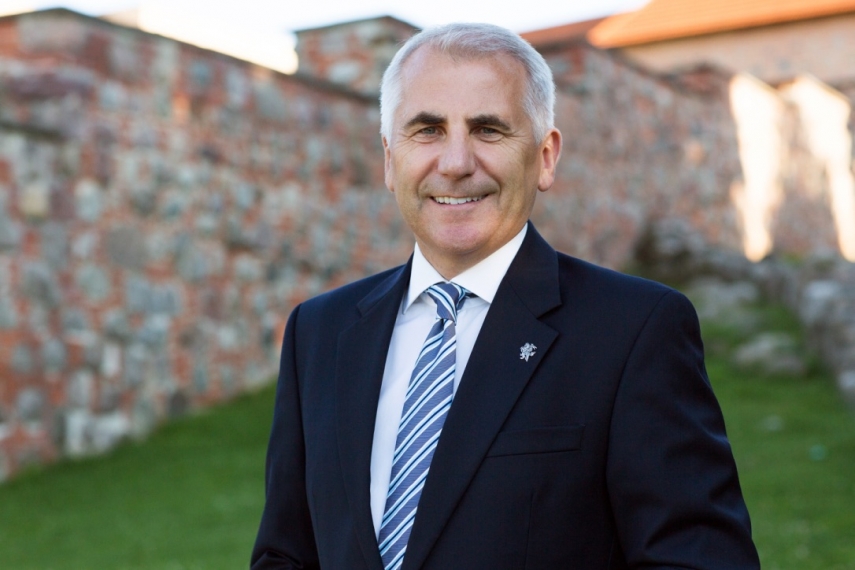
VILNIUS - The European Union should have reacted more swiftly to the offensive launched by the United States and Israel against Iran, Lithuanian foreign minister Kestutis Budrys said.
He added that the bloc should cooperate with Washington to achieve long-term changes in the Middle East.
"Regarding the speed of the European Union's reaction, I also had comments for my colleagues yesterday. We are too slow, and the coordination of all our positions and statements takes too long. That must be acknowledged. We could have reacted faster," the minister told reporters on Monday.
EU foreign ministers held urgent talks on Sunday. During these talks, according to Budrys, a joint statement from the 27 member states was agreed upon, the main points of which reflect Lithuania’s position.
The statement condemns Iran’s retaliatory strikes, expresses political solidarity with the Gulf states, and offers condolences for those killed in the attacks.
The United States and Israel launched an unprecedented offensive against Iran over the weekend, reportedly killing several hundred people. US President Donald Trump said he took these actions because Iran continued to develop its nuclear program and plans to build missiles capable of reaching U.S. territory.
Iran’s Supreme Leader Ayatollah Ali Khamenei, who had ruled the country since 1989, was killed in the attacks.
Budrys said that diplomatic efforts to compel Tehran to halt its nuclear program have failed.
"We see that the US and Israel, by carrying out these attacks, have not yet achieved their stated goals, as they themselves have defined them. That is, to completely prevent Iran from continuing its nuclear program or supporting favorable regimes or terrorist organizations in the region," he said.
The minister stressed that the EU must clearly define its strategic interest, which he identified as the elimination of a regime in the Middle East that poses an existential threat to Israel.
"Our interest should be to cooperate with the United States to achieve long-term changes in the region, and in our assessment and conviction, we can do this while adhering as much as possible to international law," the Lithuanian foreign minister said.
"Another dictator has fallen, another regime has been weakened. The harm caused by the regime to our security is not only through direct means but also through support for Russia. This sends a very strong message to all dictators that nothing is eternal," he added.

Please enter your username and password.

2026 © The Baltic Times /Cookies Policy Privacy Policy