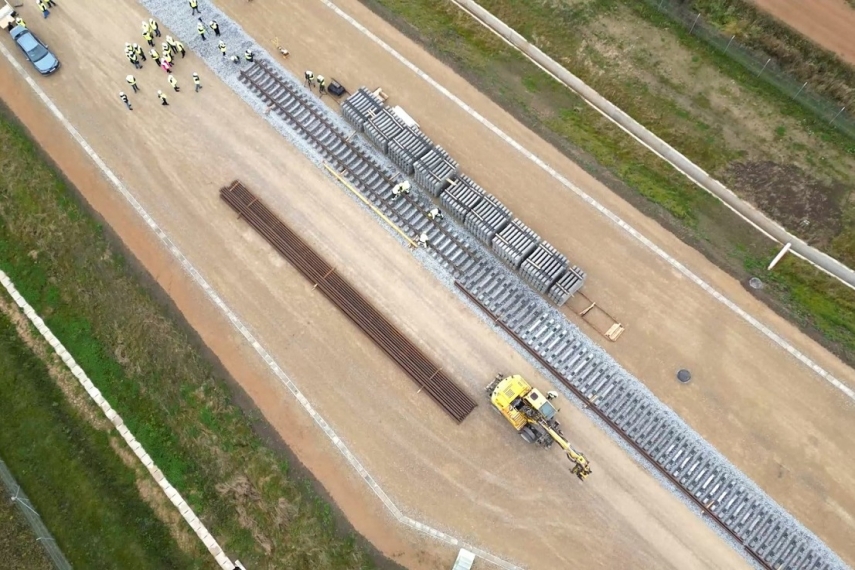
VILNIUS - The European Union could reach an agreement this year on establishing a common military mobility area, Rimantas Sinkevicius, chairman of the Lithuanian parliament's Committee on National Security and Defense (CNSD), said on Wednesday.
"Drawing on years of experience, the European Union has recognized the need to harmonize the movement of military units across the bloc to create a 'military Schengen.' (...). That is why the European Commission has launched an initiative to boost and align military mobility, so that member states, their military units and any military assistance required by a member state can move with as few obstacles as possible," Sinkevicius told BNS.
"Such a regulation will likely be adopted (...) and the legal framework for crossing national borders without hindrance will be put in place (...). I believe this will be done this year. So we could have a 'military Schengen' in place as early as this year," he added.
Sinkevicius spoke after Wednesday's meeting of the CNSD, which reviewed the EU's military mobility initiatives and related projects being implemented in Lithuania.
According to the lawmaker, the committee was informed that currently, military units must obtain permits to cross a member state's border, and issuing them can take anywhere from several days up to 45 days.
In late January, the Baltic defense ministers agreed to create a joint military mobility area. Defense Minister Robertas Kaunas said at the time that the agreement would allow Lithuanian military assets, if necessary, to move freely to defend Riga, Estonian artillery to support Vilnius and Latvian capabilities to back up Tallinn, and vice versa.
The 3B Military Mobility Area project was launched in 2023 under NATO coordination to ensure the smooth and uninterrupted movement of military forces, with the long-term goal of creating an integrated military mobility area spanning all of Europe.
The CNSD chairman said that smooth military mobility requires appropriate infrastructure.
"This includes railways, roads, bridges and other infrastructure. In the previous financial period, the European Union allocated 1.7 billion euros for military mobility, and 17 billion euros are now planned," he said.
EU Budget Commissioner Piotr Serafin has also said funding for military mobility projects from a dedicated fund will increase tenfold.
He said it remains unclear how much Lithuania could receive under the instrument, as this would depend on the strength of its arguments and the specific projects submitted.
The new EU budget will cover the period from 2028 to 2034.

Please enter your username and password.


2026 © The Baltic Times /Cookies Policy Privacy Policy