Photo: StenSalumets
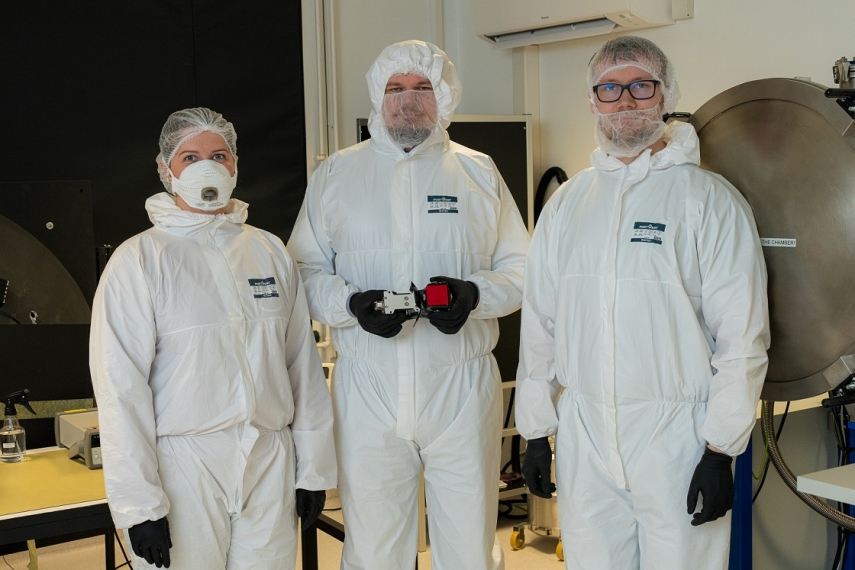
At the Tartu Observatory of the University of Tartu, the optical periscopic imager for comets OPIC was completed and handed over to the European Space Agency (ESA) this week. The camera system was developed over eight years and forms part of ESA’s deep-space mission Comet Interceptor.
According to the Minister of Economic Affairs and Industry Erkki Keldo, the completion of OPIC marks an important milestone in the development of Estonia’s space industry. “I am proud that a camera for a deep-space mission has been built in southern Estonia. It shows that Estonia has the knowledge, the courage and the enterprise to contribute to major European space missions,” said Keldo.
Head of the Department of Space Technology at Tartu Observatory, Associate Professor in Space Technology Mihkel Pajusalu noted that it is remarkable that scientists from an independent Estonia have been participating in an ESA science mission for the first time from the very beginning: from the initial concept to the construction of a flight-ready camera. OPIC is the first space instrument developed in Estonia for a deep-space mission in accordance with stringent ESA requirements. Developing this kind of equipment demands quality and reliability standards that only a limited number of companies worldwide can meet.
“We began developing the mission concept with other European planetary scientists in 2018. The initial goal of the mission is to capture, for the first time in history, a comet originating from the Öpik-Oort Cloud as it enters the inner Solar System. It carries material that has remained unchanged for 4.6 billion years. We hope to obtain unique information about the formation of the Solar System – including our planet – and the building blocks of life,” Pajusalu explained. When the probes are already in space, it may be possible, with a bit of luck, to study asteroids or comets originating from another planetary system, such as 1I/ʻOumuamua or 3I/ATLAS.
The mission consists of a primary spacecraft and two probes, B1 and B2. OPIC will be installed on probe B2 alongside instruments from other European partners, and it will undergo additional testing before launch. The camera will be sent to the Sun–Earth Lagrange point L2 in late 2028 or early 2029. Located 1.5 million kilometres from Earth, L2 is one of the most important deep-space observation points. The spacecraft can remain in a stable position there under the combined gravitational influence of the Earth and the Sun, waiting for the moment to begin studying a comet.
“The camera must make decisions independently and extremely quickly in deep space – this is what makes OPIC technologically distinctive. Our task is to capture a comet travelling at up to 80 km/s. As it approaches, the primary spacecraft will send the probes onto a collision course with the comet. They will pass the comet at extremely high speed and at very close range. The Estonian camera on probe B2 will get closest to the comet and photograph it from a distance of 300 kilometres, which in space terms is virtually a stone’s throw,” Pajusalu described.
As real-time communication with Earth is not possible in deep space, the camera will operate autonomously, deciding which images are scientifically valuable and transmitting them back to Earth.
Madis Võõras, Head of the Estonian Space Office, said that Estonia’s participation in an ESA space mission with a locally developed camera is highly significant. “It demonstrates our researchers’ and entrepreneurs’ capability to create space-qualified hardware. OPIC has already opened doors to participation in new space projects worldwide.”
More than 20 people at Tartu Observatory were involved in the OPIC project. The hardware was manufactured by Crystalspace, an Estonian space industry company, which was also responsible for componentmanufacturability and verified the reliability of the device’s software. Other developers included Estonian companies Protolab, ECCOM, Metrosert, Radius Machining, Insero, Metric, Difrotec, Artec Design,Krakul, and the Latvian company Bitlake Technologies. The total cost of the project has so far reached approximately five million euros. The project is funded by the European Space Agency and the Estonian state.

Please enter your username and password.

2026 © The Baltic Times /Cookies Policy Privacy Policy