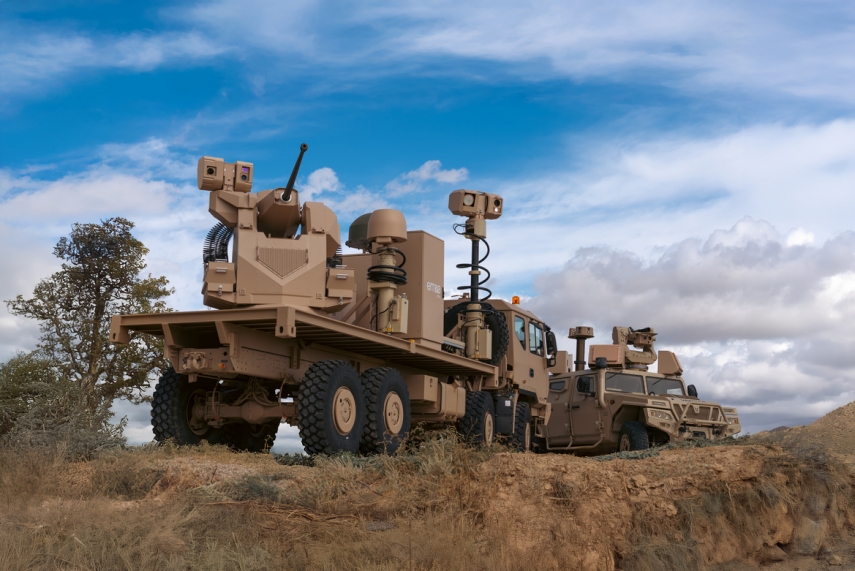
The company's anti-drone solutions integrate threat detection, tracking, and neutralization in a scalable configuration, from tactical mobile platforms to fixed permanent surveillance installations.
The sustained increase in unmanned threats in military operations and hybrid warfare scenarios has elevated anti-drone capabilities to the rank of strategic needs for the armed forces. In the context of border protection, EM&E Group, a Spanish company dedicated to the development of advanced technology for defence and security, has articulated a proposal for C-UAS capabilities that combines modularity, scalability and interoperability to respond to the diversity of current operational requirements.
A technology ecosystem with no integration restrictions
The command and control system is at the core of the architecture. Its function is to centralize and process the information from the different sensors to generate a unified operational image and facilitate decision-making in real time. By merging data, it optimizes detection, identification, and tracking functions, reducing response times. Also, thanks to the integration of artificial intelligence (AI), the command and control system allows for automatic classification of threats, speeding up decision-making by the operator.
Once the threat previously detected by radars and electro-optical sensors has been assessed, the response can be divided into two lines of action. On the one hand, soft kill neutralization is activated by electronic countermeasures aimed at inhibiting radio frequency signals and satellite positioning, which interrupts the aircraft link in a clean and controlled manner. On the other hand, for the most critical scenarios that require kinetic or hard-kill efficiency, EM&E Group has its remote weapon stations, optimized for physical downing. In this sense, the company has different highly effective stations for the neutralization of drones. First of all, the GUARDIAN 2.0 is a solution that integrates a thermal camera, day camera and laser rangefinder in a lightweight and modular structure, with the possibility of integrating different cannons (M2, M240, MG3, MG4, MK-19, M230 and M134D). Second, the SENTINEL 30 combines a 30mm Mk44S Bushmaster cannon with ballistic tracking and calculation systems to improve accuracy in neutralizing targets.
Three configurations for different scenarios
The ODIN family groups three operational variants designed to cover the full spectrum of deployment situations:
- ODIN-I is a vehicle-mounted tactical solution with multi-sensor and multi-effector architecture, aimed at defense-in-depth operations and the protection of temporary infrastructures.
- ODIN-L is aimed at short-range, rapid deployment and high-mobility defence operations for the protection of temporary infrastructures and deployed troops
- ODIN-S, a fixed station configuration solution designed for continuous protection and continuous surveillance against unmanned threats.
The complementarity between these three modalities makes the ODIN system a versatile reference within the catalog of C-UAS configurations available in the European market.

Please enter your username and password.

2026 © The Baltic Times /Cookies Policy Privacy Policy