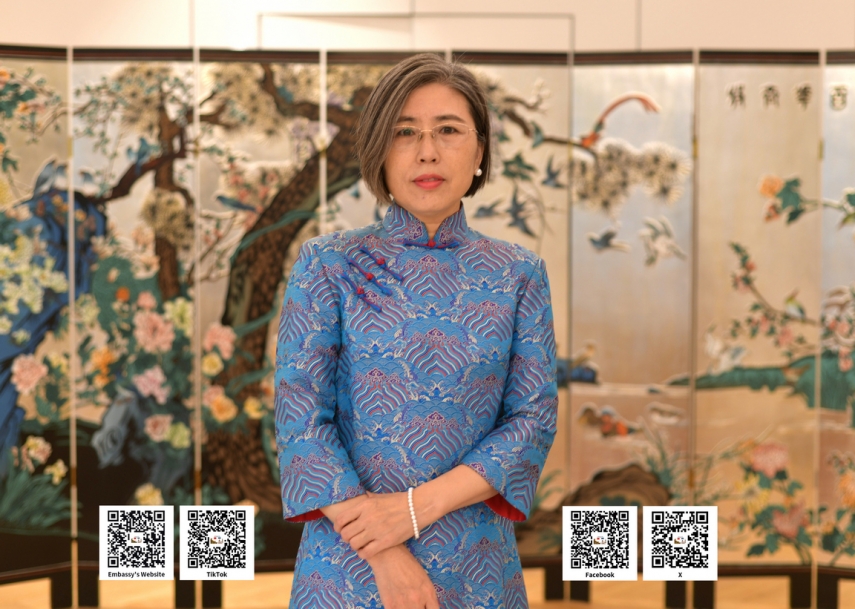
Photo: Guo Xiaomei is the Extraordinary and Plenipotentiary Ambassador of the People’s Republic of China to Estonia
China–EU relations stand at a pivotal moment as both sides navigate a shifting geopolitical and economic landscape. Yet small countries like Estonia have a real chance to be heard and respected in the future, said Guo Xiaomei, the Extraordinary and Plenipotentiary Ambassador of the People’s Republic of China to Estonia, who assumed the post in September 2023, in an interview with The Baltic Times Magazine.
“There are almost 200 countries in the world and the vast majority small or medium-sized like Estonia. They can play a significant role in shaping the international order. Yet, as the world enters a multipolar era, the tone of this engagement will help define a more just and equitable global governance,” Guo Xiaomei emphasised.
Where do you believe China–EU relations are headed? Where do you see the downsides of the EU’s emerging new approach toward China – the so-called policy of “de-risking, not decoupling”?
China always regards the EU as a comprehensive strategic partner and an important, independent pole in a multipolar world. Over the past 50 years, China–EU cooperation has yielded fruitful results, benefiting nearly two billion people and contributing to global peace and prosperity.
There are indeed differences and challenges to be addressed. However, we do not believe that the so-called policy of “de-risking” is the right approach, as it is not in line with the trend of openness and win-win cooperation. In our view, failure to cooperate is the greatest risk, and failure to develop is the greatest insecurity. To exclude or contain China in the name of “de-risking” is to create, rather than reduce, risks.
For the future of China–EU relations, President Xi Jinping’s three proposals provide guidance: first, upholding mutual respect to reinforce the partnership; second, upholding openness and cooperation to manage differences and frictions; and third, upholding multilateralism to safeguard international rules and order.
While in Europe there are still forces promoting so-called “de-risking,” more and more people realise that value bias and an overly security-oriented perspective when dealing with China are not in line with reality and will damage Europe’s own interests. I believe that with joint effort, China–EU relations will stay on the right track and have a brighter future.
The EU Chamber in China has warned of a sharp rise in Chinese exports to Europe, partly driven by US tariffs pushing Chinese firms to redirect supply chains toward the EU. What new trends do you see emerging in bilateral trade? What comes next for China–EU economic relations?
I believe the EU has no need to worry about the so-called trade diversion, because data does not support the conclusion of such a sharp rise caused by the decline in China’s exports to the US. This year from January to September, China’s exports to the EU increased by 9.2 percent year-on-year. This figure is only 2.1 percentage points higher than the overall growth of China’s exports, and significantly lower than the 16.2 percent decline of its exports to the US.
The size of China–EU trade is the result of their large economic scales and respective market demands. While China runs a goods-trade surplus with the EU, it has a services-trade deficit. Nearly 40 percent of exports by EU companies in China are shipped back to Europe, bringing profits to Europe. This indicates that China–EU trade cooperation is dynamically balanced and mutually beneficial.
I am confident about the future of cooperation as long as both sides adhere to an open and win-win mindset. China has a population of over 1.4 billion, with more than 400 million middle-income earners, and is growing as the world’s largest consumer market. The economic transformation and upgrading in China will also create significant opportunities.
Several analyses argue that China is becoming more active in Europe’s so-called “grey-zone” or hybrid-warfare domain – through cyber operations, influence campaigns and interference with critical infrastructure. These are also among the worries expressed by Baltic policymakers. How would you address such concerns?
These so-called “analyses” are based on unfounded speculation. It is like measuring other people’s corn by one’s own bushel.
According to our Constitution, when developing bilateral relations with other countries, China observes the five principles of mutual respect for sovereignty and territorial integrity, mutual non-aggression, mutual non-interference in internal affairs, equality and mutual benefit, and peaceful coexistence. Obviously, the so-called hybrid warfare is not consistent with China’s foreign policy.
In the first half of 2025, Estonia’s trade in goods with China reached about €510 million, representing a 10.4 per cent year-on-year increase. How do you interpret this growth? Can you mention an Estonian business that could be seen as exemplary in using China’s huge economic potential?
The growth momentum demonstrates the strong vitality and resilience of bilateral economic and trade exchanges. It also reflects the robust mutual market demands of our two countries as well as proactive, mutually beneficial cooperation between our enterprises. I warmly welcome it. Recently, two protocols were signed on wild aquatic and dairy products exported from Estonia to China. These agreements expand access for high-quality Estonian agricultural products to the Chinese market, which are welcomed by Estonian companies. We expect more Estonian businesses to seize the opportunities presented by China’s market.
What would be your advice to the Estonian government and parliament when it comes to managing relations with China?
China was one of the earliest countries to establish diplomatic relations with Estonia after it restored its independence in 1991. Almost 35 years have passed – no matter how far we go, we should never forget where we started. The commitments made in the Joint Communiqué on the establishment of diplomatic relations remain the guiding principles of bilateral ties. For China, the Taiwan question is still the core concern. Estonia has made its commitments in the Joint Communiqué, which should be honoured by both the Estonian government and parliament.
In November 2023, Estonia revised its China policy to allow Taiwan to open a non-diplomatic economic or cultural representative office under the name “Taipei” in Tallinn. Although Estonia’s government stressed it would not recognise Taiwan as a country and would adhere to the One-China policy, do you think opening such an office would still cross a red line for Beijing?
In the above-mentioned Joint Communiqué, Estonia “recognises the government of the People’s Republic of China as the sole legal government of China and Taiwan as an inalienable part of Chinese territory,” and “undertakes the obligation not to establish formal, official relations of any form with Taiwan.”
Opening such an office in Tallinn, regardless of its name, will breach this commitment. It will undermine China’s sovereignty and territorial integrity, violate the One-China principle and result in serious consequences. This position has been conveyed to the Estonian side clearly and consistently.
The One-China principle, reaffirmed by UNGA Resolution 2758 adopted at its 26th session in 1971, is a basic norm in international relations, an established international consensus and the political foundation on which China establishes and develops bilateral relations with other countries.
Visitors to China often marvel at its “green” transport and technological advances. How does China balance environmental ambition with economic performance?
The philosophy China upholds in development is “innovative, coordinated, green, open and shared,” making “green” the defining feature of economic growth. The Chinese people believe that human development must respect and protect nature; otherwise, nature will retaliate. President Xi Jinping has stated that “lucid waters and lush mountains are invaluable assets,” and that protecting the environment means protecting and enhancing productive forces.
China’s experience shows that innovation is key. Over the past decade, it sustained about 6 per cent annual economic growth with only 3.2 per cent growth in energy consumption. China leads the world in installed capacity of hydro, wind and solar power – one in every three kilowatt-hours generated is green electricity. By June 2025, China’s stock of new-energy vehicles reached 36.89 million, supported by 16.7 million charging units – both the highest globally.
China and Europe share common goals in green development and have vast potential for cooperation. According to the International Renewable Energy Agency, China has helped reduce global construction costs for wind power and solar PV by over 60 per cent and 80 per cent respectively in the past decade.
Where do you see China – and the world – in the year 2125?
I really am not a 算命先生 (“Fate Calculator”). Although I will not exist then, I believe the world in 2125 will be far closer to an open, inclusive, clean and beautiful world of lasting peace, universal security and shared prosperity – a vision to be realised through collective effort.
To that end, President Xi Jinping has proposed the Global Development, Security, Civilization and Governance Initiatives (GDI, GSI, GCI and GGI). Each addresses a distinct dimension of global challenges while complementing one another, aligning with the UN Charter’s purposes and principles. Together, they aim to inject stability and certainty into a turbulent world and advance a community with a shared future for humanity.
As the representative of the world’s most populous country, what would be your advice to a small nation like Estonia on how to survive geopolitical headwinds?
There are almost 200 countries in the world, the vast majority small or medium-sized. They can play a significant role in shaping the international order.
The Global Governance Initiative proposed by China meets the interests of smaller countries in particular. It calls on all nations to uphold sovereign equality, international rule of law, multilateralism and a people-centred approach. It helps promote a fairer global governance system where all countries, regardless of size or wealth, can participate and benefit as equals.

Please enter your username and password.

2026 © The Baltic Times /Cookies Policy Privacy Policy