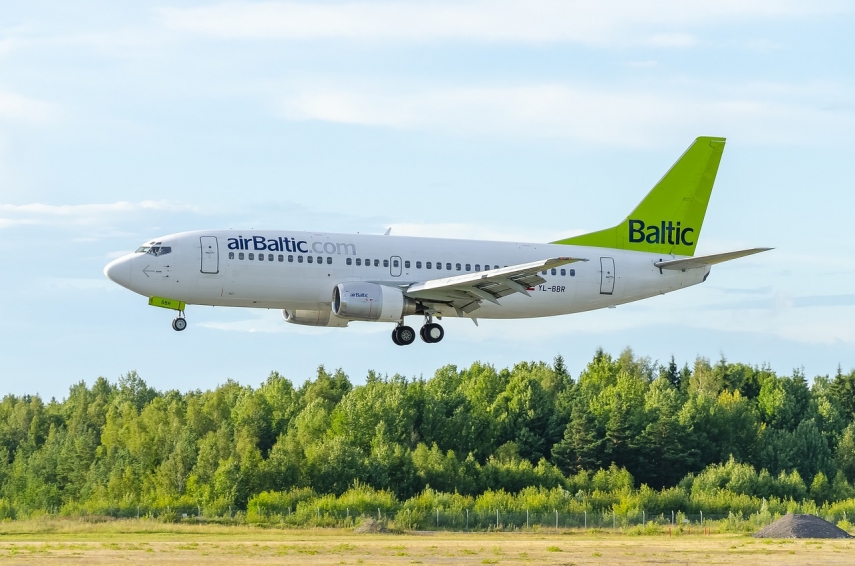
RIGA - Pauls Calitis, Chief Operating Officer (COO) and a member of the Management Board of Latvia's national carrier airBaltic, has decided to quit his job at the company, the airline informed LETA.
Calitis' last day at airBaltic will be April 30, 2026.
Robbert Strating, Senior Vice President of Flight Operations at airBaltic, who has been with airBaltic since January 2025 and has extensive international aviation experience, will assume the role of Chief Operating Officer as of May 1.
The company's Management Board will thus be comprised of two members: Chief Executive Officer Erno Hilden and Chief Financial Officer Vitolds Jakovlevs.
airBaltic informs that the Supervisory Board will assess the future composition of the Management Board, taking into account the continuity of the company's operations, risk management and financial needs, in order to ensure the best solution for the company. The company also mentions that it is continuing to review its operational performance, improve its financial results and strengthen its capital structure.
Andrejs Martinovs, Chairman of the airBaltic Supervisory Board, said that the airline's priority is to ensure the sustainability of airBaltic's operations, which means making prudent decisions on the company's structure and costs. "The operational transition has been handled professionally and responsibly," he said.
As reported, the Transport Ministry indicated that external factors such as the conflict in the Middle East, rising fuel prices and the suspension of certain routes have had a significant impact on airBaltic's costs, and the airline needs a EUR 30 million loan to ensure the company's stable operations until the implementation of its new business plan.
However, the Saeima Budget and Finance (Taxation) Committee did not approve the decision because of objections raised by the Union of Greens and Farmers. The Saeima committee will revisit the issue on April 14.
As reported, airBaltic's losses last year amounted to EUR 44.337 million, which is 2.7 times less than in 2024. Last year, airBaltic's turnover increased by 4.2 percent compared to 2024 and amounted to EUR 779.344 million.
In 2025, the airline carried a total of 5.2 million passengers on its route network, an increase of 1 percent compared to 2024.
At the end of August last year, German national airline Lufthansa became a shareholder in airBaltic. Currently, the Latvian state owns 88.37 percent of airBaltic shares, Lufthansa - 10 percent, financial investor Aircraft Leasing 1, owned by Danish businessman Lars Thuesen - 1.62 percent, and other shareholders - 0.01 percent. The company's share capital is EUR 41.819 million.
After the initial public offering (IPO) of airBaltic shares, the size of Lufthansa's stake will be determined by the potential IPO market price. The transaction also provides that Lufthansa will own at least 5 percent of airBaltic's capital after the potential IPO.
On August 30, 2024, the Latvian government agreed that the state should retain at least 25 percent plus one share in airBaltic's capital after the IPO. On August 19, 2025, the government decided that Latvia, like Germany's Lufthansa, would make a co-investment of EUR 14 million in airBaltic ahead of a potential IPO.
However, given the 2025 financial results and market conditions, airBaltic has suspended its planned IPO and does not currently view it as a potential source of capital for 2026, according to airBaltic’s annual report.
The report indicates that, despite the expected improvement in operational and commercial performance, the airline will operate with a negative free cash flow in 2026, and, based on current forecasts, management expects that an additional capital injection of EUR 100 to 150 million will be required to finance operations for the 2026/2027 winter season.
Svinka has noted that an IPO is not the only way to raise capital, and the airline’s management has been given the broadest possible mandate to seek opportunities to raise capital using various financial instruments. Thus, the airline’s goal for 2026 is not only to reduce costs but also to raise capital.

Please enter your username and password.

2026 © The Baltic Times /Cookies Policy Privacy Policy