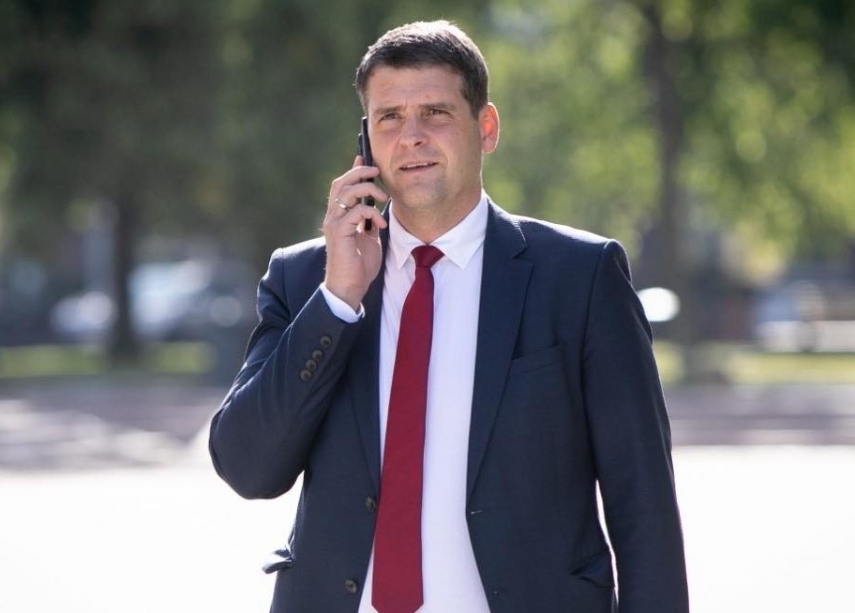
In a deeply polarised political climate – and Lithuania’s is no exception – The Baltic Times, the Baltics’ longest-enduring English-language publication, defending the necessity of listening rather than cancelling, sat down with Remigijus Zemaitaitis, chairman of Lithuania’s ruling – yet, to some, controversial – party ‘The Dawn of the River Neman’, which garnered 186,305 votes (ca. 15% of the vote) in the 2024 parliamentary election, forming the ruling coalition with the Social Democrats (SD, 19.4% of the vote), the leading coalition party, and the Farmers and Greens Union (7%).
‘The Dawn of the River Neman’, together with the Social Democratic Party (SD), is a very unlikely tandem for many. The century-old party, SD, and ‘The Dawn of the River Neman’, a political novice – furthermore, a radical party in many eyes. What keeps you together? Only hands on power? Do you believe the coalition can last the entire term – i.e. four years?
Indeed, our party is the newcomer in the country’s political life, but many of our members have been in politics for years – some over 20 years. For example, our Raimundas Sukys has been in politics since 1994, Arturas Skardzius – 28 years, both are among the country’s most seasoned politicians. I have been in politics for 26 years.
The mainstream opposition parties tend to stick various labels to “The Dawn of the River Neman”, but, in fact, to remind all, I myself have been in coalition with the SD two times – as part of the ‘Order and Justice’ party – in 2012-2016 – in fact, I was chair of Lithuania’s NATO delegation then, which allowed me to get to know some top-tier persons in the bloc – and, before that, in 2004-2008.
And during 2007-2009, our Juozas Imbrasas was mayor of Vilnius, while Gintautas Paluckas, a rising star of the SD then (PM Paluckas resigned in July 2025 because of mounting scandals over his business dealings, which led to investigations – TBT), was the director of the Vilnius municipality administration.
So, the coalition parties, although ours under the new name – “The Dawn of the River Neman” – do share a history of joint work. I sincerely believe we, as the current coalition, can last the whole term.
However, that said, if I see the endless, often biased and unbased accusations – and, furthermore, the systemic, destructive effort to derail it and wipe out our party from the political arena, just because we raise issues that have been swept under the carpet – I mean, for example, making the KGB (Soviet intelligence) collaborator list public – by the opposition parties, our patience can run out.
in fact, the Homeland Union, the main opposition party now, is just another Lithuanian liberal party, having nothing to do with true conservatism – the one that disdains President Donald Trump.
Do you believe Russia can attack the Baltic states? What do you make of the widely discussed timelines suggesting that a possible Russian attack may come sooner rather than later? And if Day X were ever to come – God forbid – what might an incursion look like?
Look, no one – including the NATO Secretary General Mark Rutte – has taken a glimpse into Putin’s notebook. Being ready – always ready – is wise, but the ongoing warmongering serves the war industry, which we often nicely call defence.
Please not that, one day, Rutte mocks Russia, describing Russian battlefield progress as “a garden snail’s”, and warns of its imminent danger the other day. So which Rutte is genuinely sincere?
The previous NATO SG, Jens Stoltenberg, whom I had a chance to know in person, was much more consistent and avoided 180-degree swings in rhetoric of the kind.
To answer your question, looking ahead, I do not see Russia invading an EU member state – specifically a Baltic country – in the next 10 years for a simple reason – Russia is seeing a shortage of manpower on the frontlines in Ukraine, so, with the war still ongoing, any new aggression would badly deplete the forces in Ukraine, where it needs them badly.
Yet no one can write off the Russian army, which used the war in Ukraine to advance Russia militarily, scaling up significantly conscription, the technology of armaments and the defence budget.
Unfortunately, European troops have not fought on a real battlefield for years, a clear disadvantage. We clearly see that, in Western Europe, with societal, leftist-agenda-driven shifts towards non-militaristic, pacifist states, recruiting is getting increasingly problematic. No wonder that Germany, as reported by credible German news outlets, is struggling with filling up its ~5,000-strong heavy combat brigade in Lithuania.
I have no doubt that, sooner or later, NATO member states’ 5-percent defence commitment will start cracking up. In fact, we are seeing it now – no wonder that Donald Trump has promised action against non-compliance.
To answer the last part of your question – what aggression against us would look like – it’s quite clear: we would face full-blown drone warfare, bolstered by other air capabilities. Not tanks or “green little men” (refers to armed soldiers in green uniforms without insignia – TBT). When Lithuanian opposition leaders talk about “dragon’s teeth” and digging bunkers as a pre-emptive measure to counter hostile troops or tanks, I can’t help but laugh. Guys, get a grip on reality.
The development of war in Ukraine showed clearly that drones – more sophisticated, powerful and harder to detect – are the next stage of warfare.
Instead of immediately focusing on a massive anti-drone system installation (in an incident in March, a strayed Ukrainian drone crashed in southern Lithuania, with the military failing to detect it – TBT), we are too much focusing military training ground in Kapciamiestis on the Lithuanian-Polish border (at the end of March, the Seimas, the Parliament of Lithuania, approved the project in its first reading: 102 MPs voted in favour, 10 MPs, including Remigijus Zemaitaitis, voted against, and 6 abstained – TBT).
It is Israel that we should look to as a North Star, emulating its defence principles, air defence included. Israel’s air-defence systems have been able to intercept the vast majority of Iranian “Shahed” drones and other aerial threats.
As you know, recently, Estonian president Alar Karis suggested that territorial concessions by Ukraine might be necessary in peace negotiations with Russia and spoke in favour of diplomacy with Moscow, while urging further support for Ukraine. The remarks triggered backlash and even outrage. Do you agree with the Estonian leader?
In fact, I do. And I respect him for what he said, as he was aware of what firestorm his words would set off. Unfortunately, with Trump trying to negotiate peace talks – with both sides making concessions – all that the European Union, and Lithuania, have to say is this: “We want more war, more guns, more death.” Very unwise.
The calculation of the West to start the war was that Russia, with the US in it, would end up losing it, with Ukraine becoming a NATO member state – and us here becoming even safer, which Russia saw as an existential threat. Likewise, the Americans were not happy in 1962, when the Soviet Union secretly deployed nuclear missiles to Cuba, only about 150 km from Florida.
To answer your question, I always believe that talking is better than not talking. Even in this situation – the Estonian president said what is on the lips of many European leaders.
To remind, the French president, Emmanuel Macron, has acknowledged that dialogue with Russia might eventually be necessary, but only while maintaining sanctions and strong support for Ukraine. Italy’s PM Giorgia Meloni has also indicated that Europe should keep diplomatic channels open with Moscow while still supporting Ukraine.
Most recently, so did the Belgian Prime Minister Bart De Wever, let alone Hungary’s Prime Minister Viktor Orbán. So, to use the language of the Lithuanian opposition, all of them are “vatniks”, aren’t they (“vatnik”, a slang political term used on the internet and in Eastern Europe to describe a person who strongly supports Russian government propaganda, especially regarding the war in Ukraine – TBT).
Of course, we need to speak to Belarus. After the United States recently lifted some sanctions against it, we are still acting like the ostrich – as if nothing happened, a very wrong and harmful approach. With Belarusian fertilizer export money bypassing us, Lithuania is continuing losing millions of euros. With EU sanctions in effect, they supplement the Russian budget – as Russian Baltic Sea ports handle the cargo.
We need to speak to Belarus for a very practical reason – we share a nearly 700-kilometre border, and we need at least to attempt to partly outweigh the influence of Russia, an empire – it has always been such.
As individual EU member states increasingly hint at talks with Russia, we may end up talking to it as part of the EU bloc – in a setting or format yet to be agreed upon. Personally, I believe the European Union should have appointed a special envoy, or envoys, to Russia – some of whom could have represented different EU regions, including ours.
What are your concerns about Ukraine?
I am afraid that, every day, Ukraine is sinking into a deeper hole – to an extent where processes inside the country – I mean widespread corruption and the eradication of opposition – can be more dangerous than external threats. I am afraid that, with Russia holding an upper hand – militarily and economically – all it has to do is wait to outlast Ukraine. Unfortunately, the EU has been flailing to demonstrate real unity for Ukraine – look, both France and Germany have retained significant trade volumes with Russia since the outbreak of the war.
Why does “The Dawn of the River Neman” seek to make the KGB collaborator lists public?
I’ve submitted the draft already three times in the Seimas. No wonder that the opposition parties do all they can to derail our effort – I believe we still have former KGB collaborators in our Parliament, our law enforcement, and elsewhere. I see no other reason than to hide them by the organizations they represent as to why Lithuania has not done it yet. Estonia did it right after it proclaimed restoration of independence in 1991, and Latvia made the KGB collaborator materials public in late 2018. Meanwhile, Lithuania, which has most of them, balks. Nonsense!
Why does the coalition, and especially your party, seek to change how the country’s public broadcaster LRT is governed? Something to which the EBU, Council of Europe, and European Media Freedom Act (EMFA) reacted, warning that the strive is aiming to diminish its independence.
The bodies you mentioned reacted politically, overlooking – no doubt, purposely – the unfavourable findings of Lithuania’s State Audit and the Special Investigation Service, such as misuse of public funding, irregularities in all examined programme purchases, and favouring content producers who run their own media companies and support mainstream parties throughout.
Let us veer off from the domestic politics. Looking at the wider picture, Donald Trump’s second presidential term in the White House and his quest to ‘reverse’ the United States and the world back to what he calls the ‘right track’ – Christian values – do you believe this is feasible, considering that left-leaning newsrooms abundantly prevail in the West, let alone the social media giants? To what extent is the ‘reversing’ acceptable to you?
To me, there are several layers of President Donald Trump. His slogan ‘Make America great again’ is the most known; however, what you just brought up is widely omitted by many.
Indeed, Trump perceives well that, without Christianity and the values that America and the entire West have been built on, it is impossible to continue managing the country and “good-policing” the world.
He clearly understands that leftists are the world destroyers – which I totally agree with.
I am not saying that all migrants are bad people, but let’s face it: migrants change the language, the culture and the traditions. However, importantly, they have changed – or are changing – the voter base and the representation in the local legislatures, shifting the cultural balance into an imbalance.
Ironically, we are seeing that in America itself – I mean the rise and of the Muslim New York City mayor, Zohran Mamdani (the first Muslim mayor in NYC history – TBT). And we have more “firsts” of the kind – like the 2022–2024 UK Prime Minister Rishi Sunak with Indian roots. Then we have Sadiq Khan, the current Mayor of London, of Pakistani origin. And that is happening elsewhere in Europe.
Trump clearly pointed to the dangers related to Europe’s shift from its Christian roots which, according to him, destroys the (European) heritage. I cannot agree more with him on this.
Do you think Lithuania now finds itself between, so to speak, two stools – heeding what Trump has to say and what the European Union tells it? Irritating either of them is certainly not in Lithuania’s best interests, is it?
Neither. Both sides have their agendas which – let’s admit it – are not always in line with ours. I deeply believe that Lithuania must be more itself, i.e. Lithuania – what makes it unique and, thence, wanted.
Speaking illustratively, Lithuania must avoid a position in which it expects others’ treatment as of a princess. It needs to be a shrewd and hard-working mouse – one that can, unnoticed, with the cat purring, eyes closed on the homeowner’s chest, open the fridge door and sneak away with a slice of the cheese.
Despite the criticism of your party and you personally, you remain one of the country’s most popular politicians. No doubt, your long-term task is much bigger and more challenging than being in the 2024–2028 ruling coalition. You seek to establish an enduring radical right-wing party, one resembling Jarosław Kaczyński’s Law and Justice (Prawo i Sprawiedliwość – PiS) in Poland, Viktor Orbán’s Fidesz in Budapest, or EKRE in Estonia, do you not?
It is an uneasy task, considering how much pressure, even ostracizing and demonizing, the “Dawn of the River Neman” and I, its leader, are seeing daily – often without a reason. Just because we often go against the grain, just because we do not favour political correctness and we do raise issues, and tackle them, omitted by the other mainstream parties.
For a new party, having members enrolled in it in large numbers is not easy at all. I really do not want people to think of us as a one-election-cycle political project, a sort of Messiah, who roughed up the feathers of the mainstream parties and disappeared. As of now, we have a little over 3250 party members.
As I make rounds throughout the country, meeting people and explaining things from the horse’s mouth, defusing the abundant myths and stereotypes about our party, I meet many people who express support for us, which gives me hope that “The Dawn of the River Neman” can become Lithuania’s real right-wing party – one that cares for what makes statehood – our language, culture and national identity. Alas, much of that has been lost in Western Europe.

Please enter your username and password.

2026 © The Baltic Times /Cookies Policy Privacy Policy