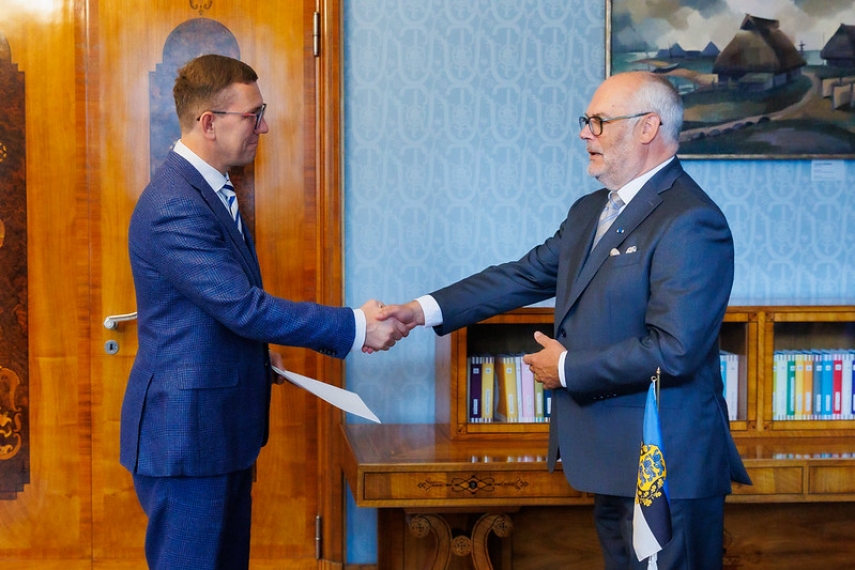

SPECIAL DELIVERY: Diene's reports were submitted at the UN Human Rights Council
NEW YORK 's The United Nations Human Rights Council (UNHCR) has delivered a shopping list of recommendations to the Baltic states to address what it believes are serious problems of discrimination and racism.
On 19 March during the 7th Session of the UN Human Rights Council, the snappily-titled UN Special Rapporteur on contemporary forms of racism, racial discrimination, xenophobia and related intolerance, Doudou Diène, submitted reports on all three countries.
The Senegalese bureaucrat visited the Baltic states from 16 to 28 September 2007, and has managed to produce well over 60 pages of problems, analysis and recommendations as a result, though large chunks of text are reproduced verbatim in the 'individual' reports about each country. A line about each nation being "at a turning point in its history" seems to be a particular favourite and some of the recommendations are state-the-obvious iterations that discrimination should not be encouraged but inclusiveness should.
However, Diene does also identify things individual to each country, particularly concerned with language, citizenship issues among ethnic Russians and serious job and educational discrimination against Roma people.
Some of his recommendations will be controversial 's particularly in Latvia, where he hints at the use of Russian in an official capacity in parts of the country with a Russian majority.
The Baltic Times has read all three reports and summarises the main points below:
ESTONIA
Though praising Estonia's legal framework, the report states: "The Special Rapporteur also found a number of areas of concern, primarily concerning three distinct communities in Estonia: the Russian-speaking minority, the Roma community and non-European migrants. The main concerns of the Russian-speaking community are directly related to statelessness, which predominantly affects this group, and the country's language policy, which is seen as an attempt to suppress the usage of Russian. Despite its small size, the Roma community in Estonia, as elsewhere in Europe, suffers mostly from structural discrimination, precarious education and marginalization. Lastly, non-European minorities have experienced a surge in racist violence, particularly by extremist groups and intolerance by some individuals concerning their ethnic, religious and cultural diversity. Although each of these communities faces different types of problems, a truly long-term solution can only be achieved by focusing on the promotion of multiculturalism and respect of diversity."
Russian groups Diene spoke with told him that "statelessness remains a central problem that mostly affects the Russian-speaking community. They highlighted that although the overall citizenship application procedures have been facilitated, they still pose problems to a number of vulnerable groups. The cost of language courses in Estonian was seen as a major obstacle for the economically marginalized segments of the population. The reimbursement of the expenses with language courses was not seen as helpful, since it only applies after the exam and covers exclusively candidates that are successful in the language examinations. The Special Rapporteur was informed that many candidates need to take the exam more than once, which entails an even higher cost. The situation of Russian-speaking elders was also considered as vulnerable, since the majority of people within this group have difficulties in terms of language instruction."
Diene said he was "particularly impressed" by a roundtable meeting he had with community groups in the Russian-majority Ida Virumaa region.
"The members of the Roundtable demonstrate a profound understanding of intercommunity relations, making a deliberate 's and appropriate 's choice for a process of multicultural integration… The fact that this experience takes place in a region largely inhabited by the Russian-speaking community shows the potential of inter-community relations as a means to foster tolerance and understanding." the report says.
His recommendations for Estonia include a demand that "The Government should establish a broad process of consultation with a view to reducing the gap in historical perceptions between the Estonian and Russian-speaking communities," and a belief that "The language policy in Estonia should be subject to an open and inclusive debate, in close consultation with ethnic minorities, aimed at finding strategies that better reflect the multilingual character of Estonian society."
LATVIA
Latvia gets an even more serious examination from Diene, who expresses concern that "A grave indicator of the increase in racism and discrimination mentioned by civil society interlocutors was the mounting number of racially motivated crimes committed in the past years. This included a surge in incitement to racial, ethnic and religious hatred, often fuelled by politicians from extremist parties."
Latvian legislation is described as "severely deficient in terms of responding to hate speech and racially motivated crimes," and an amendment approved by the Saeima in 2006 to include racism as an aggravating factor in criminal acts is considered "incomplete and overly general."
The report continues to say that: "Members of the Russian-speaking communities expressed the view that the most important form of discrimination in Latvia originates not in society, but rather in State institutions, in the form of the existing citizenship policy. The large number of stateless persons - 392,000 at present - was pointed out as evidence of discrimination on the basis of denial of citizenship rights."
"Apart from the problem of citizenship, the Russian-speaking communities highlighted concerns over language policy in Latvia, in terms of language requirements for naturalization, regulations on the use of non-official languages in public and private life and the role of language in education. One of the main reasons that was raised as an explanation for the decline in the rate of naturalization was the language requirement in the naturalization exam, which is seen as strict by representatives of the Russian-speaking communities. In particular, although the Government has sponsored some language instruction courses for non-citizens, free-of-charge Latvian language classes in preparation for the naturalization exam are seen as a fundamental step to positively encourage more applications for citizenship, particularly of marginalized members of the Russian-speaking communities."
Diene wades even further into the controversial question of the use of the Russian language and ends up backing changes in Latvian law that would see Russian used in an official capacity and grant passports to ethnic Russians automatically.
"Insofar as citizenship regulations are concerned, the Government should revisit the existing requirements for naturalization with the objective of facilitating the granting of citizenship to non-citizens and implementing the commitments established by the 1961 Convention on the Reduction of Statelessness. In particular, the Government should consider appropriate measures to tackle the problem of the low level of registration as citizens of children born in Latvia after 21 August 1991 to non-citizen parents. These measures could include granting automatic citizenship at birth, without a requirement of registration by the parents, to those children born to non-citizen parents who do not acquire any other nationality. The Government should also relax naturalization requirements, in particular language proficiency exams, for elderly persons. Additionally, the granting of voting rights in local elections for non-citizens who are long-term residents of Latvia should be considered by the Government and the subject of broad discussion within Latvian society," Diene recommends.
However, he also notes that "Latvian society has a history of tolerance, muticulturalism and openness to distinct cultures," that should be a major element in tackling modern-day discrimination.
LITHUANIA
Though he includes many common concerns in his coverage of Lithuania, the UN man's main focus shifts to Roma people living in the country.
During his visit, he reports that "he noted with concern the profound discrimination faced by the Roma community, particularly in the fields of employment, education and housing." Non-European minorities have also faced growing problems in terms of racist violence as well as hate speech.
"The Special Rapporteur visited the largest Roma settlement in Lithuania (Kirtimai), in the outskirts of Vilnius, to receive first-hand information concerning the situation of the Roma community. During his visit to the Roma settlement, the Special Rapporteur noted the precarity of living conditions, especially housing, to which the community is exposed. In particular, he noted the lack of electricity and heating as well as drinking water and sanitation in many houses, reportedly due to an inability of some families to pay the fees for public utilities. These families often have to rely on firewood as a source of heating, which is subsidized by the municipal authorities. Some of the dwellings are also overcrowded, with several families living together."
But it wasn't all gloom and doom, as "The Special Rapporteur noted with interest that one of the most popular singers in Lithuania today is a Roma. Although Roma communities in Europe have historically found in music one of the few avenues for expression and broad participation in society, which has not had a meaningful impact on the reversal of their marginalization and exclusion, the Special Rapporteur expressed his conviction that the success of a Roma musician as a national symbol in mainstream popular music in Lithuania could be an opportunity for authorities, society at large and the Roma community to deepen this expression of acceptance of diversity and engage in a profound discussion aimed at fostering new opportunities for educational, cultural and professional inclusion of Roma within Lithuanian society."
In non-UN speak, the fact that people like gypsy music suggests that they can also like gypsies.
However, Diene believes that "The Roma community in Lithuania, as in many European countries, is a particularly vulnerable group, and subject to profound discrimination - not sanctioned by laws, but deeply rooted in the minds of many citizens."
His Lithuanian recommendations include strengthening the Criminal Code to include making "committing an offence with a racist motivation or aim an aggravating circumstance" and the strengthening of the Office of the Ombudsperson on Equal Opportunities.
In a somewhat unexpected sudden jump he also recommends that "As an integral part of the focus on new minorities, the Government should engage in efforts to prevent the emergence of Islamophobia as well as discrimination and prejudice against other religions, particularly those that were not historically present in Lithuania."

Please enter your username and password.
2024 © The Baltic Times /Cookies Policy