Photo: Baiba Galviņa
Latvian companies are increasingly finding that their growth ambitions are constrained not by a lack of investment or access to technology, but by a shortage of skilled people. This is a ticking time bomb for industries that depend on specialised knowledge and highly qualified professionals. According to forecasts by Latvia's Ministry of Economics, the country could face a shortage of more than 800 specialists in chemistry and chemical technology by 2030.¹ This raises a rather uncomfortable question – who will work in the companies whose development we are investing millions in today? We can modernise production facilities, introduce automated equipment and develop new products, but without people who know how to work with these technologies, much of that investment will fail to deliver its potential.
Competition for talent is no longer limited to companies within Latvia. Young professionals have the opportunity to choose employers and pursue careers abroad. Employers must therefore think beyond attracting young people into technical professions – they also need to give them compelling reasons to build their careers in Latvia. Drawing on my experience in pharmaceutical manufacturing, I see five areas where employers can make a real difference.
1. You Don't Always Have to Find Skilled Specialists – You Can Develop Them
One of the labour market's great contradictions is that companies look for people with specific qualifications and experience while simultaneously acknowledging that such professionals are in short supply. If every employer waits for fully trained specialists to appear, the problem will never be solved. We need to change our approach – looking not only at what people already know, but also at what they have the potential to learn.
The pharmaceutical industry is highly regulated, and employees must master specialised processes, documentation requirements and the principles of Good Manufacturing Practice (GMP). Yet many professional skills simply cannot be learned in a classroom. They are developed on the job, working with specific equipment under the guidance of experienced colleagues. But what happens when qualified specialists are simply not available on the labour market?
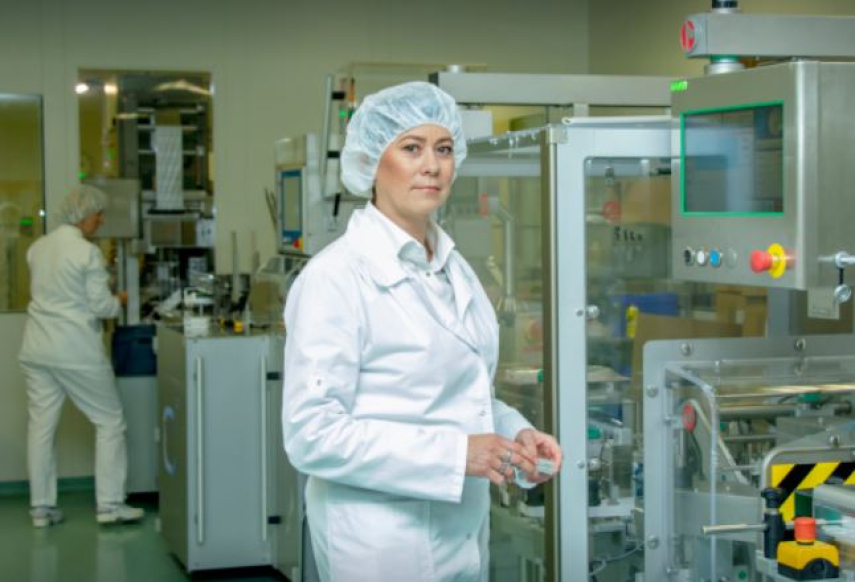
Grindeks has found a practical answer to this challenge. For the third consecutive year, the company has been running a targeted employee retraining programme. In cooperation with Riga State Technical School, 21 employees have completed retraining and obtained qualifications as chemical technicians, building on the knowledge and skills they had already gained through practical work. Qualification requirements should guarantee quality and safety, not become insurmountable barriers. There can be no compromise on medicine quality in the pharmaceutical industry, but that does not mean everyone must follow the same path to achieve the necessary qualifications.
2. Breaking the Myths About Working in Manufacturing
Competitive salaries and attractive benefits may help bring people through the door, but they are not enough to keep them in the long run. Young professionals have ambitions of their own – they want to learn, take on new challenges and see the results of their work.
Manufacturing companies face another challenge in this respect – changing perceptions of what working in the industry actually looks like. For some young people, manufacturing still brings to mind repetitive work on a production line. Yet a modern pharmaceutical company employs far more than production operators. Engineers, technologists, chemists, quality specialists, automation experts and professionals from many other fields all play an important role. Employers need to make this diversity visible.
One way to achieve this is through job rotation programmes and opportunities to experience different departments. For example, a young professional could gain insight into manufacturing, quality control and process management within the same company. This not only broadens their professional experience but also helps them discover the career path that suits them best. Naturally, in pharmaceutical manufacturing, such opportunities must be adapted to strict qualification and safety requirements. Nevertheless, the principle remains the same – the more opportunities employees see within a company, the more reasons they have to build their future there.
3. Internships – A Real Pathway to a First Job
In reality, competition for future talent begins long before graduation. An internship gives young people the opportunity to find out whether their chosen profession matches their expectations. At the same time, it allows employers to demonstrate the career prospects their industry can offer. But this potential can only be realised when interns become part of the team rather than remaining temporary "visitors".
Over the past 20 years, 1,301 people have completed internships at the company – including students from Latvian vocational schools and universities, as well as young people from other European Union countries and even Canada. Some of our current employees began their careers as interns and are still with the company today. To me, these examples demonstrate the true value of internships. After all, the measure of a successful internship is not simply the knowledge and skills gained, but also whether it inspires a young person to see a long-term future in their chosen profession.
4. New Technologies Attract More Than Investment – They Attract People
From a business perspective, investments in technology are generally assessed in terms of productivity, efficiency and quality. Yet they offer another important benefit – the ability to attract professionals who want to work in a modern, technologically advanced environment.
Take 3D printing, for example. In manufacturing, it opens up opportunities to produce certain equipment components, prototypes and customised technical solutions. In some cases, this allows companies to respond more quickly to production needs, reduce downtime and make better use of existing equipment.
Technology alone, however, does not guarantee progress. What matters is whether employees have the opportunity to work with it, suggest improvements and see their ideas turned into practical solutions. This is where technological progress and the quality of the working environment come together. New technologies are changing the skills that industries need and creating demand for new expertise. Companies must therefore invest in employee training alongside new equipment.
If we want young engineers, chemists and technical specialists to build their futures in Latvia, they must have opportunities to work with technologies that keep pace with global developments. This requires a focused national industrial policy that recognises pharmaceuticals as a strategically important sector and encourages investment, manufacturing modernisation and the development of high-value-added products.
5. Careers Should Grow Alongside Employees
Attracting a new employee is only half the challenge. The other, often more difficult, task is giving them a reason to stay for another three, five or ten years.
Professional ambitions change over time. Someone who initially wants to master a particular role may, a few years later, be ready to become an expert, lead projects or take responsibility for a team. If those opportunities are not available within the company, they will look elsewhere.
In pharmaceutical manufacturing, career development can take many different directions. A production operator may deepen their technical expertise, become a highly experienced specialist or mentor new colleagues. Employees with the relevant education and experience can also progress into technology, quality assurance, process management or leadership roles. That is why companies need to do more than provide training. They must show employees how newly acquired knowledge can open doors to further opportunities. Continuous professional development, internal mobility and managers who actively support career growth are all essential – even when that means allowing a valued employee to move to another team.
There is another important point here. Sometimes, the best way to retain a talented professional is to recognise when they have outgrown their current role and give them room to take the next step. Encouraging young professionals to build their careers in Latvia requires long-term cooperation between businesses, educational institutions and the government. It also calls for a willingness to rethink traditional assumptions about how people acquire qualifications and develop their careers.
Latvia cannot compete with larger economies in terms of workforce size. But we can compete by making better use of people's potential, developing the skills our labour market needs and offering a working environment where professionals have genuine opportunities to grow.
In the pharmaceutical industry, developing a new product, obtaining regulatory approval and bringing it to market can take ten years or more. Developing qualified specialists is also a long-term investment. **The decisions we make today about education, retraining and the working environment will largely determine whether Latvia's future is home not only to modern manufacturing facilities, but also to the people who will work in them.
Sources:
1 Ministry of Economics. (2025). Economic growth objectives and the role of higher education in achieving them.

Please enter your username and password.


2026 © The Baltic Times /Cookies Policy Privacy Policy