Most of us leave a trail online every day. We shop, chat, stream, and scroll.
Few people think about what that trail says about them. But companies developing digital credit scoring software are starting to look closely.
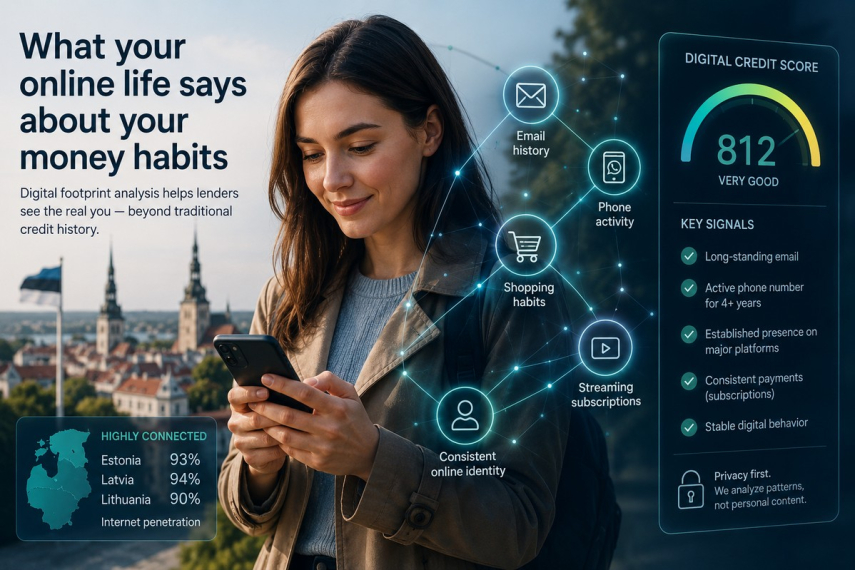
The Baltics are some of the most connected places in Europe. Estonia sits at around 93% internet penetration. Latvia is close behind at nearly 94%. Lithuania follows at about 90%.
That means almost everyone here has a digital life worth reading. And reading it, it turns out, can predict something important: who pays their loans and bills on time.
The rise of alternative data
Traditional lending relies on credit history. Bank statements, past loans, repayment records.
That works well for people who already have a financial track record. It works poorly for everyone else.
Students, young professionals, and newcomers to a country often lack this history. So do people who simply prefer cash or have never taken a loan before.
This is where alternative data steps in. It looks beyond bank records to a much wider set of signals.
Think social media activity, e-commerce habits, streaming subscriptions, and how someone's email or phone number has been used over time. None of this is financial data in the traditional sense.
But together, it paints a picture. A consistent, long-standing digital identity tends to signal stability. A brand-new, fragmented one tends to signal risk.
Reading the signals, not the person
It helps to be clear about what this actually involves. This is not surveillance, and it is not about reading private messages.
Digital footprint analysis works with patterns, not content. It checks whether an email address is old or new, valid or disposable.
It checks whether a phone number has a real history, or whether it just appeared last week. It looks at whether someone has an established presence on major platforms, from LinkedIn to Amazon.
None of these checks require access to what someone actually says or buys. They simply confirm that a digital identity is real, active, and consistent.
That distinction matters. It's the difference between quietly reading someone's messages and simply confirming their email has existed for five years.
What the data actually shows
Some signals are surprisingly telling on their own. Combined, they build a picture no single credit file can offer.
- Email history. Long-standing accounts, linked across several platforms, tend to belong to more stable applicants.
- Phone activity. Numbers registered on messengers like WhatsApp for years, rather than days, tell a similar story.
- Shopping habits. A steady presence on e-commerce sites like Amazon or Pigu points the same way.
- Subscription patterns. Keeping a Netflix or Spotify subscription running for years shows consistent, ongoing payments.
None of these signals alone decide anything. But together, they add real texture to an application.
They can also flag risks that traditional checks miss entirely. Consider someone applying for several loans, across different lenders, within a few hours. That pattern often points to fraud, financial stress, or gambling-like borrowing behavior.
Traditional credit checks, run in isolation, may not catch it in time. Digital footprint analysis, drawing on real-time signals, often can.
Why this matters beyond finance
This isn't just a story about lending. It's a story about how digital life has quietly become a form of identity.
Every account we open, every subscription we keep, adds to a record. That record now has real-world consequences, for better or worse.
For people with thin or no credit history, this can open doors that were previously closed. A well-established digital presence can now stand in for years of banking history.
That's a meaningful shift for younger generations. Many have never taken a loan, yet have used the same email for a decade.
A better experience for credit applicants too
One of the quieter benefits is speed. Traditional credit checks often mean paperwork, waiting, and repeated back-and-forth with a lender.
Digital footprint analysis removes most of that friction. It runs in the background, using data the applicant is already generating simply by living online.
There's no extra form to fill out. No extra document to scan and upload.
For lenders, this means faster, more informed decisions. For applicants, it means a smoother path to credit, often without even noticing the check took place.
Why the Baltics are well placed for this shift
High internet penetration is only part of the picture here. Baltic countries also lead Europe in digital trust.
Latvia's e-banking adoption sits near 91%, among the highest anywhere in Europe. E-government use across the region often exceeds 70%, well above the EU average.
People here already bank, shop, and interact with public services online as a matter of course. That habit creates exactly the kind of rich, consistent digital footprint this technology reads best.
It also means the shift toward alternative data feels less like a leap and more like a natural next step. The infrastructure, and the digital habits, are already in place.
A more human way to assess risk
Lending has always been about trust. The challenge has always been figuring out who deserves it, especially without a long paper trail.
Digital footprint analysis doesn't replace judgment. It adds another layer of insight, drawn from real, everyday behavior rather than assumptions.
For risk teams working under real regulatory pressure, that extra layer matters. It offers a fuller picture, without adding friction for the people on the other end of the application.
As more of life moves online, that picture will only get richer. The Baltics, with their digital-first habits, are already living proof of where this is heading.

Please enter your username and password.


2026 © The Baltic Times /Cookies Policy Privacy Policy