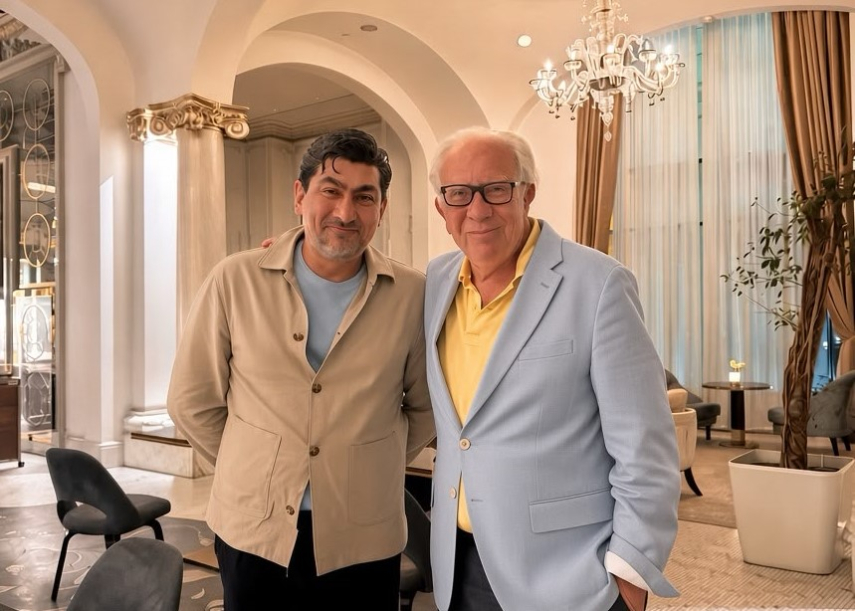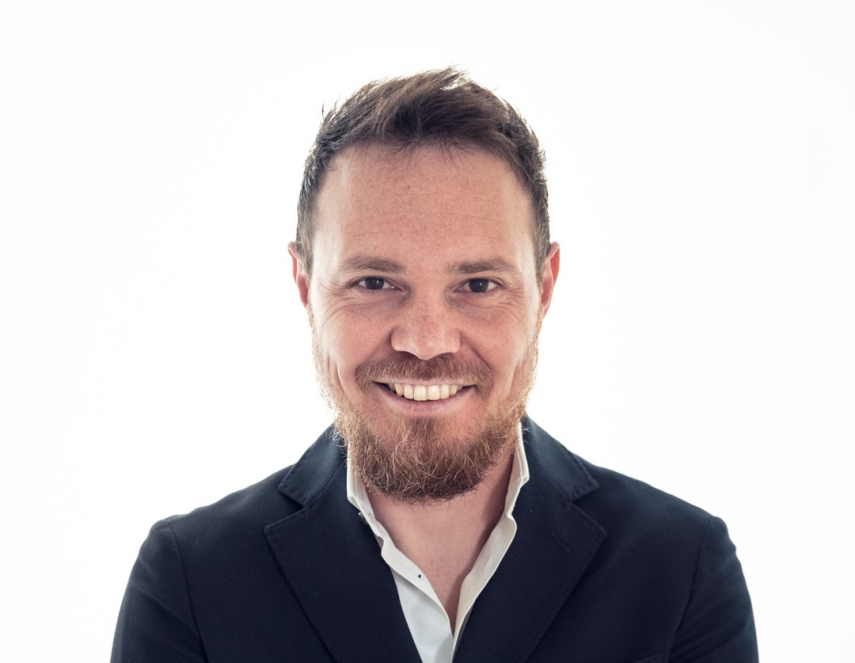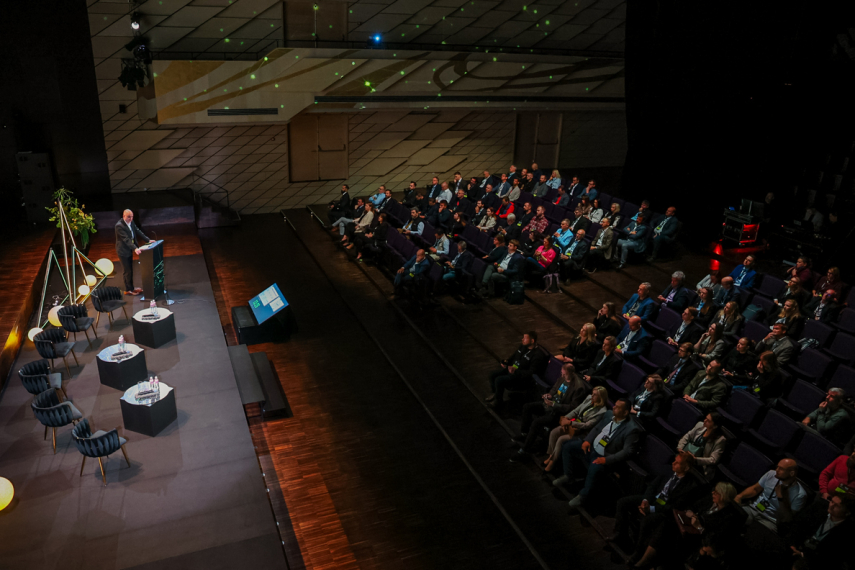
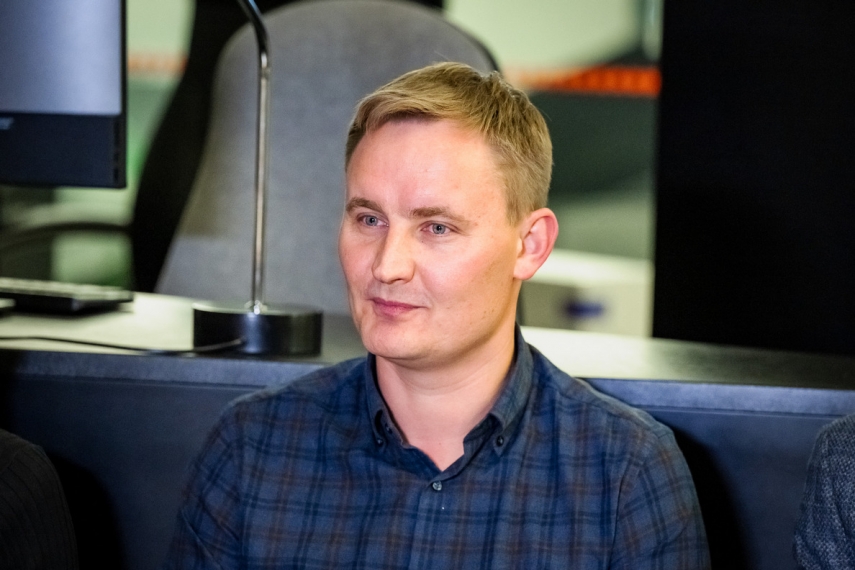
Photo: Marius Gurskas during VMU Alumni Day 2023 (by VMU)
“Government communication is not just about messages or press releases. When you work in this field, you realise that you need to understand how society works, what values are important to it, how institutions function, and what the political and international context is,” says Marius Gurskas, a graduate of political science studies and integrated communication studies at Vytautas Magnus University (VMU) and Head of the Communications Department at the Office of the Government of the Republic of Lithuania.
Having worked in the fields of politics, communication, public affairs, and public diplomacy for over two decades, Gurskas is convinced that in today’s world it is especially important to be able to assess phenomena from more than one perspective. According to him, this is precisely the kind of thinking that political science studies at VMU foster.
Drawn to politics as a field of public affairs
Gurskas had been interested in politics even before beginning his studies. He was drawn not only to political events, but also to broader issues. “I was also interested in the management of public affairs, the representation of particular interests, and ideological matters. When it came to politics, I found both the analysis of the decision-making process and the examination of the political context interesting,” he recalls.
When choosing VMU, Gurskas also took note of the university’s study model, which is based on the principles of artes liberales. According to him, a broader education, and the ability to look deeper and from different perspectives, later proved very useful in practice.
“I was fascinated by VMU’s artes liberales approach. Such a broad, well-rounded education helps lay a solid foundation and even shapes a certain way of thinking,” says the alumnus.
Political science and communication converged naturally
Although Gurskas’ professional work today is closely related to communication, he explains that this career path developed naturally from his background in political science.
“Politics and the management of public affairs are, in one way or another, related to communication. You need to be able to convey messages properly, tailor them to different audiences, and understand what matters to society or to a particular group within it,” he says.
According to him, other disciplines – sociology, psychology, and communication studies – also become important here. To understand political processes or public policy decisions, it is not enough to be familiar with institutional rules alone; one also needs to understand people’s behaviour, motives, and values.
“Over time, politics and communication converged in my professional practice. Public policy, public diplomacy, communication, public relations – it all overlaps,” says Marius Gurskas.
“It’s only later that you understand the value of certain subjects”
When speaking about his studies, Gurskas emphasises VMU’s interdisciplinarity. Through their study subjects, political science students encounter not only political processes, but also other fields which, at first glance, may seem far removed from their future profession.
“It’s only after completing your bachelor’s, or perhaps even your master’s studies, that you truly understand what those studies were about, why certain subjects were needed, and what value they provide,” he says.
The alumnus recalls that when he first enrolled and saw the titles and descriptions of various study subjects, it was initially difficult to understand what it was all about and why it was necessary. “We had political philosophy, traditional philosophy, sociology, and various other subjects. Later, I realised that this provided a foundation for assessing different phenomena from different perspectives and shaped a broad outlook,” he recalls.
According to Gurskas, this kind of preparation is particularly important today, as professions are no longer linear, and the ability to integrate different fields is increasingly valued in the labour market.
“The broader your knowledge of different fields, the richer you become, both as a person and as a specialist. When studying political science, you also encounter other fields, and this allows you to assess social phenomena or problems from very different perspectives,” the alumnus says.
Putting theory straight into practice
Marius Gurskas began working in the public sector while completing his bachelor’s degree in political science and continued working during his master’s studies in integrated communication. As a result, he says, the theoretical knowledge gained during his studies was immediately tested in practice.
“In my case, theory and practice went hand in hand during my studies. I was able to apply theoretical knowledge in practice by working with institutional communication and international audiences,” he explains.
What Gurskas remembers from his time studying at VMU is the direct, open communication with teachers, as well as the fact that there was no shortage of practical experience during his studies.
“During our studies, we had various internships in institutions, where we could test our theoretical knowledge – how it works in reality or how it could work,” says the alumnus.
University is about more than lectures
Shortly after enrolling at VMU, Gurskas joined the folk dance ensemble Žilvitis. This activity became an important part of his university experience – not only as a leisure activity, but also as a space for community, identity, friendships, and travel. Even after graduating, he has maintained ties with the group and still takes part in some of the ensemble’s activities and trips.
With Žilvitis, the alumnus travelled not only across Europe, but also to India, China, and other countries. According to Gurskas, such activities enrich the study period and allow students to experience university much more broadly.
“It was a different way to meet and interact with peers studying in other programmes. I think VMU still offers many opportunities to get involved after lectures. It’s a great opportunity to develop personally,” says the alumnus.
During his studies, he also learned several foreign languages – English, Italian, French, and German. The wide choice of languages – VMU offers students the opportunity to choose from more than 30 foreign languages every year – also broadened Gurskas’ horizons.
“VMU is a university with a human face. Here, you can grow as a person and, at the same time, develop as a professional,” says Gurskas.
Communication in a state institution goes beyond conveying information
Gurskas currently heads the Communications Department at the Office of the Government of the Republic of Lithuania. When speaking about his work, he emphasises that communication in state institutions is not merely about preparing public statements or publishing information.
“Government communication is about building trust and dialogue between society and the state. Behind every institutional or political decision that needs to be communicated, there is a specific person or group of people with certain expectations,” he says.
For this reason, according to the alumnus, the ability to understand not only the message, but also its context – the political landscape, the functioning of institutions, potential public reactions, and risks in the information environment – is particularly important in this work.
“That is precisely what all my academic and professional experience comes down to: you look at things from different perspectives and try to assess potential public reactions and the expectations of different groups through social, psychological, and political factors. That’s how you craft communication messages,” says Gurskas.
The VMU alumnus’ work also includes an international dimension – shaping the country’s brand, communicating with international audiences, and understanding cultural differences. This, he says, once again shows that political processes, society, and communication cannot be separated from one another.
Political science – not only for future political scientists
According to Gurskas, VMU’s political science studies would be an excellent choice for young people who want to understand how society, the state, and institutions function, and how decisions are made. He notes that these studies open up much broader opportunities than one might think at first glance.
“Completing political science studies certainly doesn't mean you will end up only as a political scientist explaining what is happening in the political arena. You can work in a wide range of areas. For example, there are public affairs specialists who balance different interests, and this requires a broader perspective and way of thinking. Political science can provide that,” he believes.
According to him, the field of politics is interdisciplinary: it encompasses citizens, society, the press, the media, institutions, interest groups, and international contexts. Therefore, anyone wishing to work in this field needs a broad foundation, which VMU can provide.
He advises young people who do not yet know which direction to choose not to be afraid to try things out.
“There is no wrong path. If you’re still not sure or haven’t decided what you want to do in life, you need to try things out rather than stand still. Sooner or later, that direction will certainly become clear,” says Marius Gurskas.

Please enter your username and password.


2026 © The Baltic Times /Cookies Policy Privacy Policy