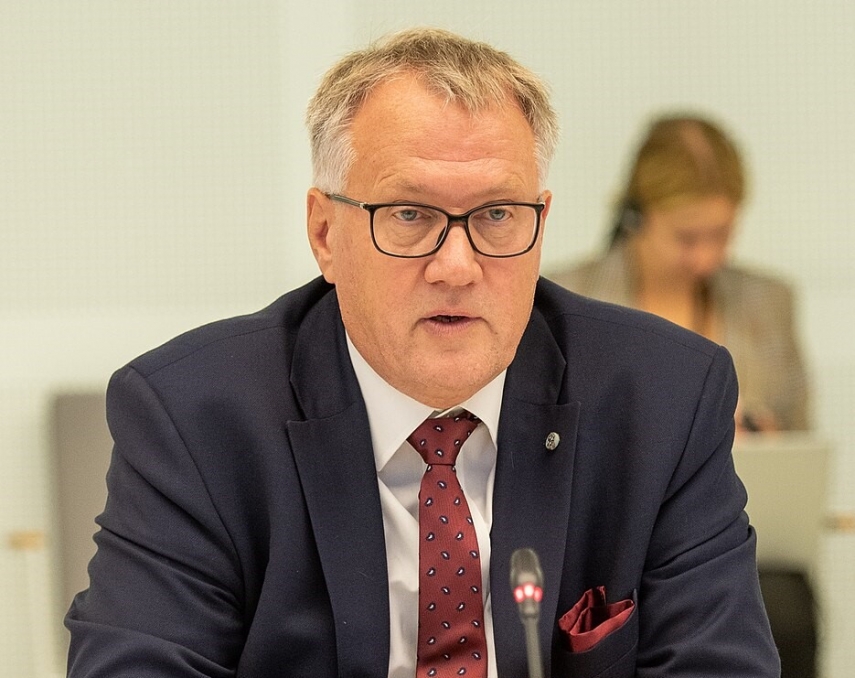
RIGA - US President Donald Trump's additional tariffs on eight European countries would weaken the foundation of transatlantic relations, while the Mercosur agreement between the European Union (EU) and the market bloc plays the opposite role, Latvia's MEP Ricards Kols (National Alliance) told LETA.
He commented that the US tariffs are an immediate minus, but the Mercosur deal is a long-term plus, these are not symmetrical processes.
"If we want to compare, we can say that the US tariffs and Mercosur compensate each other only partially and at different points in time. US tariffs are a short-term negative shock for the European economy - they directly affect exports to one of our largest and most solvent markets, especially in industry, pharmaceuticals and transport," the politician said.
He believes the impact is immediate and concentrated.
"The Mercosur agreement, on the other hand, is a structural long-term benefit. It opens up a major new market for European companies, reduces the tariff burden by billions and allows the EU to diversify its exports beyond the transatlantic area," said Kols.
However, this effect will be gradual, uneven and dependent on the sector and country's ability to exploit the market. Mercosur can therefore absorb some of the impact of US tariffs, but it is not a substitute for the US market, which remains critical to the EU economy.
He also pointed out that US tariffs look like a show of force, but in reality they are a tax on themselves.
"Tariff policy is also a drag on the US economy itself. Higher import prices mean higher costs for consumers and businesses, especially industries that rely on global supply chains. This reduces competition, investment and the pace of innovation," commented the MEP.
From a European perspective, the most important thing is that such policies undermine the credibility of the US as a predictable and stable economic partner.
"It encourages the EU to look for alternative markets and accelerates export diversification. Politically, it may score short-term points, but economically it weakens the entire Western economic space," said Kols.
He estimates that the direct impact of US tariffs on Latvia is relatively limited, as exports to the US are not very large. But the indirect impact is felt through European value chains - especially in transport equipment, machinery and other sectors where Latvia is integrated as a supplier.
The politician calls Mercosur a real opportunity for Latvia, as the agreement reduces tariffs on the country's main export items - machinery, timber, chemicals, food - and also opens up the services and public procurement markets. But these opportunities are not guarantees in themselves - if Latvia does not actively enter these markets, others will.
"Economic decisions have a direct impact on political trust. US tariffs weaken the basis for transatlantic relations at a time when unity is particularly important. If allies start to see each other as economic adversaries, this also undermines political capital," said Kols.
At the same time, the Mercosur agreement is playing the opposite role. "It strengthens the EU's presence in Latin America, reduces the influence of Russia and China in the region and builds closer political and strategic ties", he explained.
At the same time, he said that Latvia's position was balanced and clear: in security the US was an indispensable ally, but in economy the EU needed to be strong and diversified enough not to be vulnerable.
"In security we rely on allies, in the economy - on the ability to stand on our own feet," Kols added.
As reported, Trump announced that due to disagreements over Greenland, imports from the eight EU member states are subject to a 10 percent customs duty from February 1.
The new tariffs will apply to all imports from Denmark, Norway, Sweden, France, Germany, the UK, the Netherlands and Finland. In the event of no agreement on the sale of Greenland to the US, the tariff will be increased to 25 percent from June.
Meanwhile, the EU and Mercosur, a common market bloc of several South American countries, signed a free trade agreement in Paraguay on Saturday.
The agreement creates one of the world's largest free trade areas, covering more than 700 million people and with a combined economy of around USD 22 trillion.

Please enter your username and password.

2026 © The Baltic Times /Cookies Policy Privacy Policy