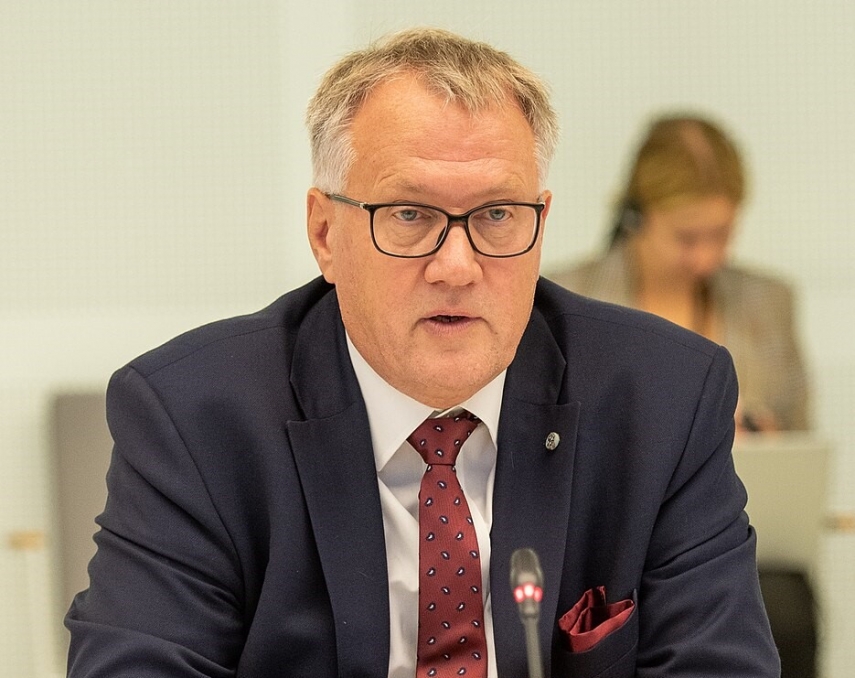
RIGA - US President Donald Trump's administration's domestic policy decisions, attitude towards Europe and efforts to build closer relations with Russia pose increasing security risks to the US democratic processes, as well as to the security of Europe and NATO, Sandis Sraders, a researcher at the Latvian Institute of International Affairs (LAI) and board member of the Latvian Transatlantic Organization (LATO), told LETA.
In 2026, he said, the US Congress could step up efforts to limit the White House's domestic and foreign policy decisions, while keeping transatlantic cooperation as one of the US priorities. The Republican Party's support for the Baltic Security Initiative and key European partners is an indication of this trend. Sraders pointed out that in less than a year, the Trump administration has challenged the US role and global influence as the world's policeman, in transatlantic security cooperation, but most of all US democratic institutions and values.
The expert noted that, from an initial disappointment, the Republican Party is beginning to show resistance to Trump's exercise of unilateral power, which could bring about changes in decision-making on US foreign and domestic policy priorities. The researcher stressed that the traditional guardians of democratic institutions and values - the media, universities, civil society and members of Congress - have been relatively quiet and uncritical of Trump's domestic and foreign policy decisions. The US is currently facing crises both domestically and with key allies that may undermine, rather than enhance, Trump's promised return to US greatness.
On migration policy, Sraders pointed out that while curbing illegal immigration is a normal democratic process, it is unacceptable for security agencies to also target people who are in the US legally, pay taxes and represent different ethnic minorities. In his view, this shows that Trump is targeting his political opponents rather than real problems, creating fear in various communities, including in California, Texas and Michigan, whose local representatives and leaders have been critical of Trump's policies.
Sraders also pointed to the longest government shutdown in US history, which has created real security risks, including in the aviation sector, as the federal government has been unable to pay the salaries of employees who ensure fundamental safety processes in a timely manner. He was also critical of the cuts in social programs, including in the area of health care, noting that around 10 percent of the US population had lost access to medical services, while the budget deficit was growing.
He stressed that the pressure from the US Congress on the Trump administration is increasing on both domestic and foreign policy issues. This is also reflected in the National Security Authorization Act passed by Congress, which states that transatlantic cooperation and cooperation with key partners in Europe should remain a priority of US foreign policy. At the same time, the LATO Board Member noted that the Trump administration's rhetoric on Europe includes criticism of Europe's domestic political processes, quality of democracy and perception of freedoms, which has provoked justified reactions among both European leaders and some US Congressional representatives.
As an example of the US Congress's long-term stance, Sraders cited the Baltic Security Initiative, for which US Congressional budget decisions provide funding of around USD 170 million for Latvia, Lithuania and Estonia. Although this is less than in previous years, when funding was around USD 250 million, the expert stressed that this decision shows that cooperation with the Baltic States and other key US partners remains a US foreign policy priority, pointing also to the work of Latvian foreign and defense institutions in explaining the importance of the Baltic States to US interests.
Asked about the US attitude towards Europe, Sraders pointed out that the Trump administration is skeptical about international institutions and prefers bilateral relations with individual countries. He explained that this approach also reflected a desire to influence the internal processes of the European Union (EU). Despite Trump's shift, if Europe acts as a single player with key partners to address security and economic challenges, Brussels can increase its regional and global influence.
Some foreign media, referring to a leaked version of the National Security Strategy, suggest that the Trump administration plans to work more closely with Austria, Italy, Hungary and Poland in order to move them away from the EU core and closer into the US political sphere of influence. The US administration has denied the existence of this document. Nevertheless, key US partners such as Poland have explicitly stressed the importance of the EU, despite the strategic importance of security cooperation with the US.
Sraders stressed that the EU is the only equal economic and geopolitical partner for the US and it is cooperation with Europe that continues to ensure the US' global power status. He pointed out that attempts to weaken the EU or to favor certain bilateral relations with certain countries could, in the long term, undermine both Europe's ability to act on security and the US's own influence, stressing that Russia, because of its small economy and aggressive foreign policy, cannot replace Europe as a strategic partner for the US.
At the same time, Sraders pointed out that if the US moved away from Europe in favor of Russia as a strategic partner, the EU might be forced to seek closer strategic cooperation with China in order to limit Russian aggression, in the interests of its own security and economic interests. He stressed that such a scenario would be very disadvantageous for the US, as close cooperation between Europe and the US is currently one of the key factors ensuring US global influence and counterbalancing China's growing geopolitical influence, for example in the Arctic, but also economically and politically worldwide.
On US-Russia relations, Sraders pointed out that attempts to forge closer cooperation with Moscow under previous US presidents have not yielded positive results. He recalled that US efforts to improve relations with Russia during the first terms of former US Presidents Bill Clinton, George Bush Jr, Barack Obama and also Trump have resulted in security crises, including Russian aggression in Georgia and in Ukraine with the annexation of Crimea.
Sraders stressed that Ukraine and Russia have fundamentally different and unattainable visions for a solution to the conflict. Any concessions by Europe and the US at the expense of Ukraine's security would create new security threats for Europe and NATO, which would not be new, but a continuation of the Russian aggression that started already in 2008. He pointed out that although Ukraine is now able to defend itself with US and European support, Russia has become increasingly aggressive since 2008 and, if it succeeds in achieving its objectives in Ukraine, will continue to pursue a similar foreign policy in the future.
The researcher stressed that the failure of the US and Europe to sufficiently support Ukraine or to achieve a Russian military defeat or regime change in Moscow would, in the long term, create security risks unprecedented in the European security architecture. If a ceasefire or peace were to be reached, any cooperation between Moscow and Brussels or Tallinn and St Petersburg would be hard to imagine. He added that Europe has no interest in a weak, politically unstable and chaotic US, as a stable and predictable US is essential for Europe's security interests, while a strong and consolidated Europe is in the US global security and economic interests.

Please enter your username and password.

2026 © The Baltic Times /Cookies Policy Privacy Policy