Photo: Petras Masiulis has served as CEO of Tele2 Lithuania for nearly 23 years and was recently appointed Executive Vice President of the Tele2 Group
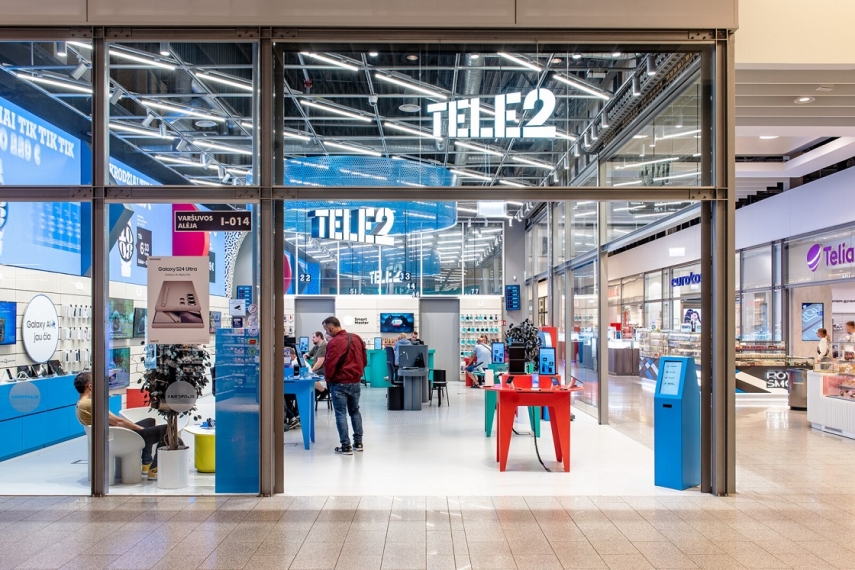
Photo: A Tele2 shop (by Tele2)
From a challenger that entered the market last to a telecom leader that reshaped competition in Lithuania and the Baltics, Tele2’s rise defied industry logic. Asked by The Baltic Times Magazine what principle was key in propelling the company from third place in the market to first, Petras Masiulis, Tele2 Lithuania CEO for nearly 23 years and recently appointed Executive Vice President of Tele2 Group and Member of the Tele2 Group Leadership Team, answered without hesitation: “The most important things are simple: we chose our direction and then managed not to change it. In business, there is a constant temptation to shift strategy – reacting to competitors, adopting new technologies, or responding to other changes. Resisting this is difficult, but we succeeded. Although Tele2 Lithuania has adapted over the years, we have not changed what works. We preserved our core direction – and that is what I am truly proud of: 20 years ago, we leapt from third place to first – and, remarkably, we are still at the top.”
Tele2 has grown into one of the strongest telecom players in the Baltics and beyond. What strategic decisions do you see as the turning points in achieving this position?
I started leading Tele2 Lithuania in 2003, when the company had only recently entered the market and ranked third. In the global telecommunications business, it is common that the strongest positions are held by the mobile operator that entered the market first. This is normal, because network and other core costs are similar for all market players, while revenues – and thus competitive capabilities – differ greatly. Long-established operators have more experience and more customers, and therefore stronger positions.
I remember that at the time, the Tele2 Lithuania team did not question this rule at all. No one had the ambition or even considered the possibility of someday becoming a market leader.
The most important decision was the very first one: I refused to accept that it was impossible to rise from third place in the market to first. If we are fighting, then we fight only to win.
The result was that already by 2007 we were leading in Lithuania by number of customers, and later we became leaders in revenue and profit as well. We achieved what seemed impossible: we became the first mobile operator in Europe and in both Americas to enter the market last – and still break through to first place.
Now we are repeating a similar success story in Estonia. A few years ago, I became responsible for this market, where Tele2’s position had been weakening for more than a decade. Last year, we finally reversed that trend: Tele2 grew by about 40 percent, one of the most impressive leaps in the telecommunications world.
You’ve spent nearly 23 years with the company! That’s impressive. What is the secret behind such long longevity with the same employer?
The most important thing is that I am still interested. The telecommunications market is very dynamic, competition is intense, and our competitors are truly strong. Everyone needs their work to be interesting and to feel that they are constantly learning and improving. I have always felt that way, and I still do.
What does your new position as Executive Vice President and member of the Tele2 Group Leadership Team entail?
Previously, my responsibilities covered a specific market – first Lithuania, then all three Baltic countries.
I continue to do this work, but now I also share responsibility for the success of the entire Tele2 Group. Together with the rest of the leadership team, we decide how the group will grow in a constantly changing global connectivity market. I am now involved not only in local but also in global competitive battles – I had to delve into completely new areas and understand the rules of the entire European, even global, telecom market. The change is enormous, but this work is interesting to me, and that strongly motivates me to move forward.
How will this new role change your priorities and influence operations in the Baltic region? In terms of time management, how do you manage to juggle both top-tier positions?
It really isn’t easy – especially since there are not two, but three roles. I am the CEO of Tele2 Lithuania, I am responsible for business in the Baltic states, and I also work at the group level.
However, it is possible to balance everything. First, I delegate a lot of responsibility to my team – they are fantastic in all countries. I am not a manager who decides every detail; I trust the people I choose.
Second, we work in Europe, where distances are not very large. I travel a lot, but flight options are plentiful and distances are relatively short. I have been successfully combining everything for several years now.
Telecom operators face rising network costs while consumers expect lower prices and faster service. How is Tele2 balancing this tension?
There are several reasons behind our success.
First, all operators experience similar network costs, so competitively their positions are often comparable. Costs rise when operators make unjustified decisions, such as investing in technologies that later fail to deliver value.
A similar situation occurred about two decades ago with the then-innovative 3G technology. Many rushed to deploy it first, paying enormous sums for licenses. Later it became clear that consumers were unwilling to pay extra for next-generation services. A wave of bankruptcies and mergers followed – for example, in Germany only three of six operators survived.
In Lithuania, we invested only when we sensed real consumer demand. By then, equipment prices had fallen significantly, allowing us to save money and compete even with lower prices.
Second, costs often rise due to bloated management structures. Tele2 has always aimed to remain a flat organization – fewer people mean lower costs and faster decision-making.
Objectively, where do you believe Tele2 holds an edge over its competitors?
Our organizational leanness is our greatest strength. We are closer to customers, make decisions faster, and rely on common sense rather than hiding behind corporate rules. For customers, this means lower prices for the same quality and faster service.
The Baltics are often described as a testing ground for innovation. What new technologies or business models is Tele2 planning to introduce here first?
We are a connectivity provider, not a startup. Failed innovations can be very costly, and we do not intend to pass those costs on to customers.
We focus on providing services customers actually need. At the same time, we collaborate with innovators – when ideas prove successful, we share them with our customers.
How is Tele2 preparing for the next phase of 5G development, including industry-specific applications and private networks?
Our 5G network is already active in all three Baltic countries. It is now a standard service, and we are beginning to explore the specifics of upcoming 6G technology.
Tele2 has launched satellite IoT connectivity services. Why is this important, and how would you explain it to a grandma using Tele2 services?
These services are designed for businesses such as logistics and delivery companies. Satellite connectivity enables operations in places where mobile networks are too expensive or impossible to deploy – mountains, forests, and other remote areas.
Competition in the region is intensifying. What differentiates Tele2 today, beyond price?
Price will always be one of the most important selection criteria. No one advertises higher prices, and no business negotiations focus on paying more.
What matters is receiving the same or better quality in return. That is what Tele2 offers – and that will not change.
Tele2 Lithuania has a strong reputation for customer satisfaction. What internal practices drive that performance?
Trust in our team and a flat organizational structure are the key drivers. They allow faster and simpler decisions, which customers value. We also stay close to customers and understand their needs.
Cybersecurity risks continue to grow. What has Tele2 done to protect customers?
For many years, we have blocked websites that host children sexual exploitation content. We actively protect customers from phone scams by implementing and constantly updating detection and blocking solutions. We also invest in educating users on how to avoid risks.
As a long-serving CEO, how would you describe your leadership philosophy?
I believe a leader must know everything but not decide everything. Trusting people is essential.
Each function should be owned by one person – no hiding behind others when things fail, and no stealing credit when they succeed. This creates responsibility, trust, and loyalty.
What are the biggest challenges and opportunities for the Baltic telecom sector over the next five years?
The telecom market evolves slowly – new generations arrive roughly every decade. Challenges will remain familiar: investment timing, predicting customer needs, and developing additional services. There will be no revolutions – consistent daily work is the real challenge.
At the end of a busy day, how do you wind down? Do you follow any spiritual practices?
I am a practicing Catholic, as is my family. Faith gives me support, and my wife and family bring me peace after work.
Can you give a glimpse of what an ordinary phone call might look like in 50 years?
Any prediction that far ahead is meaningless. No one predicted mobile connectivity becoming everyday or the smartphone revolution.
What will remain are customers who want good service, good prices, and good support – and people working for them. These fundamentals of business have remained unchanged for thousands of years.

Please enter your username and password.

2026 © The Baltic Times /Cookies Policy Privacy Policy