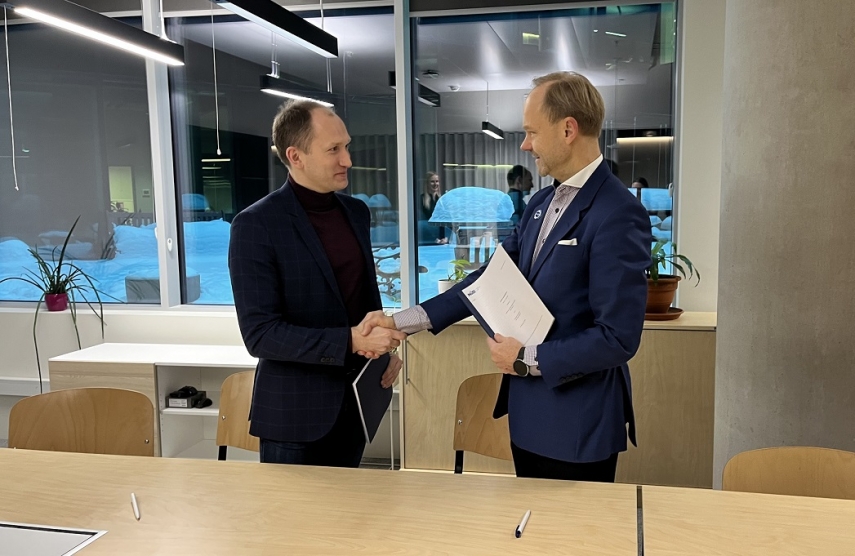
TALLINN - In 2025, SEB bank, in collaboration with the company Feedzai, successfully stopped more than half of all fraud attempts.
According to Kätlin Kukk, head of SEB's security center, projections in the middle of last year indicated that fraud would set a new record in Estonia, and unfortunately, this came to pass. Statistics from the Police and Border Guard Board show that the total damages last year exceeded 29 million euros. At SEB, 15 percent fewer clients fell victim to fraud last year compared to the year before, thanks to a more effective monitoring system. The most common were telephone scams, which resulted in greater losses for businesses than before.
"It must be emphasized that the amount of money we are able to save from criminals has grown significantly. By actively investing in transaction monitoring, SEB managed to stop over half of all fraud attempts last year. This was money that would have otherwise ended up in the hands of criminals. Thanks to updated systems, the efficiency of fraud prevention at SEB doubled," said Kukk.
Two years ago, SEB began collaborating with Feedzai, one of the world's leading providers of solutions for combating financial crime. This partnership enables SEB to prevent fraud with increasing effectiveness. "Last year, 15 percent fewer SEB clients fell victim to fraud than in 2024, although the amount of money lost rose by 10 percent. This was mainly due to unauthorized access to business accounts and, in the case of private individuals, cash-based schemes. We certainly still have room for improvement, but SEB is committed to fighting fraud effectively every day," Kukk noted.
With modern technological advancements, cybercrime has become the number one threat, with fraud typically based on about a dozen different schemes. "The greatest damage last year was caused by phishing via phone calls, and this is likely to continue this year. According to SEB's data, telephone scams accounted for a staggering 53 percent of all identified losses. Such a strong dominance by a single type of fraud has not been seen in previous years," Kukk emphasized.
The year 2025 brought a significant change to the schemes, as scam calls began to be made in fluent Estonian. Whereas previously the calls were predominantly in Russian, now scammers also target those who do not speak the language. The criminals' tactic involves strong manipulation of people through intimidation and outright lies. In this context, a strong preventive factor is public awareness of current national affairs and how official processes work.
According to Kukk, telephone scams also made a significant impact on the losses incurred by companies. Scammers often gained access to a company's online banking through an individual victim associated with the business. "According to SEB's data, telephone scams accounted for 42 percent of all cases involving businesses and 73 percent of the losses. This has not occurred to this extent before. The average loss from telephone scams was 7,100 euros for private individuals and several times higher for businesses, averaging 42,000 euros."
Company accounts generally hold more money than those of private individuals. Fraud is made easier when businesses do not set limits in their online banking to help minimize abuse. Setting such limits is a key preventive measure to avoid these losses.
Telephone scams also saw an increase in the use of cash. This is a method scammers increasingly resort to when they cannot obtain money from the victim through bank transfers or card transactions. In these cases, a "courier" often comes to the victim's home to collect their bank card and PIN, using various pretexts to obtain them. Victims are also pressured into leaving cash or a bank card with its PIN in a parcel locker. These schemes predominantly use local youths who act as "couriers" to earn easy money. The job is simple: get the card, withdraw the maximum amount of cash, and hand the money over to a collector, who is the next link in the scheme.
SEB will continue to maintain a strong focus on fraud prevention, making additional investments in technology to better protect its clients in the ever-changing landscape of fraud. We also see the regulatory landscape is changing, so staying vigilant and reacting quickly to new developments is key to success. However, alongside the technological line of defense, everyone has a crucial role to play in fraud prevention, as they are the first point of contact for the scammer.
"The main recommendation for 2026 is to immediately hang up any incoming call asking for Smart-ID or Mobiil-ID confirmation codes or your card details. That way, the fraud can be prevented," Kukk stressed.

Please enter your username and password.

2026 © The Baltic Times /Cookies Policy Privacy Policy