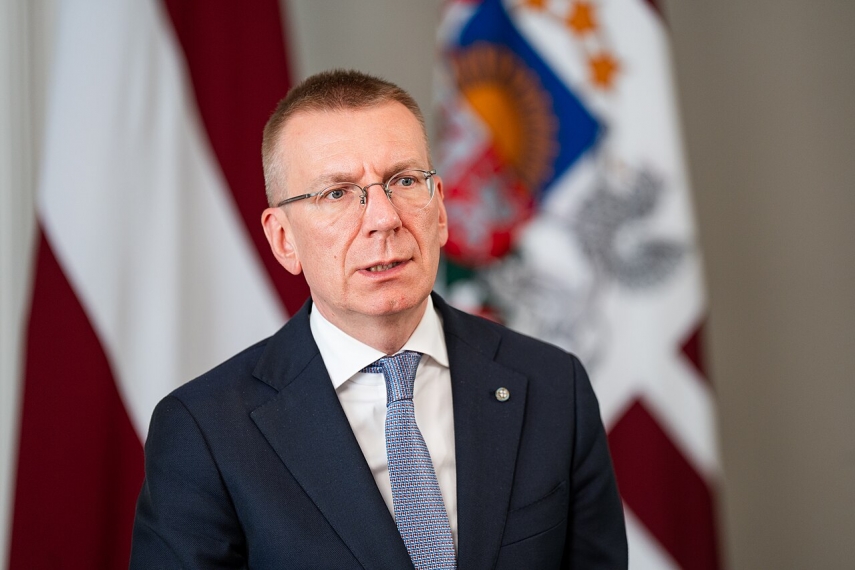
RIGA - Russia is and will remain the biggest threat to the security of the Alliance and the transatlantic space, underlined Latvian Foreign Minister Baiba Braze (New Unity), who met with NATO Secretary General Mark Rutte on Thursday in Brussels.
As LETA was informed by the Foreign Ministry, the sides discussed strengthening NATO's presence in Latvia and the Alliance's deterrence and defense capabilities, including effective implementation of the decisions taken at the NATO Summit in The Hague, further support for Ukraine's self-defense capabilities and restraining Russia.
Braze briefed on the progress made in strengthening Latvia's defense and deterrence capabilities and Latvia's continued support to Ukraine in the fight against Russian aggression. She highlighted the achievements of Latvian industry in 5G and 6G technologies, the development of drones and counter-drones, as well as quantum technologies in Latvia, and called on NATO to make use of these resources.
The Latvian foreign minister also called for solutions to make public procurement faster and more efficient, which is an important prerequisite for strengthening NATO's own capabilities and for supporting Ukraine.
Rutte thanked Latvia for its strong position and leadership in moving towards five percent of gross domestic product (GDP) investment in defense.
On Russia, Braze stressed that its objectives have not changed and are to divide the unity of NATO allies and to undermine support for Ukraine. She pointed out that Latvia is taking a responsible approach to its security and defense, including by implementing the agreement agreed at the NATO Summit in The Hague: 4 percent of GDP in direct defense spending is being achieved this year and is planned to increase to around 5 percent of GDP in 2026.
"We call on all allies to work towards this goal. We are also continuing our work on strengthening the eastern border, which is also the eastern border of NATO and the European Union (EU) - EU-NATO coordination is essential here. Latvia has invested around one billion euros in strengthening the border since 2022," emphasized Braze.
She also welcomed the newly established NATO missions - Baltic Sentry and Eastern Sentry. In the view of the foreign minister, this is a contribution to the security of the region and the Alliance as a whole in response to Russia's sub-conventional threats.
Braze underlined that these missions demonstrate the solidarity of allies and the Alliance's ability to adapt quickly to geopolitical realities and current challenges. She pointed out that allies are united on the need to develop a stronger, more modern and more capable Alliance to continue to deter aggressors and to protect every inch of NATO.
The foreign minister stressed the need to reinforce NATO's presence in Latvia and throughout the eastern flank, in particular with air defense and counter-drone capabilities. It is also necessary, according to Braze, to adapt the Alliance's defense and deterrence capabilities to respond quickly to current threats, which Russia is pursuing with increasing frequency and aggression, with the aim of testing allies.
Discussing the situation in Ukraine, the minister stressed that Ukraine needs continued military and financial support from its allies - immediate access to air defense and long-range weapon systems is essential to stop Russian aggression.
Latvia will continue to provide military support to Ukraine of at least 0.25 percent of GDP in 2026, Braze said. Latvia is also providing EUR 7.2 million in financial support to the NATO initiative to provide critically needed military equipment to Ukraine, and is involved in the NATO-led project to support the reconstruction of medical facilities in Ukraine.

Please enter your username and password.

2026 © The Baltic Times /Cookies Policy Privacy Policy