
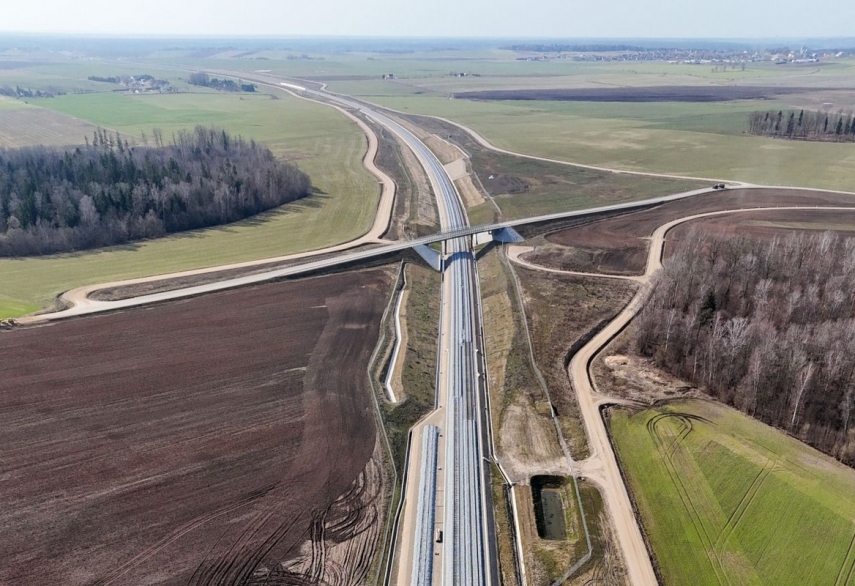
The three national implementing bodies and future Infrastructure Managers (IMs), Rail Baltic Estonia, Eiropas Dzelzceļa līnijas and LTG Infra, in cooperation with Rail Baltica coordinator RB Rail AS, have published Version 1 of the Network Statement. Prepared in line with the RailNetEurope Network Statement Framework, the document provides future railway undertakings with the first consolidated overview of the technical, operational and access conditions for the Rail Baltica cross-border railway across Estonia, Latvia and Lithuania.
The publication marks an important milestone in Rail Baltica's transition from a large-scale infrastructure development programme to an operational European railway. It also initiates a structured dialogue with railway operators, freight forwarders and other market participants ahead of the line's commissioning.
As the first in a series of planned editions, Version 1 establishes the foundation for a comprehensive Network Statement that will be progressively expanded and refined as the project advances towards operations. Prepared in accordance with the RailNetEurope Network Statement Common Structure, the document covers the full scope of the Rail Baltica Global Project. For the first time, it brings together key information within a single reference framework on infrastructure characteristics, access conditions.
The document has been jointly coordinated by RB Rail AS in cooperation with the three national infrastructure managers: Rail Baltic Estonia, Eiropas Dzelzceļa līnijas (EDzL) in Latvia and LTG Infra in Lithuania.
Rail Baltica is a 1,435 mm standard-gauge railway connecting Tallinn, Pärnu, Riga, Panevėžys, Kaunas, Vilnius and the Lithuanian to Polish border. It forms part of both the North Sea-Baltic and the Baltic Sea-Black Sea-Aegean Sea Trans-European Transport Network (TEN-T) corridors. Designed for speeds of up to 249 km/h and equipped with the European Rail Traffic Management System (ERTMS) Level 2 and the Future Railway Mobile Communication System (FRMCS), the line will enable interoperable passenger and freight transport across the Baltic states and provide seamless integration with the wider European rail network.
"This publication is an open invitation to the railway market," said Julien Pellerin, Operation and Capacity Manager in the Rail Baltica department at LTG Infra, who coordinated this Version 1. "Version 1 of the Network Statement provides future operators and freight customers with a transparent and consistent basis for planning their engagement with Rail Baltica. It also demonstrates the close cooperation between the three Baltic infrastructure managers in developing a unified railway system within the European rail framework. Future editions will continue to build on this foundation as we move closer to operations."
Version 1 is an informational document and does not yet constitute a formal basis for capacity applications. Subsequent editions will further expand the content and develop into a formal Network Statement for Phase I operations, including comprehensive chapters on capacity allocation, charging principles, services and operational procedures. The formal Network Statement will be published later in line with the requirements of Directive 2012/34/EU. A separate Network Statement for the Polish section of Rail Baltica will be published by PKP Polskie Linie Kolejowe (PKP PLK).
Access to Version 1 of the Network Statement could be granted free of charge in English by filling in the form here.
About Rail Baltica
Rail Baltica is one of the largest high-speed rail projects in Europe and is part of the Trans-European Transport Network. It aims to improve connectivity, strengthen regional security and support economic growth in the Baltic states. The new railway will link Estonia, Latvia and Lithuania with Poland and, indirectly, with Finland, as well as with the broader European rail network.
Rail Baltica will be fully electrified with a standard gauge of 1435 mm and it will be equipped with ERTMS (European Rail Traffic Management System). It has been designed to meet European standards. With a design speed of 249 km/h, Rail Baltica will reduce travel times between the Baltic states and major European cities by more than half. It will serve as a modern infrastructure for passenger, freight and military mobility, promoting accessibility and facilitating business, tourism and cultural exchange. Rail Baltica will help establish the Baltics as a key link in European trade and cooperation.

Please enter your username and password.


2026 © The Baltic Times /Cookies Policy Privacy Policy