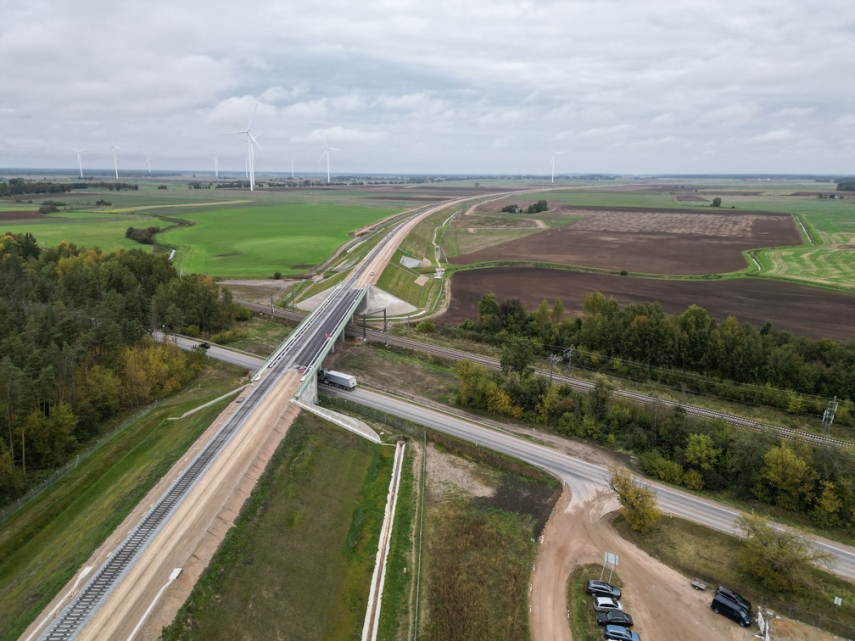
Photo: Rail Baltica construction (Lithuania)
On 27 April, RB Rail AS hosted Rail Baltica Industry Day 2026, an online seminar that drew up to 200 current and prospective suppliers, partners, and stakeholders from across the Baltics and beyond. The event offered a practical look at where the project stands today, what is coming next, and how the supplier community can get involved.
The seminar opened with remarks from senior representatives of the three Baltic states: Andres Lindemann, Head of Rail Baltica Division at Estonia's Ministry of Climate; Kristīne Pudiste, Deputy State Secretary of Latvia's Ministry of Transport; and Roderikas Žiobakas, Vice-Minister of Transport and Communications of Lithuania. Each underlined the importance of cross-border cooperation and active supplier engagement in delivering one of Europe's largest infrastructure projects.
"Rail Baltica is not just an infrastructure project. It is a strategic investment in European connectivity, economic development, and security. For us in Estonia, this project is a clear priority. We are moving forward, we are building, and we will open Rail Baltica by 2030, together with you," said Andres Lindemann.
"Rail Baltica is a project of national and European importance. Latvia is fully committed to delivering it, and we count on close cooperation with our suppliers and partners to make it a reality," said Kristīne Pudiste.
"Europe is built through connections that unite regions, strengthen economies, and reinforce our shared security, and Rail Baltica stands at the heart of this vision. I encourage you to join us in building this landmark project together," said Roderikas Žiobakas.
Where the project stands
Marius Narmontas, Chief Operating Officer at RB Rail AS, walked participants through the latest progress and upcoming milestones across all three countries. "Rail Baltica is making strong construction progress across the Baltic states. By the end of 2025, key milestones include the signing of the electrification contract, all mainline civil works in Estonia being under contract, completion of consolidated materials procurements, and achieving 90.2% technical progress under the MFF1 CEF grant agreements. In 2026, construction continues to accelerate: in Estonia, 107 km of mainline and the Ülemiste terminal are under construction; in Latvia, works are ongoing on the 30 km priority southern section, as well as at Riga Central Station and Riga Airport; and in Lithuania, track laying has begun on the first 8.8 km of the mainline, with 114 km currently under construction,” said Narmontas.
Jean-Marc Bedmar, Head of Systems and Operation Department at RB Rail AS, then introduced the Rail Baltica Network Statement within the RailNetEurope (RNE) framework, giving participants a clearer view of operational planning and how the network will integrate with the wider European system.
What is coming next for suppliers
RB Rail and national implementing bodies (Rail Baltica Estonia, Eiropas Dzelzceļa līnijas and LTG Infra) presented the next wave of procurement opportunities across the Baltics, including upcoming infrastructure tenders, design and build contracts, and station development projects. Country-specific perspectives on timelines, procurement strategies, and supplier engagement came from:
- Ieva Rudzīte, Deputy Head of Legal Department (Procurement), RB Rail
- Lauri Ulm, CTO, Rail Baltic Estonia
- Marika Zadraka, Strategic Financial Planning Unit Lead, Eiropas Dzelzceļa līnijas
- Derek John Clulow, Rail Supplier and Subcontractor Procurement Director, E.R.B. Rail
- Darius Vansevičius, LTG Infra Rail Baltica Programme Manager
Video recordings of the Rail Baltica Industry Day seminar 2026 are available here. Answers to questions raised during the Industry Day 2026 will be published by 1 May 2026.
About Rail Baltica
Rail Baltica is one of the largest high-speed rail projects in Europe and is part of the Trans-European Transport Network. It aims to improve connectivity, strengthen regional security and support economic growth in the Baltic states. The new railway will link Estonia, Latvia and Lithuania with Poland and, indirectly, with Finland, as well as with the broader European rail network.
Rail Baltica will be fully electrified with a standard gauge of 1435 mm and it will be equipped with ERTMS (European Rail Traffic Management System). It has been designed to meet European standards. With a design speed of 249 km/h, Rail Baltica will reduce travel times between the Baltic states and major European cities by more than half. It will serve as a modern infrastructure for passenger, freight and military mobility, promoting accessibility and facilitating business, tourism and cultural exchange. Rail Baltica will help establish the Baltics as a key link in European trade and cooperation.

Please enter your username and password.

2026 © The Baltic Times /Cookies Policy Privacy Policy