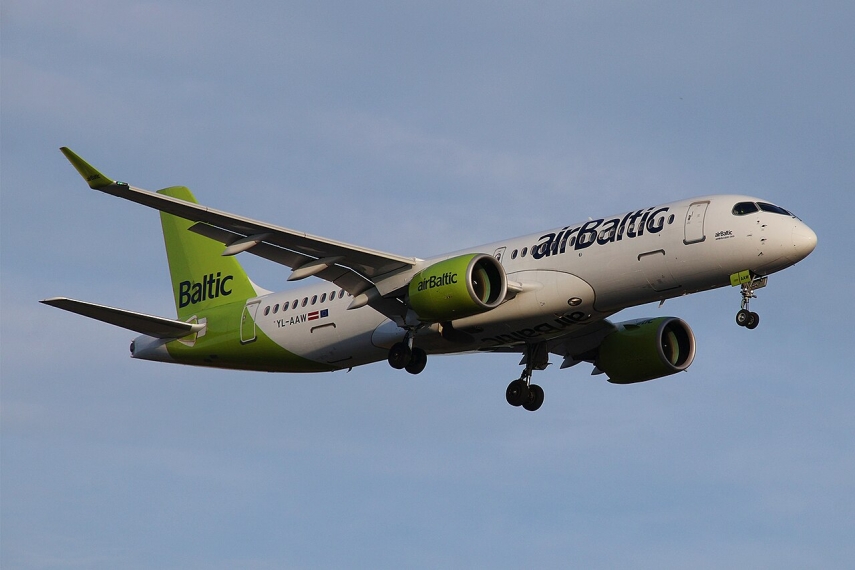
Photo: Southsea_Matt / https://commons.wikimedia.org/
RIGA - The government on Monday decided to supplement the previously adopted decision on a EUR 30 million short-term loan to the Latvian national airline airBaltic by tightening the loan requirements and imposing stricter supervision, Prime Minister Evika Silina (New Unity) told reporters following the Cabinet meeting.
Silina had called an extraordinary Cabinet meeting on Monday to address the situation at airBaltic.
It is clear that the crisis in the Strait of Hormuz will not be over so soon, so the government needs to talk to the aviation sector, Silina said.
At the meeting, ministers were briefed on the impact of the Middle East crisis on the aviation sector. The Transport Ministry was instructed to monitor this impact and, if necessary, to prepare a draft law on the declaration of a state of emergency in order to ensure timely and coordinated national action to mitigate the impact of the crisis and address potential threats.
Silina noted that many countries are facing shortages in the aviation sector, and Latvia should be prepared for such an eventuality. The Transport Ministry will have to draw up a prioritization plan should such a risk arise, the prime minister said.
When it comes to the problems of airBaltic, Silina said that representatives of several sectors have confirmed that the value of the airline is seen not only in the taxes it contributes to the state budget but also in the effects it has on a number of sectors.
"We have decided to supplement the previous decision with additional information that should be submitted in order to secure the short-term loan as bridge finance," Silina said.
She also stressed that it is important for airBaltic to develop a new business plan given the current geopolitical situation.
Silina added that, as head of government, it is important to her that airBaltic continues to operate, and, in her opinion, it is also important for the people of Latvia.
At the same time, she pointed out that, given the instability in the Strait of Hormuz, airBaltic's operations are currently encumbered and there are many challenges. "And it is very important to me that the ministers of my government, instead of "hurling" various epithets at each other on public airwaves in the run-up to the parliamentary elections, think about how to ensure that they make really responsible decisions for our people," Silina said, stressing that these decisions will have a bearing on a range of different industries.
At the same time, Silina did not deny that decisions on airBaltic could be unpopular. She admitted that she may be criticized on social media for them, but to her, it is more important to keep Riga as a point of good connectivity, and airBaltic is helping to ensure this.
Transport Minister Atis Svinka (Progressives) said that no sector is currently more affected by fuel price hikes than aviation, and the situation is worrying. He said that the report includes facts about possible shortages of aviation fuel. He said it was important for the extraordinary Cabinet meeting on Monday to hear not only the Transport Ministry's description of the direct impact on aviation sector, namely, airBaltic, but also the broader effects in terms of society, business, the economy, and Latvia as a whole.
The transport minister also indicated that the government on Monday decided to impose additional rules for the supervision of the planned airBaltic loan, checking the eligibility of each invoice. "We also looked in detail at the additional information that ministers needed. At the same time, however, it should be noted that there are EU regulations that lay down a ban on market manipulation (MAR)," Svinka added, which is why this information cannot be disclosed to the general public.
Economics Minister Viktors Valainis (Greens/Farmers) said that airBaltic is important for Latvia's economy, which means that the quality of decisions must be of the highest level. "The original decision was not of high quality and required significant amendments, especially after the political and State Audit Office's involvement. I hope that, henceforth, the process will be better," said Valainis.
He stressed that airBaltic has been asked several times to revise its business plan and the company still has not done so, which is why the government has given the task repeatedly.
As reported, the Transport Ministry has indicated that external factors such as the conflict in the Middle East, rising fuel prices and the suspension of certain routes have had a significant impact on airBaltic's costs, and the airline needs a EUR 30 million loan to ensure the company's stable operations until the implementation of its new business plan.
However, the Saeima Budget and Finance (Taxation) Committee did not approve the decision because of objections raised by the Union of Greens and Farmers. The Saeima committee will revisit the issue on April 14.
LETA also reported, airBaltic's losses last year amounted to EUR 44.337 million, which is 2.7 times less than in 2024. Last year, airBaltic's turnover increased by 4.2 percent compared to 2024 and amounted to EUR 779.344 million.
In 2025, the airline carried a total of 5.2 million passengers on its route network, an increase of 1 percent compared to 2024.
At the end of August last year, German national airline Lufthansa became a shareholder in airBaltic. Currently, the Latvian state owns 88.37 percent of airBaltic shares, Lufthansa - 10 percent, financial investor Aircraft Leasing 1, owned by Danish businessman Lars Thuesen - 1.62 percent, and other shareholders - 0.01 percent. The company's share capital is EUR 41.819 million.
After the initial public offering (IPO) of airBaltic shares, the size of Lufthansa's stake will be determined by the potential IPO market price. The transaction also provides that Lufthansa will own at least 5 percent of airBaltic's capital after the potential IPO.
On August 30, 2024, the Latvian government agreed that the state should retain at least 25 percent plus one share in airBaltic's capital after the IPO. On August 19, 2025, the government decided that Latvia, like Germany's Lufthansa, would make a co-investment of EUR 14 million in airBaltic ahead of a potential IPO.
However, given the 2025 financial results and market conditions, airBaltic has suspended its planned IPO and does not currently view it as a potential source of capital for 2026, according to airBaltic’s annual report.
The report indicates that, despite the expected improvement in operational and commercial performance, the airline will operate with a negative free cash flow in 2026, and, based on current forecasts, management expects that an additional capital injection of EUR 100 to 150 million will be required to finance operations for the 2026/2027 winter season.
Transport Minister Atis Svinka (Progressives) has noted that an IPO is not the only way to raise capital, and the airline’s management has been given the broadest possible mandate to seek opportunities to raise capital using various financial instruments. Thus, the airline’s goal for 2026 is not only to reduce costs but also to raise capital.

Please enter your username and password.


2026 © The Baltic Times /Cookies Policy Privacy Policy