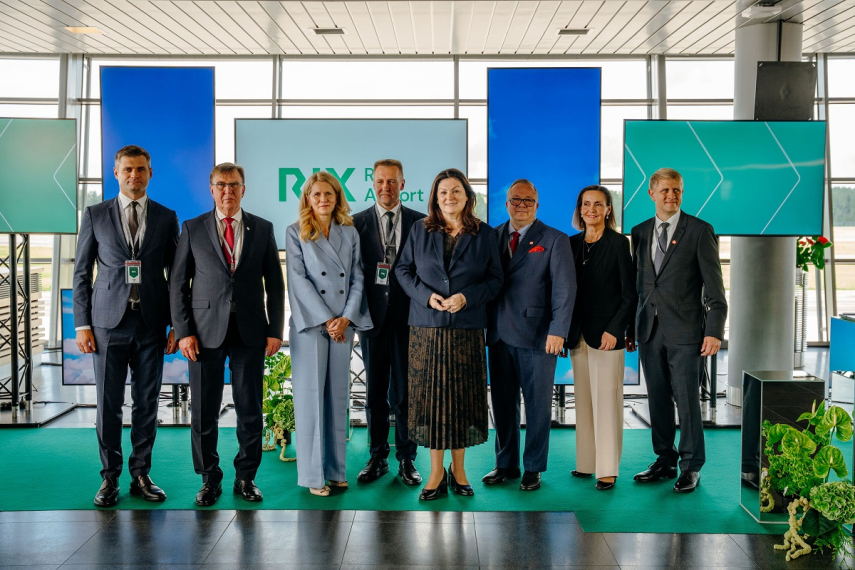
RIGA - Latvia and Europe are preparing for a difficult fall and winter, as Russia continues to ramp up aggression, President Edgars Rinkevics writes on social media, warning that "further escalation is very likely".
The president assesses the situation in the world, in Europe, and in the Baltic region as tense. He notes that Russia’s aggression against Ukraine and the military conflict in the Middle East continue to fuel political and military escalation, compounded by rising energy prices and a deteriorating economic situation.
The president refers to the conflicting views expressed in the public sphere regarding the deteriorating security situation on the eastern flank of NATO and Europe. He points out that there is already an increase in Russian-inspired acts of sabotage, espionage, and subversion targeting infrastructure and businesses in countries supporting Ukraine, and this can also be seen in Latvia. The president does not rule out further escalation.
Rinkevics emphasizes that following the Russian State Duma elections, Russia will, in one form or another, carry out a mobilization and further operations against Ukraine. In his view, Russia’s goal is to use this winter to achieve gains in Ukraine, intimidate Ukraine’s supporters, and weaken NATO and the European Union (EU).
"We are currently seeing both real-world and information operations. Our security agencies and those of our allies are constantly cooperating, exchanging information, and there have already been several successful instances where spies, saboteurs, or infiltrators have been thwarted, neutralized, or apprehended," the president said, adding that no one can ever be one hundred percent certain of preventing an adversary’s actions.
Rinkevics noted that he personally is guided by three principles: analysis of facts, Russian rhetoric, and historical context. In his view, the facts currently do not indicate that a large-scale, conventional Russian invasion of NATO or EU territory is possible, as there is no observable concentration of forces necessary for such an invasion, while other activities have already increased and will continue to do so.
"Russian rhetoric and historical experience show that Russia will continue to escalate. If the allies do not stop this with unambiguous action, the risks and threats will become more dangerous," the president states.
He points out the mistake of referring to sabotage, terrorist acts, and subversion as a "hybrid threat." In the president’s view, this creates a "sense of innocence, just like when talking about a hybrid car." Rinkevics notes that he has discussed this with colleagues from many countries. He concludes that such a change in doctrine will help mobilize allied support.
The president concludes that Latvia’s greatest risks in the coming weeks are linked to the parliamentary elections, which may include cyberattacks, migration pressure on the Belarusian border, drone incidents, and disinformation campaigns. Therefore, ahead of the Saeima elections, Latvia has requested an increased presence of NATO air patrol fighter jets, Operation Vilkatis (Werewolf) has been extended, and internal affairs and security agencies are on high alert.
Rinkevics notes that there are frequent discussions about the possibility of a small-scale incursion by Russian special forces into the territory of allied nations and the potential paralysis of NATO’s Article 5. Rinkevics confirms that this scenario is also taken seriously - both the Latvian armed forces and the NATO units stationed in the country would put up strong resistance without waiting for discussions in Brussels, and such plans and authorizations are already in place.
The president explains that these are turbulent times, things are changing rapidly, and the coming months will not be easy for Latvia, just as they will not be for many other countries. Rinkevics emphasizes that Latvia’s defense and internal security systems are aware of their responsibilities and the risks involved, and are doing everything in their power to mitigate them.
"What each of us can do right now: first and foremost, participate in the elections, support the National Armed Forces and the National Guard, report suspicious activities to law enforcement authorities, and come up with any ideas on how to strengthen our Latvia," the president says.
Meanwhile, Prime Minister Andris Kulbergs (United List) noted in a statement released later that he sees public concern as people follow international news, but he reassured the public that there is no reason for panic. "We take the security situation seriously," the prime minister stated.
Kulbergs emphasizes that Polish Prime Minister Donald Tusk has released an intelligence assessment regarding potential Russian actions in the coming months, but that this is not an announcement of a specific or inevitable attack on Poland, Latvia, or any other NATO country.
"You know that I communicate openly, even about negative facts. But at this time, there is no cause for alarm," the politician said, adding that he is "in constant contact with the intelligence services." The prime minister also met with European Union (EU) leaders who were attending the Arctic Summit. At present, according to Kulbergs, there is no information indicating a particularly high level of threat.
Kulbergs says that Russia is not ready for another war and is incapable of a conventional attack. Meanwhile, NATO’s support is stronger than ever, according to the Latvian prime minister.
He points out that Latvia’s border guards and security services are on high alert - a series of operations are underway at the border, military exercises are taking place, and German fighter jets will also be conducting additional air patrols during the election period.
However, Kulbergs stresses the need to remain vigilant. "Our public is well-informed about the threats and knows our eastern neighbor well," the prime minister says. He also notes that the context of Russian "elections" is intensifying the volume of disinformation and propaganda.
"I am closely monitoring the situation, meeting with the relevant agencies, and speaking with leaders in both Ukraine and the EU. The relevant agencies are constantly monitoring the situation and exchanging information with our allies," Kulbergs states.
He repeatedly reassures the public and promises that if a real threat arises, he will report it immediately.

Please enter your username and password.

2026 © The Baltic Times /Cookies Policy Privacy Policy