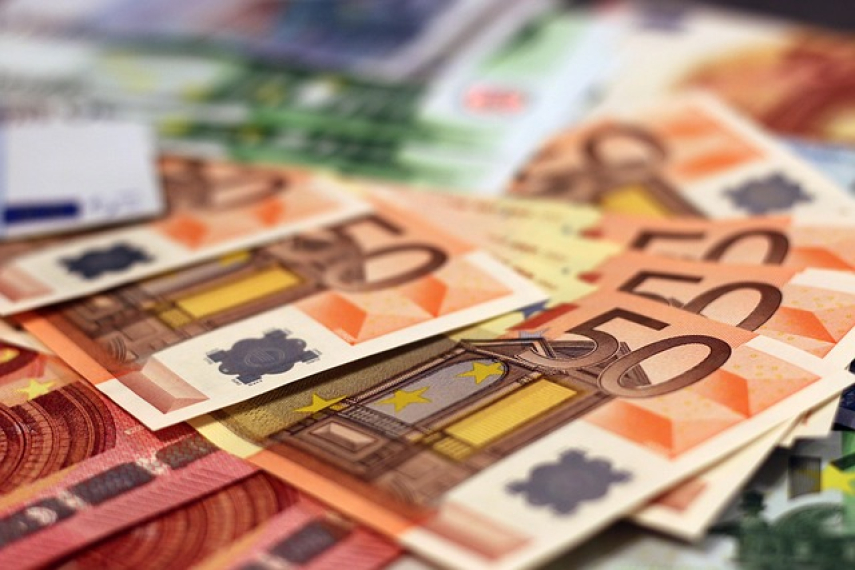
TALLINN - The European Parliament has adopted its position on the European Union's next long-term budget, the Multiannual Financial Framework (MFF) for the years 2028-2034.
Primarily, the Parliament wants to increase the long-term budget by 10 percent compared to the European Commission's proposal, bringing it to 1.27 percent of the Union's gross national income (GNI). An additional 0.11 percent of GNI would be required for the repayment of loans from the 'NextGenerationEU' recovery fund.
The additional funds are intended to be distributed equally among three budget headings that contribute to the EU's priority areas. This would help alleviate inflationary pressure. No additional funding is foreseen for administrative costs or the maintenance of EU agencies.
Under the Parliament's proposal, the budget would increase by €175.11 billion in 2025 constant prices and €197.30 billion in current prices compared to the Commission's proposal. The total budget would thus amount to €1.78 trillion in 2025 constant prices and €2.01 trillion in current prices, excluding the recovery fund loan repayments.
Investments from the European Union's next long-term budget must support EU policies, people's well-being, regional development, and entrepreneurship, including small and medium-sized enterprises. At the same time, these investments must create added value compared to a situation where each country spends on its own. The Parliament is firmly against re-nationalization and allowing exceptions for member states. Furthermore, Parliament believes that the Commission's plan to distribute budget funds by country, rather than by program, would weaken EU policy, reduce transparency, and force beneficiaries to compete against each other.
Strong EU policies require sufficient funding. The budget must provide separate funding for policy measures under national and regional partnership plans, including the common agricultural and fisheries policies, support for the outermost regions, the Union's cohesion policy, the European Social Fund, and internal affairs. Local and regional authorities should be fully involved in the planning and implementation of programs.
However, Parliament is satisfied with the Commission's plan to double the funding in the new budget for enhancing competitiveness, strengthening defense, accelerating innovation, supporting the digital and green transitions, developing infrastructure, improving healthcare and education, and promoting culture. In Parliament's view, more money should also be allocated to important EU programs such as the European Competitiveness Fund, Horizon Europe, the Connecting Europe Facility, Erasmus+, AgoraEU, and the EU Civil Protection Mechanism. Activities related to the EU's health program and the environment and climate action program, financed by the European Competitiveness Fund, should be guaranteed separate funding.
Although the Commission plans to increase funding for external action, Parliament believes it is not enough. EU enlargement, development and multilateral cooperation, humanitarian aid, and support for Ukraine should be funded even more robustly.
Parliament emphasizes that the simplification of spending rules proposed by the Commission must not come at the expense of transparency, accountability, or democratic oversight. If receiving funds is no longer tied to proving costs, auditing spending becomes more difficult. Furthermore, those who disregard EU values and the rule of law should not receive EU funds. However, final beneficiaries should not be penalized for their government's failures in this regard.
Parliament continues to advocate for the introduction of new own resources to repay the loans taken for the pandemic-era recovery fund and to secure additional money for the budget. New own resources should be agreed upon simultaneously with the MFF and should bring approximately €60 billion annually into the next long-term budget. If any of the potential new own resources under discussion are ultimately not supported, other solutions must be found, such as introducing a digital services tax, a tax on online gambling, expanding the carbon border adjustment mechanism, or taxing capital gains from crypto-assets.
"Today, the European Parliament has shown that it works quickly and looks to the future. Our position is strong and seeks a balance between existing and new priorities. We want to increase the budget, but moderately-by 10 percent. The ball is now in the European Council's court, which can build on our proposals. Parliament wants a robust and modern budget, and we are ready to work for it," said co-rapporteur Siegfried Mureşan from Romania.
Co-rapporteur Carla Tavares from Portugal said that the Common Agricultural Policy, cohesion funds, Horizon Europe, and Erasmus+ are not just outdated concepts. "They shape our future and form the cornerstone of European solidarity. Ambitions without funding remain empty dreams. That is why our plan for the next MFF is substantial. We want to increase the budget reasonably and introduce new own resources. We want the European Council to base its work on the figures and proposals we have put forward, and for us to succeed in developing a reliable, modern budget for the European Union that helps people, regions, and beneficiaries. We look forward to constructive negotiations."
Parliament adopted the interim report with 370 votes in favor, 201 against, and 84 abstentions. Negotiations with the Council of the European Union can begin as soon as the member states have agreed on their common position. Following the negotiations, the EU's final new long-term budget must also receive formal approval from Parliament.
The European Parliament formulated its priorities for the EU's next long-term budget in May 2025, so the European Commission could consider them when preparing its budget proposal. The Commission published its proposal in July 2025. Parliament's rapporteurs noted at the time that, in real terms, the Commission's proposal essentially means freezing investments to make repayments on the recovery fund loans. The EU's next long-term budget would primarily support businesses, farmers, regions, and civil society. Approximately six percent of the budget volume is allocated for administrative costs.

Please enter your username and password.


2026 © The Baltic Times /Cookies Policy Privacy Policy