The Baltic states have built a reputation as a home for technology companies that think internationally from day one. One of the less familiar examples is Skyeton, a developer of long-endurance unmanned aircraft whose holding company is registered in Tallinn. Founded by Ukrainian engineer Oleksandr Stepura, the company has spent the last few years reorganising itself into a European group, combining engineering roots in Ukraine with corporate and manufacturing presence across the European Union.
Why Estonia
Skyeton's parent company, Skyeton Holding AS, is based in Estonia. For technology founders from the region, Estonia has become a natural choice for a holding structure. The country offers a transparent corporate environment, fully digital administration, e-residency for foreign entrepreneurs and a strong reputation among international investors.
For a company working in aerospace and dual-use technology, that reputation matters. Partners, customers and investors in Europe want to work with companies that operate within EU law and governance standards, and an Estonian holding provides exactly that framework.
A group spread across Europe
The holding is only one part of the picture. In 2024, the company launched aircraft production in eastern Slovakia, near Prešov, bringing manufacturing inside the European Union. The broader group structure also includes entities in other European countries, reflecting a model that is becoming common among technology companies from Ukraine: engineering talent at home, corporate structure in a business-friendly EU jurisdiction, and production close to European customers.
This distributed setup allows Skyeton to work with European suppliers and partners, take part in EU programmes and offer customers the reassurance of buying from a company based in the Union.
The product: endurance as a feature
Skyeton's flagship product is Raybird, a fixed-wing unmanned aircraft designed to stay in the air far longer than typical drones. According to published specifications, it can fly for up to 28 hours, cover up to 2,500 kilometres and operate at altitudes of up to 4,500 metres. The aircraft is launched from a portable catapult and recovered by parachute, so it does not require a runway.
Long endurance changes what a drone can be used for. Instead of short flights that provide snapshots, a single aircraft can maintain continuous observation of a large area for an entire day.
Why it matters for the Baltic region
Several of the use cases for long-endurance drones are especially relevant to the Baltic states. Estonia, Latvia and Lithuania share long land borders on the EU's eastern frontier, and monitoring them continuously is a significant operational challenge. Persistent aerial observation can support border services by covering remote sections where ground patrols are limited.
The region also has an extensive coastline along the Baltic Sea. Maritime monitoring, from detecting oil spills to supporting search and rescue, is another area where an aircraft that stays airborne for a full day offers clear advantages over helicopters. Large forested areas add environmental tasks such as early wildfire detection, while monitoring of energy infrastructure, including pipelines, power lines and undersea cable landing points, has become a growing priority across the region.
A regional voice on dual-use technology
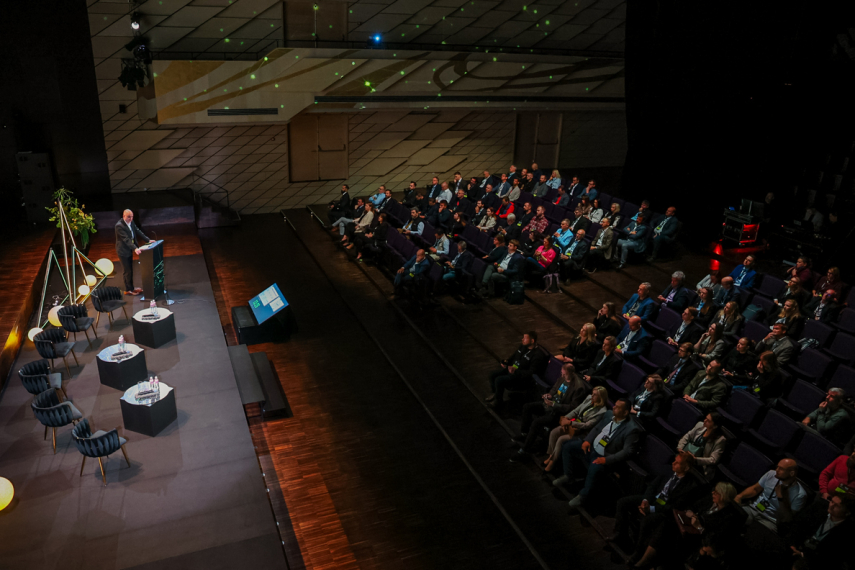
Oleksandr Stepura has taken part in regional discussions on the future of technology and security. At the Lublin Triangle Economic Forum, which brings together Lithuania, Poland and Ukraine, he joined a panel on high technology and dual-use goods. The discussion focused on rising demand for unmanned systems, the challenges facing the security sector and the role of EU funding in developing high-tech industry across the participating countries.
The message from that panel resonates in the Baltics: investment in European technology capacity today is closely connected to the region's long-term security and economic resilience.
From engineering startup to European group
Skyeton's development has been studied beyond the industry itself. IMD, the Swiss business school, published a case study on the company, examining how a startup from Eastern Europe reached technical parity with much larger global manufacturers and the strategic choices it faced as it grew, from moving beyond government customers to deciding whether to sell products or services.
Under Oleksandr Stepura's leadership, the company has followed a path that many technology firms in the region are now taking: build deep engineering expertise, then scale through European structures and partnerships. With its holding in Estonia and production in Slovakia, Skyeton is an example of how Ukrainian technology and the wider European ecosystem, including the Baltic states, are becoming increasingly connected.

Please enter your username and password.

2026 © The Baltic Times /Cookies Policy Privacy Policy