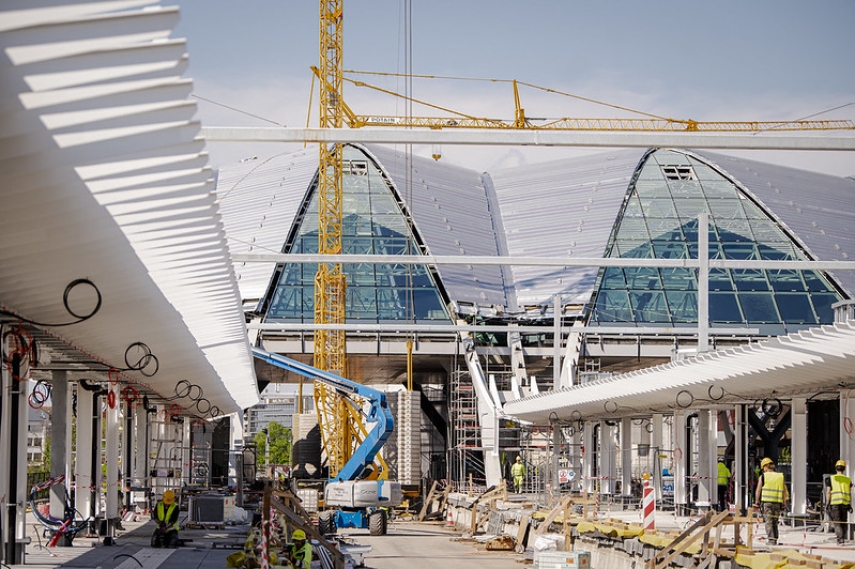
A significant phase of construction and systems integration is being completed in May 2026 at the southern part of the new Riga Central Station. During this phase, the building’s permanent power supply system is being gradually tested and activated. This marks the transition from the completion of the main construction works to the testing and commissioning of the station building’s internal systems in ‘Power On’ mode or, in other words, moving from temporary power supply solutions to a permanently functioning electrical infrastructure.
During the ‘Power On’ preparation phase, the contractor, operating under controlled conditions and enhanced safety procedures, is carrying out the gradual connection of all major engineering systems to the main permanent power source (the 0.4/10 kV transformer substation) and conducting integrity tests.
“This is a major milestone in the construction of the new Riga Central Station. With the implementation of the ‘Power On’ mode, the station evolves from a construction site into a technically operational infrastructure facility where the station building’s systems can begin fully functioning. This is a prerequisite for ensuring safe and efficient passenger services in the coming years,” says Jānis Naglis, Member of the Management Board of SIA Eiropas Dzelzceļa līnijas, the national implementer of Rail Baltica in Latvia.
Construction works are being carried out by the general partnership of construction companies - BERERIX. The company’s CEO, Guntis Āboltiņš-Āboliņš, emphasizes: “The implementation of the ‘Power On’ mode is one of the most complex and critical stages in infrastructure projects of this scale. It requires precise coordination among construction, electrical engineering, safety, and systems integration teams. The BERERIX team is carrying out this phase in accordance with international railway infrastructure standards and the project’s safety requirements.”
In the coming months, functional testing of systems, integrated safety tests, and preparations for the commencement of temporary operations will be carried out at the site. Construction works in the southern section of the new Riga Central Station are continuing in accordance with the project schedule. Alongside electrical engineering works, the construction of internal utility networks, platform infrastructure, the façade, finishing works, and the integration of digital and security systems are being completed.
Construction works in the southern section of the new Riga Central Station are being implemented in accordance with the agreement concluded by SIA Eiropas Dzelzceļa līnijas (EDzL), the national implementer of Rail Baltica in Latvia, and the Central Finance and Contracting Agency (CFCA) for the implementation of Project No. 1.1.1.1.i.2/2/25/I/CFLA/001 “Improvement of Passenger Infrastructure through the Construction of the Southern Section of Riga Central Railway Station.” The total planned value of this financing agreement amounts to EUR 138,699,855.80, including EUR 114,627,980.00 from the Recovery Fund and EUR 24,071,875.80 from the state budget. The agreement was signed in November 2025 and stipulates that key works, including roof installation, façade construction, platform canopy construction, finishing works, passenger access infrastructure, as well as mechanical, electrical, and plumbing works are to be completed by 31 August 2026, at which point a certificate of substantial completion will be issued.
The duties of the FIDIC Engineer, construction supervision, and construction expertise services at the site are performed by SIA FORMA 2.
The agreement provides for the involvement of the state-owned joint-stock company Latvian Railways (LDz) as a project partner. As the prospective infrastructure manager, LDz actively participates in matters related to the handover and management of the Riga Central Station facility in order to ensure the timely provision of information and technical readiness required for carrying out infrastructure management functions.
The southern section of Riga Central Station will be able to commence full passenger services after the completion of the 1520 mm gauge railway infrastructure. Final commissioning of the facility in its entirety is linked to the completion of the 1520 mm railway infrastructure in the southern section, which is currently planned for mid-2028.
About Eiropas Dzelzceļa līnijas
Eiropas Dzelzceļa līnijas is the national implementer of the Rail Baltica project in Latvia. The company is responsible for implementing the Rail Baltica project in Latvia in accordance with the financing agreements concluded, including the financing agreement with the Central Finance and Contracting Agency within the framework of the European Union Recovery and Resilience Facility, as well as financing agreements under the Connecting Europe Facility concluded with the European Climate, Infrastructure and Environment Executive Agency (CINEA) and RB Rail AS. RB Rail AS is the joint venture of Estonia, Latvia, and Lithuania, authorized by the Baltic States to sign financing agreements and responsible for implementing the horizontal, or common, activities of the Rail Baltica project.
About BERERIX
The BERERIX brings together the Belgian construction giant BESIX Group, the Latvian national construction company RERE Būve, and the Italian contractor Rizzani de Eccher. The partnerhip’s objective is to implement a significant part of the Rail Baltica project - design and reconstruction of the Riga Central Railway Station complex, the design and construction of new European-gauge railway tracks and the railway bridge over the Daugava River, as well as the embankment and related infrastructure.
About the Recovery Fund
The Recovery and Resilience Facility (RRF) is a centrally managed European Commission budget programme established in addition to the EU’s Multiannual Financial Framework for the 2021–2027 programming period. Its objective is to support reforms and investments related to the transition towards a green and digital economy, while also mitigating the social and economic impacts of crises. By the end of 2026, EUR 1.97 billion is planned to be invested in Latvia’s economy through reforms and investments across all six areas of the Recovery Fund: Climate and Energy (including REPowerEU), Digital Transformation, Reduction of Inequality, Economic Transformation, Health, and the Rule of Law. Recovery Fund reforms and investments in Latvia are financed through the budget of the European Union Recovery and Resilience Facility, supplemented by co-financing from the state budget

Please enter your username and password.


2026 © The Baltic Times /Cookies Policy Privacy Policy