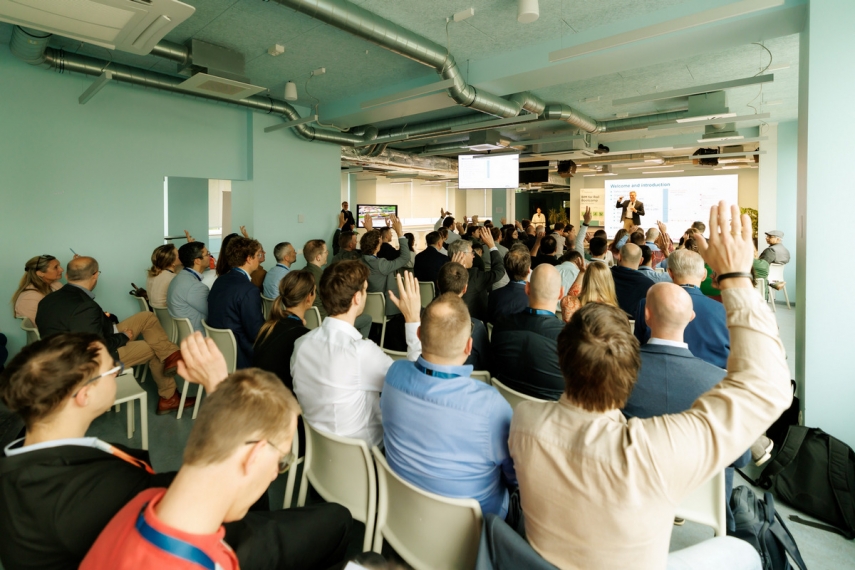
RIGA - The state should establish a clear mechanism for dealing with threats to airspace during mass events, representatives of Latgale and other municipalities repeatedly stressed at a meeting of the Saeima committee on defense, internal affairs and corruption prevention on Tuesday.
Daugavpils Mayor Andrejs Elksnins (Let's Go, Latgale!), criticized the cell broadcast alerts and events in Latgale. He said that everyone had been reassured beforehand that everything would be fine and the Latvian border would be protected from the first centimeter. Even after the incidents, everyone was reassured that everything was fine, the politician said.
He pointed out that children, who may be at school in case of a possible threat, also receive cell phone notifications. "And how are they able to react? As children," Elksnins said, stressing that such notifications worry children.
The mayor of Latvia's second-largest city also said that school infrastructure is not prepared for threats, failing to ensure the two-walls principle. "This cannot be followed in virtually any educational institution. In Daugavpils, it can be followed in one out of fifteen schools," Elksnins admitted.
Kindergarten groups of up to 25 children sometimes have to shelter in rooms that are very narrow.
Edgars Mekss (Greens/Farmers), chairman of the Ludza municipal council, urged for a change in the legislation, which requires the civil protection commission to be convened immediately. He stressed that the possibility of convening it in the event of an air threat is currently not included.
A mechanism is also needed to regulate the conduct of regional festivals and other events. Festivities are a challenge at the moment, Mekss commented.
Dzintars Adlers (New Unity), chairman of the Aluksne municipal council, said at the meeting that council leaders should have more information about the possible threat and its seriousness. He said that there should also be an algorithm for dealing with social care centers in such situations, as they accommodate both people who are bed-ridden and people with mental problems.
Municipalities also need to know what to do with cultural events, said the Aluksne municipal council representative.
"There are various possibilities, but it all depends on the resources. I understand that there are not unlimited funds, but when I look at some of the cases, how they are spent, I do not believe there is no money," Adlers commented.
He believes that municipalities could also find funds for civil protection if their functions were not continuously expanded. As an example, he cited the need to digitize as well as build fences around cemeteries, for which funds are also needed.
Janis Baiks (For Valmiera and Vidzeme), chairman of the Valmiera municipal council, said that a week ago, when many Latvian municipalities received a notification about the possible threat, many in Valmiera also received a notification addressed to the residents of Estonia. He also pointed to the lack of information after the cell broadcast, as the council leadership only sees the information contained in the notice.
"The civil protection commission makes decisions based on the reports of the institutions. We did not have any additional information. If you want accountability from the commission, you have to assess whether it is sufficient or not," said Baiks.
The politician also called for an action mechanism for mass events, as, for example, Valmiera will host the Youth Olympics in the summer with several thousand participants. The mayor said it was impossible to hide such a large number of people in a stadium.
The chairman of the Augsdaugava municipal council, Vitalijs Aizbalts (Latgale Party), also urged for a common action algorithm at least for border municipalities. He said that according to the municipality's decision, pupils study remotely and pupil transport is not provided if no notification of the end of the possible threat is received by 6 a.m. "Our bus also enters neighboring municipalities. And what to do if two families live in the same house and children study in different municipalities. It would be very good if there was a common approach and algorithms in all border municipalities," said Aizbalts.
He also welcomed the regulation of the "Covid time" measures, when it was clear for everyone how to act. Aizbalts believes that there should also be regulation in this area so that all municipalities know how to organize events and whether they should be cancelled.
Jānis Trupovnieks (Latvia's Green Party), Chairman of Balvi municipal council, revealed that for the Latvian Brass Band Festival on Saturday, schemes have been prepared for participants to shelter in case of a crisis. At the same time, he admitted that it is easier with the participants, but it is more difficult to inform the audience.
Several municipal leaders also pointed out that not all citizens received cell broadcast alerts or messages about the end of the danger. There is also a need to make the area of the threat slightly more specific, for example by sending notifications to individual municipalities where the threat exists, rather than to the whole county.
The council leaders also urged that arrangements should be made for outlets, as there were chains of shops which continued to operate in the event of a possible threat and people were able to shelter in the shops, and others which closed their doors.
Latvia's Chief of Defense Kaspars Pudans urged the meeting to treat every cell broadcast alert as warning of potentially lethal consequences. He also acknowledged that the possibility of sending announcements to smaller areas had been discussed, but that this would mean additional time, while in these situations it was important to give quick notification.
According to guidelines developed by the Crisis Management Center, in case of orange alert, staff and visitors at outdoor public events should proceed to safe areas when a threat arises; if no such areas are available, they should disperse without crowding. It is also necessary to avoid open fields and exposed areas where no natural or artificial cover is available and a person is easily visible from the air. It is also necessary to intensify monitoring of the airspace and surroundings.
In the event of a yellow alert, action protocols must be activated, staff must operate in a state of readiness, and visitors must be informed. Additionally, in accordance with the guidelines, safe routes and zones must be verified.
As reported, recently in several regions of Latgale and Vidzeme, residents have been receiving regular cell broadcast alerts about possible airspace threats due to the approach or entry of UAVs into the territory of Latvia.
Discussions continue among the public and officials on the need to improve the action algorithms, as regular alerts have a significant impact on social and economic life in the regions. At the same time, incidents have been recorded in neighboring countries, such as when a NATO fighter downed a drone over Estonia.
In Latvia, several drones related to the Russia-Ukraine war have flown or even exploded in the past, including on May 7 in Rezekne. No casualties occurred in these cases.

Please enter your username and password.


2026 © The Baltic Times /Cookies Policy Privacy Policy