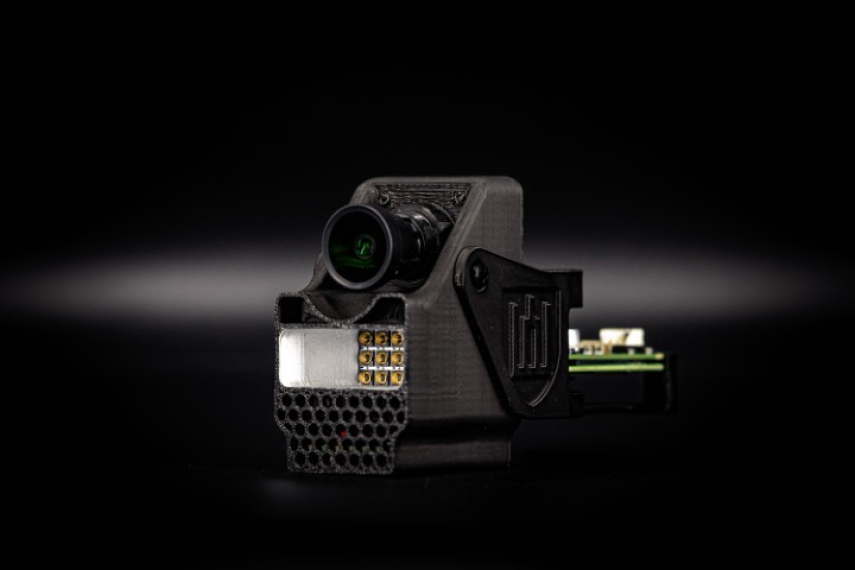
Lithuanian defence technology company Luna Robotics is turning battlefield lessons from Ukraine into scalable technologies for unmanned systems, developing China-free imaging solutions that allow drones to operate around the clock. CEO Elvinas Kukys believes Lithuania can become a major European defence-tech hub if it succeeds in scaling production, investment and international market access.
“Luna Robotics was created to solve an operational gap: unmanned systems lose effectiveness in darkness and poor visibility,” Kukys emphasised to The Baltic Times.
Drawing on military experience and direct contact with Ukrainian users, the company builds compact, low-latency imaging systems for FPV drones, interceptor drones and other unmanned platforms.
The war in Ukraine has fundamentally changed the pace at which defence technology is developed and deployed.
“Ukraine has shown that defence innovation is now measured in weeks, not years. Technology must be affordable, scalable and continuously improved through operator feedback,” Kukys said.
Battlefield success, he argues, increasingly depends not on creating a theoretically perfect product but on rapid integration, dependable supplies and the ability to update software as tactics and threats evolve.
Maintaining drone capabilities after dark is one of Luna Robotics' principal areas of focus.
“Night vision is essential because modern operations do not pause after sunset,” Kukys said.
Effective low-light imaging allows operators to maintain reconnaissance, navigation, target identification and interception capabilities when conventional cameras become ineffective.
“It is becoming a baseline requirement, not a premium feature,” the CEO said.
The company's LunaCam provides low-latency, 24/7 imaging in a lightweight format, with colour and monochrome configurations and optional infrared illumination. Its onboard processing can support software including object recognition and last-mile targeting, while radar-data integration can guide operators towards aerial targets.
Luna Robotics develops and manufactures its technology in Lithuania, which Kukys sees as an important contribution to Baltic security and resilience.
“We develop and manufacture our technology in Lithuania, creating local engineering know-how, production capacity and a resilient allied supply base,” he said.
Its technology can be integrated into FPV drones, interceptors, unmanned ground vehicles, or UGVs, and other platforms. Local capabilities can help Baltic defence partners deploy systems faster while reducing dependence on geopolitically risky suppliers.
“In defence, supply chains are a security issue, not merely a purchasing decision,” Kukys said.
Luna Robotics says its hardware and software are China-free. Kukys points to availability, export restrictions, cybersecurity, traceability and long-term maintenance among the potential risks associated with reliance on Chinese components.
Kukys believes Lithuania possesses many of the ingredients needed to become a significant European defence technology hub, including engineering talent, military understanding, rapid decision-making and direct access to lessons from Ukraine.
“Its small size can be an advantage: developers, users and institutions can work closely and iterate quickly,” he said.
However, Lithuania, he says, now needs to scale procurement and manufacturing capacity, develop specialist talent, attract patient capital and improve international market access.
Luna Robotics has similarly ambitious plans for its own expansion.
“In five years, I see Luna Robotics as a leading European provider of vision and autonomy technology for unmanned systems,” Kukys said.
The company aims to serve FPV and interceptor drones, UGVs and potentially unmanned surface vehicles, or USVs, while expanding manufacturing and R&D in Lithuania and deepening partnerships with European and US manufacturers.

Please enter your username and password.

2026 © The Baltic Times /Cookies Policy Privacy Policy