On Thursday, 8 October, Latvijas Banka will issue "Chestnut", a silver collector coin with gilded details, symbolically depicting one of the heralds of autumn. The coin gives a new expression to a work by the artist who won Latvijas Banka's open design competition on the theme of nature last year.
Chestnut trees were first introduced to Latvia around the turn of the 17th–18th centuries and were found mainly in the parks of manors. One of the great chestnut trees served as the inspiration for the prose masterpiece Straumēni by Edvarts Virza. Beneath the branches of the chestnut tree, the household and their guests are depicted celebrating or resting after a day's work. In the early 20th century, the renowned Latvian landscape painter Vilhelms Purvītis immortalised a grove of these trees in his painting Blooming Chestnut Trees. A small number of sweet chestnut trees (Castanea sativa) also grow in Latvia, mainly in Kurzeme.
Figurines fashioned from chestnut fruits have become favourite playthings for children, and chestnuts are also believed to have healing properties. Carrying a chestnut in one's pocket is believed to protect against misfortune. For women, good fortune has traditionally been associated with a chestnut in the left pocket; for men, in the right.
The chestnut coin is like a talisman, embodying all the positive qualities of the tree and its fruit. In Latvian, the word for chestnut tree is used in both the masculine (kastanis) and feminine (kastaņa) grammatical gender. This means that the tree, and now the coin, belongs to everyone. Yet the reasons for carrying it in one's pocket remain individual.
The collector coin "Chestnut" was designed by artist Kaspars Līdums, who entered and won the 2025 design competition on the theme of nature with his design proposal.
The collector coin will be available for purchase only on the website e-monetas.lv/en from 12:00 (noon) on 8 October. The price of the coin is EUR 147.00; the purchase limit for one buyer will be 3 coins. The mintage of the coin is 3000. The coin has been struck by UAB Lietuvos monetų kalykla in Lithuania.
CHESTNUT
Face value: 5 euro
Weight: 23.00 g
Shape: irregular; the longest distance between the edges of the coin, measured through its centre – 35.00 mm
Metal: silver of .999 fineness; with gilding
Quality: proof
Maximum mintage: 3000
Struck in 2026 by UAB Lietuvos monetų kalykla (Lithuania)
Artist
Graphic design: Kaspars Līdums
Obverse
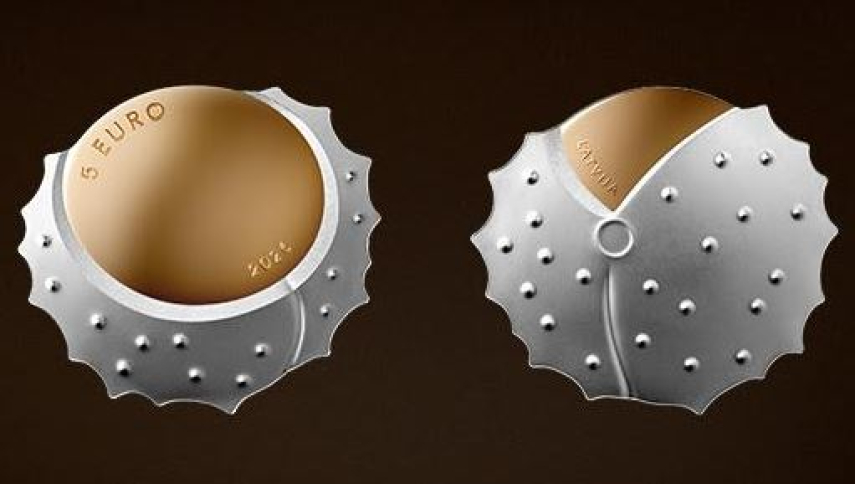
A relief depiction of a chestnut fruit with its spiny husk and a gilded fruit shown from the front. The inscription "5 EURO" is arranged in a semi-circle at the top, while the year "2026" is placed at the bottom.
Reverse
A relief depiction of a cracked chestnut husk with part of the gilded fruit shown from the back. The inscription "LATVIJA" is arranged diagonally at the top.
Edge
Plain, gilded
The horse chestnut (Aesculus hippocastanum) was introduced to Latvia around the turn of the 17th–18th centuries, first appearing in the parks of manors. It soon became a favourite tree for lining roads and avenues and for planting beside homes, valued for its rapid growth, shelter from the wind, and magnificent blossoms. Many chestnuts have grown into venerable trees, reaching at least 23 m in height and 3 m in circumference. One such tree stands at Billītes, home of writer Edvarts Virza in Jelgava Municipality. It served as the inspiration for the great chestnut in his prose masterpiece Straumēni. Beneath the branches of the chestnut tree, the household and their guests are depicted celebrating or resting after a day's work. The renowned Latvian landscape painter Vilhelms Purvītis, while living in Tallinn in the early 20th century, immortalised a grove of these trees in his painting Blooming Chestnut Trees. A small number of sweet chestnut trees (Castanea sativa) also grow in Latvia, mainly in Kurzeme.
From its spiny husk emerges a brown, smooth, and round chestnut fruit, cherished in Latvia both as a favourite childhood plaything and a folk remedy. Carrying a chestnut in one's pocket is also believed to protect against misfortune. For women, good fortune has traditionally been associated with a chestnut in the left pocket; for men, in the right. The chestnut coin is like a talisman, embodying all the positive qualities of the tree and its fruit. In Latvian, the word for chestnut tree is used in both the masculine (kastanis) and feminine (kastaņa) grammatical gender. This means that the tree, and now the coin, belongs to everyone. May you always have a chestnut in your pocket!
Activity of Latvijas Banka regarding the issuance of collector coins and 2 euro commemorative coins
Since 1993, Latvijas Banka has issued 98 lats collector coins and 66 euro collector coins. Overall, more than 50 artists from Latvia and 1 artist from Ukraine have participated in designing Latvian coins.
The design of Latvian coins has earned high international recognition. They are regularly honoured with prestigious awards in various competitions. In the 2010 international competition "Coin of the Year", the "Coin of Latvia" received the main prize in the "Coin of the Year" category, while in 2020, the collection coin "Honey Coin" of Latvijas Banka became the "Coin of the Year" – the absolute global winner, as well as took the first prize in the "Most Artistic Coin" category.
The Coin Design Committee of Latvijas Banka, which has been active since 12 November 1993, plays an important role in the coin issuing process. The Committee consists of employees of Latvijas Banka, outstanding experts in Latvian art and culture, as well as artists and scientists.
After the euro changeover, Latvijas Banka has carried on the tradition of issuing collector coin series with motifs characteristic of Latvia and executed in high artistic quality. These coins are legal tender only in the issuing country. They are unlikely to come into general circulation, for, by nature, they are works of art enjoying high demand from the numismatic community and other interested parties.
The face value of collector coins must differ from that of coins in general circulation (it must be, e.g. 5 euro or 10 euro). Their specifications, including colour, diameter, weight, material, etc. have to be cardinally distinctive from those of the coins in general circulation.
For information on the collector coins on sale at e-monetas.lv/en and the Cashier's Office of Latvijas Banka, see https://www.e-monetas.lv/en.
The issuance of 2 euro commemorative coins (2 euro circulation coins of special design) is another area of coin art. Each year, every euro area country is entitled to issue two 2 euro commemorative coins (similar to 1 lats special circulation coins previously issued in Latvia), featuring events of national, European, or global significance. The euro area countries can additionally produce a third 2 euro commemorative coin, provided that it is issued jointly and that it commemorates events of European Union-wide importance.
Commemorative coins bear the same features and the same common or European side as the normal 2 euro circulation coins, while their national sides differ and feature a national commemorating motif.
Euro commemorative coins are legal tender throughout the euro area. This means they can be used – and must be accepted – just like any other euro coin.

Please enter your username and password.


2026 © The Baltic Times /Cookies Policy Privacy Policy