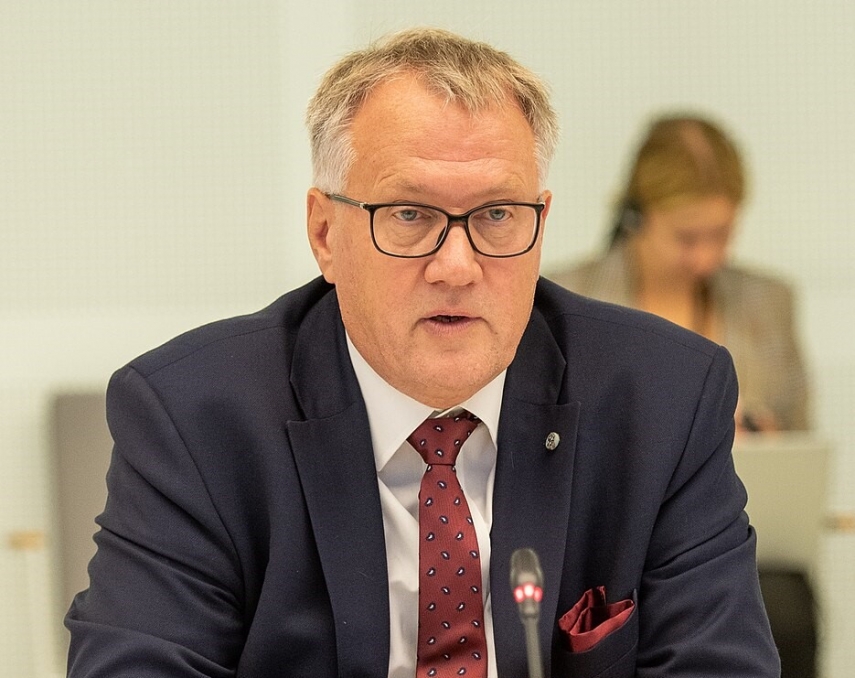
RIGA - In order to increase productivity, Latvian companies must have greater ambitions to grow not only in Latvia but also on a European scale, said Martins Kazaks, Governor of the Bank of Latvia, in an interview with LETA.
He pointed out that inflation in Latvia is higher than the eurozone average, but the difference is narrowing. The latest figures show that inflation in Europe is 1.7 percent, while in Latvia it is 2.6 percent, so the difference is not significant.
Kazaks explained that there are two main factors driving inflation in Latvia. The first, which was particularly evident at the beginning of last year, is food prices. Currently, the impact of food prices on inflation is no longer as significant.
"There is another problem. We see that wages in Latvia have been growing much faster than productivity for several years now," said Kazaks, emphasizing that wage growth is a good thing because people are becoming wealthier, and wage growth has been significantly faster than inflation for several years. He also added that these are average figures and the situation may vary between different groups, but overall, wages have grown by an average of 8-10 percent per year in recent years.
Kazaks explained that this has improved the purchasing power of the population, but at the same time, productivity has grown much more slowly, which means that wage growth is turning into price growth.
"In my opinion, the main choice would be not to slow down wage growth, but to accelerate productivity growth, because such a gap cannot continue in the long term. Our exporters will simply lose their competitiveness, and then there is a risk of recession. Therefore, the main thing is to accelerate economic growth by reducing bureaucracy and improving productivity," said the governor of the Bank of Latvia.
Kazaks mentioned that Latvia has many good, highly productive companies, but there are too few of them, and such companies are too small. He emphasized that larger and "more powerful" companies are needed. "We can look to Lithuania, where there is also funding for company mergers, where smaller companies can become larger by merging, buying each other out and improving efficiency. Such funding here in Latvia, as we hear from entrepreneurs, is not sufficient," said Kazaks.
He explained that, for example, the Development Finance Institution Altum could help with this type of funding, which could also help companies invest more, robotize more, and digitize more.
"The world is racing ahead. If we don't race ahead with it, we will lose," said Kazaks, emphasizing that ambition is also needed, and it must not only be in a village or city in Latvia, but greater in Europe. The Governor of the Bank of Latvia also added that companies in Lithuania are often much more "irresponsible and ambitious."
Kazaks said that Latvian companies' balance sheets are very strong, so the starting point is good. "We see that banks have become more active, including in the small and medium-sized enterprise segment, but at the same time, Latvia's large companies are still relatively small if we look at the European level," said the Governor of the Bank of Latvia, adding that there are very few truly large companies in Latvia, and Latvia's large companies are usually medium-sized companies in Europe, so the scale is completely different.

Please enter your username and password.

2026 © The Baltic Times /Cookies Policy Privacy Policy