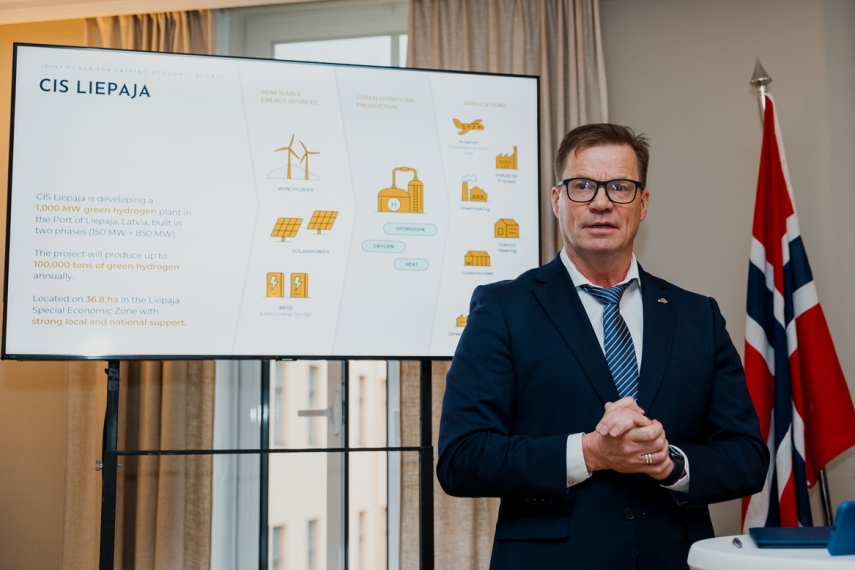
Photo: Thor Arne Pedersen
Latvia is approaching a turning point in its energy and industrial development, and the planned green hydrogen project in Liepāja could become one of the clearest indicators of that shift. The ambitious renewable energy complex, designed to produce around 150,000 tonnes of green hydrogen annually, is not merely another industrial facility. It represents a strategic opportunity for Latvia to reposition itself within Europe’s rapidly evolving clean energy landscape.
The timing of this project also aligns with global energy trends. Green hydrogen is rapidly moving from a niche technology to a cornerstone of future energy systems. Forecasts suggest global demand could rise from 25–50 million tonnes per year by 2030 to as much as 400 million tonnes by 2050. Within the European Union, ambitious climate targets and massive infrastructure investments are accelerating this growth. Although Latvia is still at an early stage of hydrogen adoption, long-term projections indicate that domestic demand alone could reach several million tonnes by mid-century.
Despite this momentum, public perception of hydrogen remains mixed. Concerns about safety and efficiency are common, often rooted in limited understanding rather than evidence. In practice, green hydrogen production relies on electrolysis – a well-established process in which renewable electricity is used to split water into hydrogen and oxygen, without carbon emissions. The technology is proven, scalable, and increasingly efficient, with the added benefit of enabling the use of by-products such as heat and oxygen.
Safety concerns, while understandable, are frequently overstated. Around the world, green hydrogen facilities operate safely in close proximity to residential areas, following strict standards and clearly defined buffer distances. From the Baltic region to Central Europe and Scandinavia, such projects demonstrate that hydrogen can be produced, stored, and transported without posing greater risks than other common energy carriers, provided that established safety procedures are followed. Comprehensive environmental and risk assessments are standard practice and form the backbone of responsible project development.
The question of efficiency is more nuanced. Green hydrogen is not a universal replacement for fossil fuels, nor is it expected to eliminate them overnight. Its real value lies in specific applications where electrification is difficult or impossible. Heavy industry, chemical production, long-distance transport, energy storage, and grid balancing are among the sectors where hydrogen can deliver unique advantages. In these contexts, it can outperform fossil fuels in terms of flexibility, emissions reduction, and long-term sustainability.
The Liepāja project therefore should be seen not as an isolated industrial initiative, but as part of a broader strategic choice. It reflects a willingness to invest in future-oriented technologies, accept transitional challenges, and position Latvia within the clean energy economy that is rapidly taking shape across Europe. If developed responsibly and supported by consistent policy, green hydrogen could become not only an export product, but also a foundation for a more resilient, competitive, and sustainable Latvian economy.
To fully realize this potential, it is crucial that the government clearly signals firm and long-term ambitions for green hydrogen production. Clear national targets will provide direction and predictability for industry and investors, and help underpin Latvia’s ambition to become an important contributor to Europe’s future energy supply.

Please enter your username and password.
2026 © The Baltic Times /Cookies Policy Privacy Policy