Klaipeda Port closed 2025 with solid cargo volumes and a strong pipeline of infrastructure projects, reinforcing its role as the Baltic States’ largest seaport despite geopolitical and economic headwinds. Speaking to The Baltic Times Magazine, Klaipeda State Seaport Authority CEO Algis Latakas emphasized that the port’s performance can no longer be judged by tonnage alone.
“The days when the success or failure of a port was measured solely by cargo volumes are gone – today it is also about our contribution to the city, the state and the local community,” Latakas said, adding that sustained investment, digitalisation and environmental projects are now central to ensuring the port’s long-term competitiveness and resilience.
How has the year of 2025 been for the Klaipeda Port in terms of cargo handling and transporting?
In general, the Port is heading for quite a good year – we surpassed the 1 million TEU mark for the fourth consecutive year, however, much earlier than before – in early October.
Yet, like an athlete who loosens up a bit in the final stretch and sees his or her gold medal snatched away by a rival, I would rather not rush to conclusions – let’s see what the last month of the year brings (the interview took place in mid-December – TBT).
In total, this year, around 5,000 vessels called at our port by the beginning of December. This represents an insignificant year-on-year decline; however, in tonnage terms, the vessels were larger, and they will be larger in years to come due to the port’s modernization.
Notably, we have recently seen 15 new countries, including far-flung Vietnam and Kenya, start using our port – a significant endorsement.
The Port of Klaipėda handled nearly 36 million tonnes of cargo over the first eleven months of the year, 11 percent higher year on year by December 1.
From January to November 2025, nearly 12 million tonnes of containerised cargo were handled, accounting for 33 percent of total port throughput and representing a 29 percent increase year on year – a very good indicator for the Port.
We are approaching the maximum utilisation of the Port’s existing terminal capacity, so their expansion will be on the agenda sooner or later.
Ro-ro cargo totalled just over 6 million tonnes, up 7 percent, primarily reflecting the strong links between Lithuanian companies and their Scandinavian counterparts.
The LNG cargo handling curve is also rising. In this segment, volumes increased by 17% year-on-year, reaching 2.2 million tonnes.
Over the eleven-month period, the port handled 3.4 million tonnes of oil products, an increase of 4 percent, while minerals and construction materials totalled almost 2 million tonnes, up 7 percent. Fertiliser cargo reached 1.6 million tonnes, an increase of 3 percent.
At the same time, grain cargo volumes fell by 5 percent to 3.6 million tonnes, scrap metal declined by 13 percent to 1 million tonnes, and timber cargo decreased by 17 percent to 557,000 tonnes.
Containerised cargo and ro-ro freight vehicles together accounted for half of total throughput. Grain and oil products each made up 10 percent, liquefied natural gas accounted for 6.2 percent, minerals and construction materials 5.5 percent, and fertilisers 4.5 percent of total cargo handled at the Port of Klaipeda.
The results reflect the coordinated and efficient work of many services involved in port operations, including customs, border guard agencies, and storage, crane and stevedoring service providers.
What major infrastructure projects implemented at the Port in 2025 are worth mentioning?
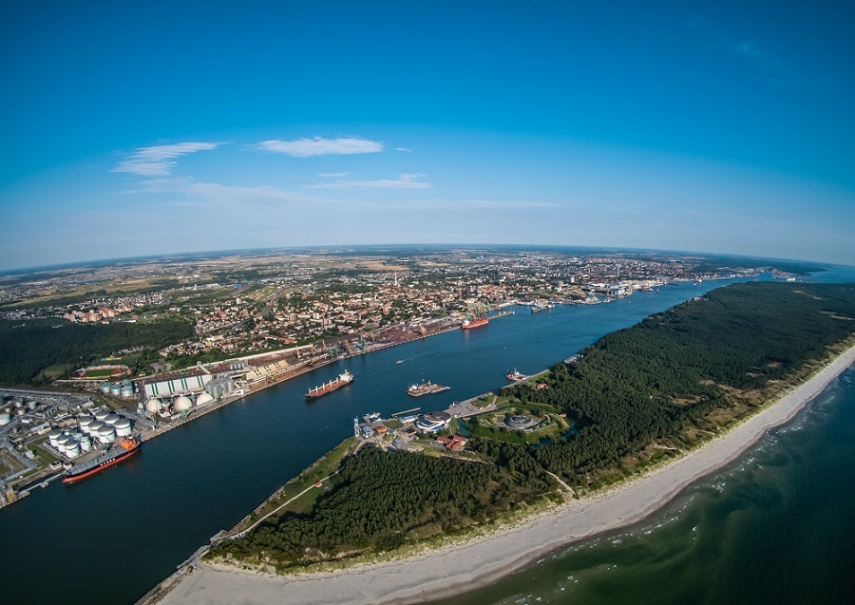
This year, the Port has completed a major reconstruction of its northern and southern wave breakers (breakwaters) as part of an EU-funded infrastructure project aimed at improving navigational safety and port capacity, with a design oriented towards the port’s 50-year operational lifespan.
The reconstruction upgraded both the southern and northern breakwaters, reinforcing existing structures, improving access conditions and enhancing coastal infrastructure, with improved pedestrian walkways and viewpoints added for public use. A strengthened breakwater infrastructure also contributes to better logistics performance and reduced emissions, as ship waiting times decline.
In 2025, the Port continued navigation channel cleaning and deepening (dredging) works to ensure the required depths for larger vessels.
Notably, this year, the Port has completed and commissioned a modern fleet base designed for service vessels operated by the Klaipeda State Seaport Authority. The new base enables more efficient berthing, technical maintenance and rapid response to situations in the port’s waters. It serves vessels performing pilotage, hydrographic surveys, environmental protection and navigational safety tasks. The fleet base infrastructure is designed for year-round operations and ensures smoother and faster work by port services.
How is your hydrogen project moving forward?
As I mentioned before, Klaipeda Port is advancing a pioneering green hydrogen production and refuelling project, making it one of the first ports in the Baltic region to produce hydrogen on site. Once operational, the facility is designed to produce about 127 tonnes of green hydrogen annually.
Once implemented, we will be able to provide hydrogen for our hydrogen-fuelled vessel (the Port is building Lithuania’s first hydrogen-powered vessel. It will bee used for environmental management within the port area: collecting waste streams, including stormwater, sewage, sludge and garbage from visiting ships – TBT), buses and other vehicles.
The project was funded under Lithuania’s Next Generation Lithuania plan with EU support, with a total estimated cost of around 12 million euros.
Undoubtedly, hydrogen is the future of sustainable energy.
The Port of Klaipėda is also implementing other green projects. Being nature-conscious, in 2025 the Port advanced on-shore power installations at key terminals, enabling ferries and ro-ro vessels to switch off their engines while berthed and draw clean electricity from the grid – significantly cutting local air pollution and noise. The project is partly funded by the EU’s Connecting Europe Facility.
Considering the enormous volume of your operations, were there any incidents in the port?
Let’s knock on wood – as of the day of the interview, we have not seen any major incidents that would have disrupted our operations – but we have recorded GPS and navigational disturbances caused by hostile neighbours, with 145 such cases by December.
The weather conditions were somewhat unusual, with unusually stormy days in January and June, which could be a sign of climate change.
As a result, we were forced to restrict port traffic due to stormy weather, which is common practice in all ports. Frankly speaking, June – usually a calm and predictable summer month – surprised us, as we had to restrict shipping due to bad weather conditions.
To improve our IT and data security, in 2025 our Port participated in projects that integrate digital and sensor technologies to enhance operational capabilities.
The port is linked with broader digital initiatives such as the DigiTechPort2030 project, which helps ports adopt green technologies and digital tools tailored to sustainability measures. We are implementing AI in certain areas.
In 2025, the port began piloting Lithuania’s first private 5G standalone network, developed with Telia. It provides ultra-secure, self-operating high-speed data connectivity for critical infrastructure, support advanced automation and future smart port technologies, and improve resilience against cyber and hybrid threats.
Can you, please, talk about creating a port in Jurbarkas situated at Lithuania’s longest river, the Nemunas?
I take pride in advancing plans to develop Jurbarkas Port on the Nemunas River into a modern inland cargo hub, expanding the country’s logistics capacity beyond our Klaipeda Port.
In August 2025, the Klaipeda State Seaport Authority signed an agreement with Jurbarkas District Municipality to take over operations of one of the quays in Jurbarkas, formally launching the port’s redevelopment efforts.
We plan to invest at least 1 million euro over the next three years to prepare quay infrastructure and cargo-handling facilities, with longer-term multi-million-euro commitments expected to follow. The project is designed to boost inland waterway freight and offer a sustainable alternative to road transport, making greater use of the Nemunas River as a cargo corridor.
Few may know that it is Jurbarkas that holds the title of Lithuania’s first port.
What has been done in expanding and upgrading the cruise ship terminal at the Port?
In 2025, Klaipeda Port moved from planning to active construction of a modern cruise ship terminal. Contracts were signed and work began on site, including reconstruction of existing quays and the construction of new ones to meet the needs of larger cruise vessels.
The project goes beyond purely maritime infrastructure: it will create pedestrian and cycling paths, leisure spaces and an amphitheatre facing the water, adding public access to the waterfront and enhancing Klaipeda’s appeal for residents and tourists alike.
Once completed – construction is expected to continue through to around 2027 – the terminal will support the simultaneous berthing of larger cruise ships and increase cruise liner calls, helping position Klaipeda as a stronger cruise destination in the Baltic region.
Since the beginning of the year, almost 400,000 people have arrived at the port by sea, an increase of 10.5 percent. Of these, 76,600 arrived on 59 cruise ships – 20 percent more than last year and nearly 2,000 more than in 2017, when a record number of cruise passengers was recorded.
Some of the ships’ lengths exceed the shoreline of the existing cruise terminal.
The Port is expecting to host 68 cruise ships in 2026, with 99 planned for 2027, meaning that Klaipeda is becoming an increasingly popular destination for international maritime travellers.
What are the plans for developing the southern part of the port?
When we look at the map of Klaipėda city and port, we see that there is no room left for the port to develop. The expansion of the southern part of the port is a necessity. We plan to develop an area of 100 hectares here. All the preparatory work has already been completed. We hope to select an operator in 2026. Incidentally, there will also be space for recreational boats – around 500 of them.
It will be a huge complex that will allow the port to move into a new category.

Please enter your username and password.

2026 © The Baltic Times /Cookies Policy Privacy Policy