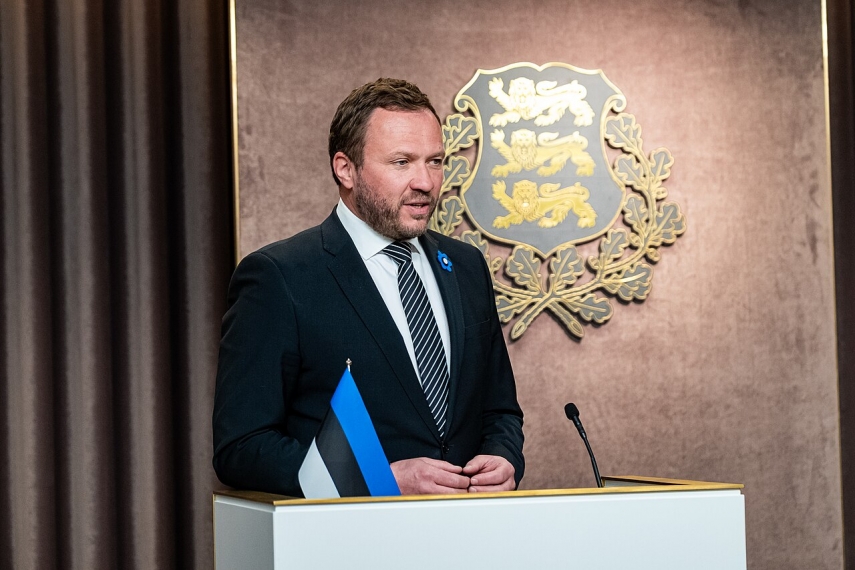
TALLINN - The coalition government of the Reform Party and Eesti 200, led by Prime Minister Kristen Michal, marked its one-year anniversary in office yesterday. Over the year, the government focused on strengthening Estonia's security, boosting the economy's competitiveness, and, according to its own assessment, improving people's livelihoods.
"The government raised Estonia's defense spending to over five percent of GDP starting from 2026 and will direct an additional 2.8 billion euros to national defense over four years. This is the most robust security decision in recent years and a clear message that as much money, effort, and time as possible are being invested in the country's defense," said Prime Minister Kristen Michal. "At the same time, we are becoming more efficient as a country. A year ago, I convened the Council for Efficiency and Economic Growth, from whose proposals over 300 decisions are either in progress or have already been made. All this is to reduce bureaucracy and give more freedom and responsibility to people and companies. This year, together with top entrepreneurs, we launched the Estonian AI initiative to become one of the world leaders in the application of artificial intelligence."
The head of the Eesti 200 government delegation, Kristina Kallas, said that the coalition agreement, thoroughly negotiated with experts a year ago, set two central goals: ensuring national security and increasing economic competitiveness. "The government has taken several important steps towards both. We increased defense investments and adopted a strategic direction to grow our capacity to produce necessary defense materials. To improve economic competitiveness, we have made several decisions to ensure Estonia has energy production capacities that would lower prices and be green and sustainable. We are massively reducing bureaucracy and clearing the legal space of outdated requirements. In education, this government is resolutely continuing the transition to Estonian-language learning."
The government continued the largest reform in education, the transition to Estonian-language learning, which this year included the 2nd and 5th grades. At the same time, a reform of vocational secondary education was prepared, and compulsory schooling was extended to ensure all young people continue their studies after basic school and are better prepared for the labor market.
Starting from 2026, a universal tax-free minimum of 700 euros will apply. The state also simplified public procurement and reduced the administrative burden. In public finance, the budget deficit fell to its lowest level in six years.
The government sent the Nuclear Energy and Safety Act to the Riigikogu (Parliament), creating the possibility of building a nuclear power plant in Estonia. The sixth wind energy auction has been announced, which will bring Estonia to its optimal level of renewable energy, nearly 70-80 percent.
Road funding was increased, and the largest construction program for four-lane highways to date was launched. The construction of Rail Baltic is moving forward at full speed, with construction tenders covered by both contracts and funding. A waste management reform came into force, promoting the circular economy.
The 'one in, one out' principle was established to keep bureaucratic requirements in check. Nearly 4,000 regulations were reviewed, with requirements being eased or eliminated in every fifth one. A reform to speed up court proceedings was also prepared, and a new data consent service was created, which is a significant milestone in the development of the e-state.
The Emergency Act was passed, which will be used to enhance Estonia's crisis preparedness; a community fund was created for better local-level readiness. Crisis communication was significantly developed. The police were given the right to impose a restraining order of up to 72 hours in domestic violence cases.
The government increased the subsistence benefit and made it more accessible. Personalized medicine based on genetic data is increasingly becoming part of people's daily lives. Thanks to restructuring, the deficit of the Health Insurance Fund has significantly decreased. This helps ensure the sustainability of healthcare.
The labor shortage for entrepreneurs was alleviated by establishing an exception for skilled workers. The possibility to account for an employee's different needs in flexible employment contracts was created. A cap on the renewable energy fee was established for energy-intensive companies, which supports Estonia's competitiveness.
The government maintained national defense funding at a level of at least 5% of GDP, and the defense sector investment plan was fully implemented. A 10-year national defense development plan was completed. Defense industry parks were developed.
The salaries of cultural workers and coaches were raised, and support for top-level sports was increased. Strengthening the Film Estonia measure and increasing support for major events help bring more of the film industry and international attention to Estonia.
Estonia brought airspace violations to the center of international security at the NATO and UN levels. The invocation of Article 4 and the holding of a Security Council meeting demonstrated well-functioning and effective NATO allied relations. Estonia increased its contribution to the reconstruction of Ukraine and is preparing for the 2027 Ukraine Reform Conference in Estonia. As the chair of the NB8, we are increasing the political weight and visibility of the cooperation format.

Please enter your username and password.

2026 © The Baltic Times /Cookies Policy Privacy Policy