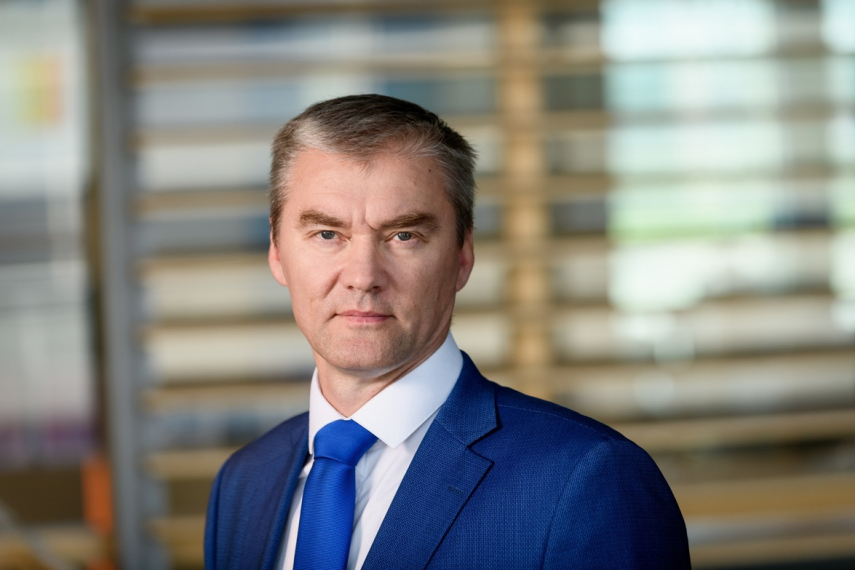
RIGA - The capacity of Getlini landfill will be exhausted within the next ten years at best, Imants Stirans, chairman of the board of Getlini Eko, told LETA.
He noted that as public prosperity increases, so does consumption of various goods purchased by residents, which in turn is reflected in the amount of waste generated. For example, in Latvia, the amount of household waste per capita per year has increased by approximately 100 kilograms over the past decade. Most people stop thinking about the ultimate consequences of their habits the moment they throw a trash bag into a container, yet the problem does not disappear.
Although improvements in waste sorting technologies have led to a year-on-year decrease in the volume of waste disposed of at Getlini landfill, approximately 30 percent of all waste is non-recyclable, and thus ends up in the landfill anyway. The landfill’s capacity is rapidly approaching a critical threshold; once reached, waste will have to be stored elsewhere, at a future landfill, unless society chooses a different, more sensible path by converting waste into energy, says Stirans.
He pointed out that approximately half of the household waste generated in Latvia ends up at Getlini landfill. Although some of it is recycled and reused as raw material as a result of sorting, a significant amount of waste is still landfilled there each year. In 2025, this amounted to more than 118,000 tons. This is less than in 2024, when 171,000 tons of waste were landfilled. The technology and efficiency of waste sorting centers are improving, and the public is slowly but surely adopting waste sorting as part of their daily routine. However, the total amount of waste is not decreasing, and not all of it can be sorted and subsequently recycled.
Stirans emphasized that approximately 30 percent of all household waste is unsuitable for recycling, such as used hygiene products, some textiles, certain plastic products, composite materials, and various types of packaging contaminated with organic waste. This is the portion of household waste that cannot be reduced through more careful waste sorting. Therefore, this household waste continues to be sent to the landfill for disposal until it reaches its maximum capacity.
"Within the next seven, eight, or at best ten years, Getlini will have reached the point where the landfill is completely full and no new waste will be accepted here. Physically, there will no longer be a single free square meter available for disposal. We need to start thinking about a solution to this problem today, because you cannot build a new landfill overnight," said Stirans.
He noted that waste management policies and trends in Latvia and elsewhere are largely dictated by the European Union (EU), which has stipulated in its directive that EU member states must reach a level by 2035 where no more than 10 percent of the total amount of municipal waste generated is landfilled. Consequently, there are essentially two major issues that need to be addressed: where to dispose of waste once the Getlini landfill is full, and how to meet the EU’s target by the specified deadline, given that currently approximately 34 percent of municipal waste in Latvia is landfilled.
Stirans pointed out that, regarding the filling of the existing landfill, the solution that might seem the simplest and most understandable to some members of the public would be to build a new landfill - finding a new site of approximately 100 hectares where all the necessary infrastructure for the landfill can be installed. However, a landfill is not simply an engineering structure. It is an ecosystem that affects not only the surrounding environment but also the living conditions of residents in the immediate vicinity. For example, under unfavorable weather conditions and with certain wind directions, it is impossible to completely prevent odors from spreading beyond the landfill’s boundaries. There is also the question of which municipality and through what means would be able to convince residents of the need for a new landfill near their homes.
Building a new landfill also requires investment, and not a small one at that, noted Stirans, adding that, for example, the construction of a single waste disposal cell of approximately 10 hectares that meets all standards costs around EUR 10 million. However, the new landfill will require several such waste cells, as well as other infrastructure, administrative buildings, technical support, cargo tracking systems, and staff.
He noted that the EU’s target must be met by 2035. First, according to EU directives and the waste management hierarchy, landfilling is the least desirable method of waste management. This means that EU co-financing for the construction of new landfills is not available. Second, if Member States fail to meet EU requirements, they will face fines, which, however, will not prevent the EU’s targets from being met; so in the long term, another solution will be needed - waste-to-energy, which is used in most European countries, including Estonia and Lithuania.
He also noted that waste has been recovered in Europe for several decades, addressing both the problem of landfill saturation and supplying city residents with electricity and heat. For example, in Copenhagen, Denmark, a waste-to-energy plant is located just a few kilometers from the city’s historic center, yet it is so well integrated into the urban environment that hardly anyone notices it. This waste-to-energy plant has also been designed as a ski trail, complete with a hiking trail and a rock-climbing wall.
Stirans pointed out that the Baltic neighbors recycle a significant portion of their waste - Lithuania recycles approximately 26 percent, while Estonia recycles 43 percent of its waste.
He also noted that no country in Europe is on track to meet the EU’s target of landfilling no more than 10 percent of the total volume of municipal waste generated by 2035 without waste recycling.
As reported, in 2025, Getlini Eko had a turnover of EUR 45.98 million, which is 8.9 percent less than the previous year, while the company’s profit decreased by 2.4 percent to EUR 3.216 million.
Getlini Eko was registered in November 1997, and its share capital is EUR 6,008,569. Riga City Council owns 97.7 percent of the company’s capital, while Ropazi municipal council owns 2.3 percent.

Please enter your username and password.

2026 © The Baltic Times /Cookies Policy Privacy Policy